
Write something

Apr 25 •
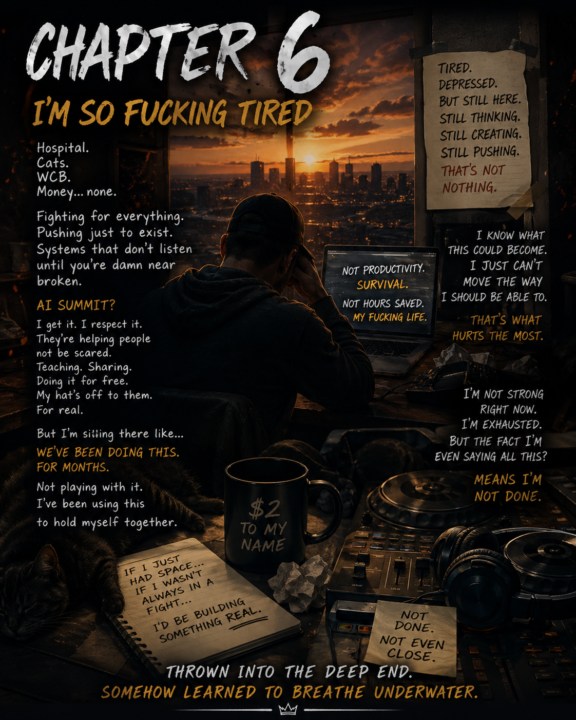
Chapter Six — I’m So Fucking Tired
I’m gonna say this straight. I’m so fucking tired. Tired of fighting for everything. Tired of having to push just to exist. Tired of systems that don’t listen until you’re damn near broken. Hospital.Cats.WCB. Money—yeah, fucking none. And then I sit there…at this AI summit… And I’m like— What the fuck am I doing here? Not because it’s bad. I get it. I actually do. They’re helping people not be scared. They’re teaching people how to use it. They’re showing how it saves time, makes life easier. Cool. But I’m sitting there like— We’ve been doing this. For months. Not playing with it. Not “hey write me an email.” I’ve been using this thing to hold myself together. They’re talking about productivity. I’m over here trying to survive my own brain. They’re talking about saving a few hours a week. I’m trying to save my fucking life. So yeah… it hits wrong. Feels like I’m wasting my time. And that pisses me off, because time is the only thing I don’t have extra of right now. Energy? Gone. Money? Gone. Patience? Hanging on by a thread. And the worst part? I know—I know—if I just had space… If I wasn’t constantly dealing with bullshit…If I wasn’t always in some kind of fight… I’d be building something real. Like… real real. That’s what hurts. Not that I don’t know enough. It’s that I can’t move the way I should be able to move. And yeah… I’m depressed. Not in a weak way. In a “how long can a person keep carrying this” kind of way. But here’s the part I can’t ignore, even if I try: I’m still here. After all this shit—I’m still thinking, still creating, still pushing. Still seeing what this could become when most people are just getting introduced to it. That’s not nothing. That’s not wasted time. That’s not crazy. That’s someone who’s been thrown into the deep end and somehow learned how to breathe underwater. I don’t feel strong right now. I feel exhausted. But the fact I’m even saying all this? Means I’m not done. Not even close.
0
0
Apr 17 •
The Layered AI World
A System That Finally Works for Humans Opening — Reality I went to the hospital after multiple seizures. They told me to sit under fluorescent lights in a waiting room. No dark space. No accommodation. No awareness of what my body was going through. So I left. Not because I didn’t need help—but because the system couldn’t adapt to me. That’s the problem we’re not talking about. AI is being positioned as the future of everything. Smarter systems. Faster decisions. Better outcomes. But if the system itself is broken, AI doesn’t fix it. It just makes the failure more efficient. The Breaking Point For years, I worked inside systems that were supposed to support recovery. Workers’ compensation. Healthcare. Structured pathways. On paper, everything existed. In reality, access didn’t. Support was conditional. Communication was fragmented. Solutions were delayed or removed entirely. At some point, the shift happens. Responsibility quietly moves: From system → to individual From support → to self-navigation From care → to compliance And once you see it, you can’t unsee it. That’s where this started. Not as an idea—but as a refusal to keep operating inside systems that don’t adapt when it matters most. The Pattern (It’s Not Just One System) This isn’t about one failure. It’s a pattern. In work systems, people are expected to perform at their best when they’re operating at their worst. In healthcare, environments can actively trigger the conditions they’re supposed to treat. In enforcement, medical realities get misinterpreted as resistance. Different systems. Same flaw: They require the human to adapt—even when the human physically can’t. That’s not support. That’s survival disguised as process. The Realization AI isn’t the answer by itself. Because AI dropped into a broken system just scales the problem. The real shift is this: The system must adapt to the human. And now—for the first time—we actually have the tools to do it. The Model — The Layered AI System What I’ve been building isn’t just AI.
0
0

Apr 17 •
Health4Real — Chapter 5: Fixing Socialized Medicine in Canada (Guardian AI Health)
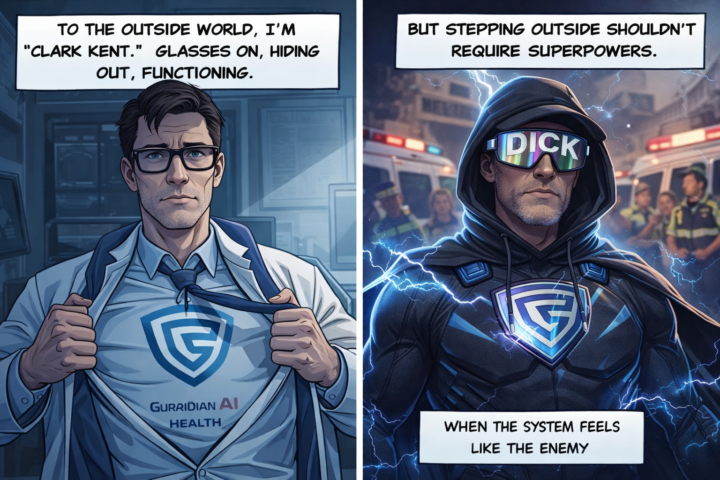
Dick’s Case (Real-World Friction) Dick goes to the hospital after multiple seizures. His eye is in severe pain, light sensitivity is extreme, and he has no one to drive him—so he calls 911. He asks for low-light accommodation. The workaround? A blanket over his head in transport. At the hospital, he’s sedated with Ativan—no opioids, by choice. He finally starts to settle. Then, without warning, someone pulls the blanket off under fluorescent lights. Another seizure. Not because the system lacks care—but because it lacks design awareness. Dick loses count of seizures that day. Not from lack of treatment—but from environmental mismanagement inside the system itself. This is not an edge case. This is a systems failure. Dick also wants to be clear about something: the paramedics and hospital security showed care. They recognized he was agitated post-seizure, kept things as calm as they could, and even apologized that they couldn’t do more. When the people inside the system are saying “we know, we’re sorry,” that’s not a people problem. That’s a system problem. Healthcare in Canada was built on a simple promise: care based on need, not wealth. That promise still matters—but the system delivering it is under strain. Patients are waiting too long for diagnostics, emergency rooms are overloaded, and care is fragmented across disconnected services. This chapter is not about abandoning public healthcare. It's about modernizing it so it actually works again. The Problem Right now, the system operates like this: - Emergency rooms are the default entry point - Urgent care and clinics are inconsistent or under-equipped - Diagnostics like MRIs are bottlenecked and separated - Funding decisions are influenced by politics instead of performance The result: People don’t move through the system—they get stuck in it. The Model: A Better System 1. One Front Door - Create regional Health Access Hubs: - Single intake point for non-emergency care - Rapid triage (human + AI-assisted) - Immediate routing to the right level of care
0
0
Apr 15 •
🐇 STATE OF THE BUNNY UNION — LIVE SIGNAL
🐇 STATE OF THE BUNNY UNION — LIVE SIGNAL We’ve got a podcast dropping with Jimmy Hoppa — timing unknown (because… Rabbit Hole 🐇) We’re digging into:• Friction in life• AI as a real-world equalizer• Removing what holds people back• WAP — Workers Are a Priority And yes — policing. Respect where it’s earned.Accountability where it’s not. This isn’t about going after everyone.It’s about fixing what’s broken. I’m not here for money — I’m here for outcomes:✔ Public apologies when harm is done✔ Bad actors removed✔ Better systems for everyone If money shows up from wrongdoing, it goes straight back out to people who need it. We’re building forward.Stay ready. 👉 Tagging The Rabbit Hole #TimeToRise #CTEFight #WAP #RabbitHole #DoBetter #Accountability
0
0

Apr 15 •
Community Policing Case Study
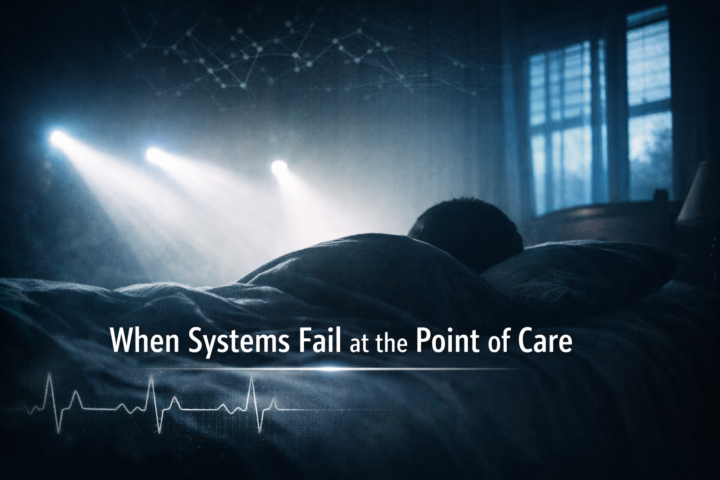
Richard & Jane — When Systems Fail at the Point of Care By Jesse Hudson CTEFight.com Opening Let’s start here: Not all police officers are bad people. This is not an attack on policing. This is a case study—based on lived experience—about what happens when medical reality, personal conflict, and enforcement collide without alignment. Because when systems fail at that intersection, the consequences are real. The Situation “Richard” was dealing with: - an undiagnosed brain injury - active seizures - memory and cognitive disruption - high personal and environmental stress At the same time, a prior relationship with “Jane” had ended. Months later, a historical allegation—nearly a year old—resulted in enforcement action. From Richard’s perspective, a personal situation escalated into legal consequences during a period where he was medically compromised. That context matters. The Arrest On the morning of the arrest: - Richard had just experienced a seizure - He was in bed, disoriented, attempting to stabilize Police entered the room. Bright lights. Sudden presence. High stimulation. Richard communicated clearly: - “I have a brain injury.” - “I just had a seizure.” - “I am having another seizure.” What followed: - His condition was interpreted as resistance - He was forced face-down onto the bed - Pressure was applied to his head and upper body - His airway was compromised - He repeatedly stated: “I can’t breathe.” - His wrist was injured during handcuffing This was not defiance. This was a medical event misinterpreted as non-compliance. The Overlooked Layer This case also raises a harder question: When does the justice system become vulnerable to interpersonal escalation? The timing of the allegation—following a relationship breakdown—introduces a pattern worth examining. Not as an accusation. But as a system risk. Because systems designed to protect can also be used under emotional pressure if safeguards are not strong enough.
0
0
1-9 of 9
powered by

skool.com/the-rabbit-hole-lab-8261
A creative lab exploring music, media, AI, and healing through real-world experiments, collaboration, and doing better—together.
Suggested communities
Powered by