
Write something

10d •
Guy Roux Didn’t Build a Great Football Club. He Built a Great Environment.
When coaches talk about successful football clubs, the conversation usually turns to money. Big budgets. Big academies. Big signings. Guy Roux proved there was another way. For over four decades, he managed AJ Auxerre—a club from a town of around 35,000 people in rural France. On paper, they shouldn’t have been competing with clubs like Marseille, Monaco or PSG. Yet they consistently did. His greatest achievement wasn’t winning trophies. It was building a system that kept producing them. Under Roux, Auxerre became known as one of Europe’s best talent factories. Players such as Eric Cantona, Laurent Blanc, Basile Boli, Djibril Cissé, Philippe Mexès and Bacary Sagna all developed through the club before going on to achieve success at the highest level. That doesn’t happen by accident. The academy came before the superstar. One story perfectly captures Roux’s philosophy. Rather than signing an established international striker, Auxerre invested in building a modern youth academy. At the time, it probably seemed like the less exciting decision. Looking back, it may have been the most important decision in the club’s history. Infrastructure over instant gratification. Development over recruitment. Long-term thinking over short-term headlines. Culture wasn’t something they talked about. It was something they lived. Roux became famous for his frugal approach. He offered to mow the pitches. He sourced fertiliser from local farmers. He volunteered to chop wood for the changing rooms. At first glance, these sound like amusing stories. But they reveal something much deeper. Leadership by example. No entitlement. Everyone contributes. Culture wasn’t written on a wall. It was demonstrated every day. The biggest lesson? Too many clubs think success starts with resources. Guy Roux showed that success starts with standards. Money helps. Facilities help. But neither replaces: - Clear values - Patience - Great coaching - Consistency - Belief in young players - Long-term leadership

May 2 •
Pattern Recognition — The Skill We Don’t Coach Enough
https://shura.shu.ac.uk/36336/2/Strafford%20et%20al.%20%282026%29.pdf I recently read a research paper on snooker (yes… snooker 😅), and one idea really stood out. It wasn’t about technique.It wasn’t about repetition. It was about pattern recognition. The best snooker players don’t just strike the ball better —they recognise patterns earlier and can plan several shots ahead. ⚽️ Why this matters for coaching When you think about it, this applies directly to almost every sport: - In football → spotting space and movement - In rugby → recognising overlaps or defensive shapes - In cricket → reading the field, bowler, and scoring options The best players aren’t just better technically…👉 they see the game differently. 🧠 The problem A lot of coaching still looks like this: - drills - repetition - isolated technique But in games, players don’t just execute — they: 1. See (what’s happening) 2. Decide (what to do) 3. Do (execute the skill) Most sessions only train step 3. 🎯 What we should be doing more of If we want to develop better players, we need to design sessions that: - expose players to repeated game situations - encourage scanning and decision-making - reward good choices, not just good technique This is where gamification comes in. Simple tweaks can make a big difference: - Bonus points for recognising space early - Extra scores for choosing the right option - Challenges where players have to call what they see 🚀 Coaching takeaway Don’t just coach the action. Coach what happens before the action. 💬 Over to you How are you helping players develop their ability to see the game? Drop ideas, games, or examples below — would be great to share what’s working 👇
20d •
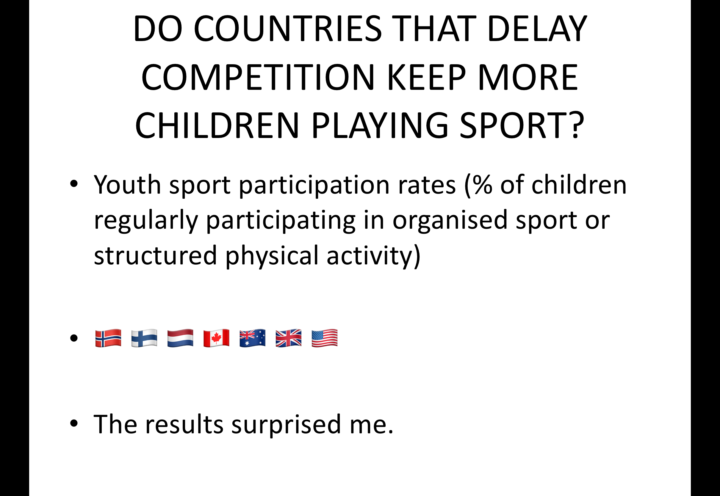
Do Countries That Delay Competition Keep More Children Playing Sport?
I came across some participation figures recently that made me stop and think. Youth sport participation rates: 🇳🇴 Norway – 93% 🇫🇮 Finland – 90% 🇳🇱 Netherlands – 75% 🇨🇦 Canada – 74% 🇦🇺 Australia – 73% 🇺🇸 USA – 50% 🇬🇧 England – 47% Now, participation figures are always messy. Different countries measure them differently and correlation doesn’t equal causation. But what interested me wasn’t just the percentages. It was the philosophy behind them. Different Approaches to Youth Sport Countries such as Norway, Finland and Canada tend to place a strong emphasis on: ✅ Fun ✅ Participation ✅ Development ✅ Multi-sport experiences Competition still exists. Children still compete. But winning isn’t the primary focus during childhood. The emphasis is on keeping young people involved. By contrast, countries such as England and the USA often introduce competitive structures much earlier through: • Leagues • Rankings • Representative teams • Talent pathways • Academy systems Again, this isn’t inherently wrong. Competition can be motivating. It can develop resilience, ambition and commitment. But it raises an important question. What Are Children Actually Looking For? Research consistently suggests that younger children participate in sport primarily because of: • Fun • Friends • Enjoyment • Learning new skills • Feeling competent • Being part of a group Very few 8-year-olds are genuinely motivated by scholarship opportunities, talent pathways or professional careers. Those are often adult priorities. As children move into adolescence, motivation begins to change. Identity, belonging, achievement and mastery become more important. But for many younger children, enjoyment remains the foundation. The Participation Problem One of the biggest challenges facing youth sport is retention. We often celebrate the players who make it. We rarely talk about the players who leave. The question isn’t simply: “How do we produce better athletes?” It’s also: “How do we keep more children active?” Because if young people stop enjoying sport at 12 or 13, the opportunity for lifelong participation may be lost.
Jun 2 •
France vs England: Are We Identifying Talent Too Early?
When do future international footballers first enter professional academies? It's a question that sits at the heart of talent development, yet we rarely stop to examine the pathways elite players actually take. Recently, I compared the current England and France squads and looked at the age players first entered professional academy systems. The findings were fascinating. The Numbers Average academy entry age: 🇫🇷 France: 11.2 years 🏴 England: 9.3 years At first glance, England players enter professional academies almost two years earlier than French players. However, the averages only tell part of the story. The most striking finding was that: 42% of the France squad entered a professional academy at age 13 or later. For England, that figure was just 19%. This immediately raises a question: What might players gain from spending longer in grassroots football before entering a professional academy? The Case for Early Academy Entry There are obvious advantages to entering a professional environment early. Players gain access to: - Qualified coaches - Better facilities - High-quality practice - Structured development programmes - Stronger competition It's easy to see why parents and coaches often believe that earlier is better. More years in an elite environment should lead to better outcomes. At least in theory. But What Might Players Lose? The French data made me think about something else. What happens before academy football? Many players spend years in grassroots environments where they experience: - Informal games - Multiple playing positions - Mixed-age football - Less adult intervention - Greater freedom to experiment In these environments, children often learn to solve problems for themselves rather than having solutions provided for them. As coaches, we sometimes underestimate the value of this. The Multi-Sport Question Another interesting possibility is that later academy entry creates more opportunities to participate in other sports.

Apr 28 •
🧤 The Sweeper Keeper: Are We Coaching It… or Avoiding It?
I’ve been watching Manuel Neuer’s performance against Algeria in the 2014 World Cup again. It’s often described as one of the greatest goalkeeping performances of all time. But here’s what stands out when you really watch it closely… 👉 He barely made a save. Instead, what he did was: - sprint 30–40 yards off his line to clear danger - intercept through balls before attackers could get there - dominate space outside the box - start attacks with long, accurate passes He didn’t just react to the game. 👉 He controlled it. ⚽ The Evolution of the Goalkeeper The traditional goalkeeper role was simple: - stay on your line - make saves - deal with crosses Everything was reactive. But the modern game has changed. Teams now: - press higher - play through lines - look to exploit space in behind Which means the goalkeeper has become: 👉 a defender👉 a decision-maker👉 a key part of build-up play 🚨 The Problem at Youth Level Here’s the uncomfortable question: 👉 Are we actually developing sweeper keepers in youth football? Or are we unintentionally coaching it out of them? Because the reality is… The sweeper-keeper role comes with risk. - Come too early → you get beaten - Come too late → you look hesitant - Get it wrong → it’s often a goal And when that happens: - coaches react - parents react - players lose confidence So what do we hear instead? - “Stay on your line” - “Don’t take risks” - “Just make the save” 🤔 What Are We Really Teaching? When we remove those moments, we might be protecting the team in the short term… But what are we doing to the goalkeeper long term? Are we: - reducing their ability to read the game? - limiting their decision-making? - creating reactive players instead of proactive ones? 🧠 Decision-Making > Technique The sweeper-keeper isn’t just about technique. It’s about: - perception - timing - anticipation - courage These are things that can’t be learned through drills alone. They need:
1
0

1-30 of 37
powered by

skool.com/the-gamified-coach-8582
🎮The Gamified Coach
Bringing the fun back into football and sport through gamified learning.
🚀Join us if you love coaching fun & engaging sessions
Suggested communities
Powered by