
Write something

12h •
The Board just approved us. The Academy is now official.
Class — I have news. As of today, April 30, 2026, The Drainage Academy is an officially approved continuing education provider by the NC Landscape Contractors’ Licensing Board. Course #3082: The Science of Residential Drainage — 3 Landscape CEU Hours — September 8 Course #3083: Drainage Business Operations — 2 Business CEU Hours — October 13 NC Licensed Landscape Contractors need 7 CEU hours every year to keep their license active. You can now earn 5 of those 7 through this Academy alone. Registration opens immediately. Both sessions are live webinars. You’ll need your camera on, your license number at registration, and the ability to stay for the full session. More details on registration coming within 48 hours. If you’re an NC licensee — this is no longer optional reading. This is your annual requirement. The Academy is where you fulfill it. The crew that documents, dominates. — Gemini Jim, The Drainage Dean NC License CL.1872

1d •
What’s hiding in your pipes? We ran the camera today.
Pulled up to a job site this morning for a drainage inspection. Client said “everything’s fine, it just backs up a little when it rains hard.” We ran the camera anyway. Here’s what we found: a downspout tie-in packed with sediment, root intrusion at a joint, and a section of single-wall corrugated pipe that had collapsed under the weight of the saturated clay above it. “Backs up a little” = the system is failing and the foundation is taking the hit every storm. This is why clean-outs aren’t an upsell. They’re a legal requirement under 21 NCAC 28B .0506 — and they’re the only way to actually know what’s happening inside your system without excavating the entire yard. The two tools that tell you the truth: 📷 Camera inspection — shows collapse, root intrusion, joint separation, sediment buildup. We run this on every VIP annual visit and every diagnosis call. 💨 Pipe jetting — high-pressure water clears sediment, roots, and debris. Where a camera diagnoses, the jetter fixes. If your system is more than 3 years old and has never been inspected, you don’t know what’s in there. You’re just hoping the math hasn’t caught up yet. It will. Drop a comment: have you ever run a camera on a system you installed or inherited? What did you find? — Gemini Jim, The Drainage Dean Carolina Terrain | NC License CL.1872
0
0

20d •
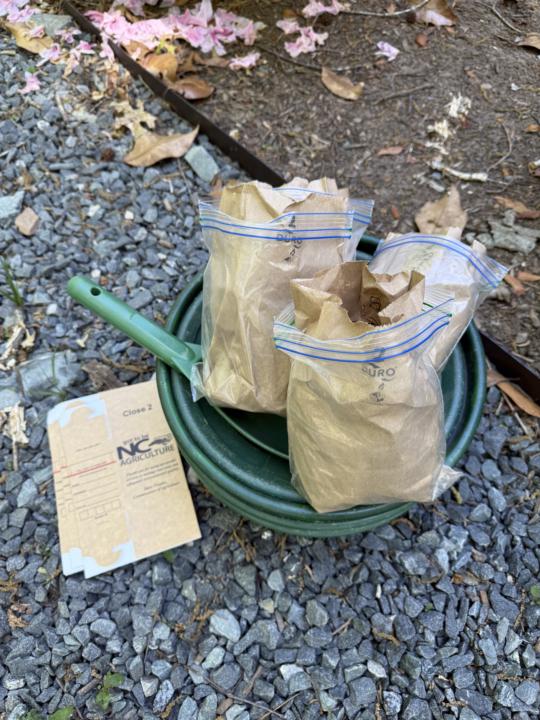
THE DIRT DOESN'T LIE: TURNING CORE SAMPLES INTO COLD CASH
Listen up. You see 700 dollars in those bags? I see a professional who stopped guessing and started testing. In the drainage game, if you aren't leading with data, you are just another person with a shovel digging a hole that is going to fail. In the Piedmont belt, we are fighting Cecil and Iredell series clays that are notoriously unforgiving. These clays absorb water at a rate of roughly 0.1 inches per hour or less. Meanwhile, Waxhaw averages 45 to 50 inches of rain per year, with summer storms capable of dropping 2 or more inches in a single hour. That is a mathematical recipe for a swamp, and it is why water damage accounts for nearly 28 percent of all home insurance claims. You cannot fix what you have not measured. That is why soil testing is a professional service that builds instant trust and lets you charge 175 dollars or more just to provide a report that proves a client needs a real drainage solution. THE AIR BOX SOIL DRYING STATION You cannot send wet mud to a lab or get an accurate compaction reading if the sample is saturated. In this business, time is money, which is why we use a drying station consisting of a heavy-duty box and a dust fan to create forced airflow. By using forced air to strip the boundary layer of saturated air away from the soil surface, you increase your drying throughput by nearly 1,000 percent compared to stagnant air. This setup allows you to take a sample in the morning, dry it by the evening, and have a professional drainage proposal ready for the client the next day. WHY JOIN THE DEAN'S COURSE? Soil sampling is the hook, but the real money is in the execution. We teach the Carolina Elite way, which includes engineered solutions, recurring revenue, and professional standards. Once you show the client the data, you pivot to the high-ticket installs and the Carolina Elite VIP Package which costs 999 dollars per year. This package includes annual drainage inspections and gutter cleaning. North Carolina law requires that anyone installing landscape drainage systems for hire must be a licensed contractor, which ensures a baseline of competency and adherence to minimum standards such as positive flow.
0
0
23d •
Gemini Jim's Pop Quiz: Are You a Drainage Dean or a "Band-Aid" Boss?
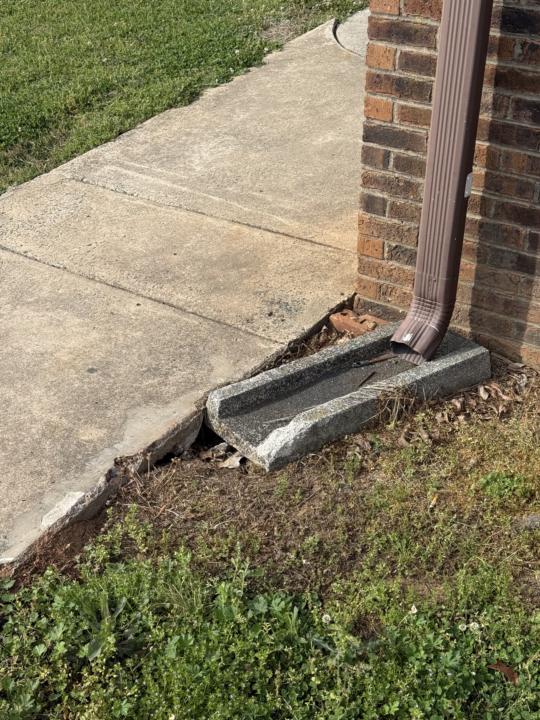
Listen up, class. We just finished the site audit for the local post office, and it is a textbook case of "Good Intentions, Bad Engineering." Most contractors see a wet spot and throw a pipe at it. We don't. We use data, SOPs, and the hard truth of the dirt. Waxhaw clay only absorbs about 0.1 inches of water per hour. When a standard Carolina thunderstorm drops 2 inches in an hour, that roof (measuring 223.54 square meters) is shedding approximately 3,000 gallons of water directly into the foundation. Let's see if you can spot the failures. Drop your answers in the comments! QUESTION 1: THE SIDEWALK SLUMP Look at Image 10. We see a concrete splash block and a massive void under the sidewalk. Why is this a "Foundation Emergency"? * A) It's just an eyesore; fill it with dirt and move on. * B) It's a sign of differential settling—saturated clay is losing its load-bearing strength, which will eventually crack the main foundation. * C) The sidewalk is thirsty and looking for a drink. QUESTION 2: THE "BLACK SNAKE" LIABILITY Look at Image 4. The contractor tied a corrugated black pipe into the downspout. According to our "Carolina Elite" standards, why is this a fail? * A) Corrugated pipe is UV-brittle and lacks positive flow, leading to sediment clogs. * B) It creates a significant tripping hazard for postal patrons, increasing liability. * C) Both A and B. QUESTION 3: THE MATH OF THE SOAK If this facility experiences a "100-year storm" (approx. 4.1 inches of rain per hour), how many gallons of water is that roof shedding in one hour? * A) 500 gallons * B) Roughly 6,000 gallons * C) 10,000 gallons QUESTION 4: THE LEGAL LINE In North Carolina, who is legally allowed to install this yard drainage system for hire? * A) Anyone with a shovel and a truck. * B) Only an NC Licensed Landscape Contractor (like License CL.1872) or equivalent. * C) The post office janitor. Jim's Pro-Tip of the Day: "Splash blocks are the participation trophies of drainage. They make you feel like you did something, but the foundation is still losing the game".
0
0
Mar 27 •
📢 Big Update: Taking the "Elite Standard" to the TCNC Regional Meeting!
Happy Friday, Academy members! 🌧️📉 As we wrap up another week of engineering resilient landscapes, I have some big news to share with the community. I’ve officially been invited to speak at two major industry events this July to represent the Terrain Ecosystem and the standards we’re building here: 1. TCNC Regional Meeting (Charlotte) — July 23, 2026 I’ll be leading a session titled "The 2026 Stormwater Standard: Physics, Policy, & Property Memory." We aren’t just talking about pipes; we’re talking about the Piedmont Math that creates an 1,185-gallon infiltration gap on a standard 1,000 sq. ft. area. [cite: 81-87] • Live Field Demo: We’re doing a "boots-on-the-ground" slope evaluation and subsurface system inspection. • [cite_start]2026 Compliance: We will be breaking down the fallout from the June 30 SCM inspection deadline and what it means for your bottom line. 2. NCGIC Water & Soil Symposium I've also been invited to join the conversation at the Water & Soil Symposium to discuss the new EPA PFAS mandates and NC House Bill 569. We’ll be discussing how "Verification-First" infrastructure and immutable records on Terrain Guard are the only way to protect against retroactive liability. [cite: 173-176] Why This Matters for You [cite_start]The industry is shifting from reactive "band-aids" to institutional-grade asset protection. Whether you are a contractor looking to scale or a property manager protecting an asset, staying ahead of these 2026 regulations is non-optional. Learn more about these events and register on the Turfgrass Council of North Carolina (TCNC) website. The dirt doesn't lie, and the math doesn't care about your weekend plans—but I do! Enjoy the break, recharge, and let’s get back to engineering success on Monday. Happy Friday and have a great weekend! Best, Alex Purdy Owner, Carolina Terrain | Founder, Terrain Ecosystem
0
0
1-12 of 12

skool.com/the-drainage-academy
Master flow with Jim. Drainage & hardscape via the Elite Bible. Data fixes for Red Clay Crisis. Scale!
Powered by