
Write something
Pinned

Mar 7 •
https://heyft-consistency.web.app/
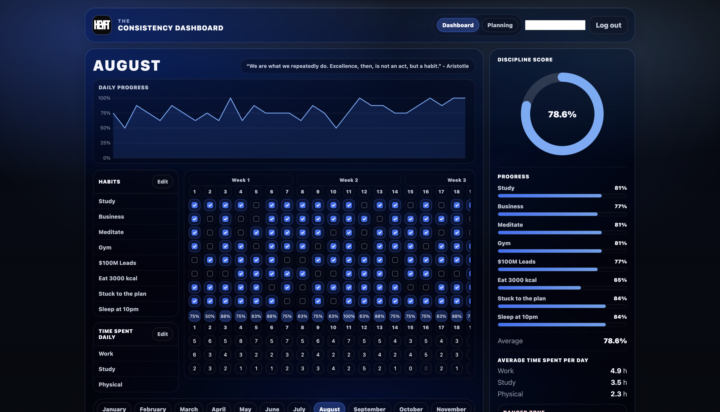
This is the link where you can sign up and start tracking. If you're not tracking, you don't care. Check the Classroom for a detailed breakdown of how things work, and what you can do to maximise output and the most efficient way of using The Consistency Dashboard. Look out for my community posts as they can help you find more success using the dashboard.
2
0
Pinned
Mar 7 •
Welcome! Introduce yourself + share a pic of your dashboard 🎉
Let's get to know each other! Comment below sharing where you are in the world, a photo of your dashboard habits including your workstation, and something you like to do for fun. 😊
Mar 27 •
Dark Mode + Revamp
I have been working during the past week on a dark mode, and a slight light mode revamp. Also includes small bug fixes.
0
0
Mar 16 •
Lessons & Learning
I like the saying “People don’t have business problems; they have personal problems that reflect in their business”. Also, it's not about going $1k to $10k/month, it's mostly about the lessons you learn in the process. Learn the life&business lessons, and the income will reflect the lessons. AKA Pay down your ignorance debt. How to learn? These are the 7 steps of outlearning everyone 1. Understand what learning actually is Learning means changing your behavior in the same situation. If you react differently than before, it means you learned something. Simply consuming information (watching videos, reading) is not learning unless your behavior changes. 2. Deconstruct the skill Break the skill into smaller components instead of treating it as one big thing. Identify the individual parts that make up the skill so you can practice each one separately. 3. Define success Clearly define what success looks like before you start. If you don’t know what outcome you are trying to achieve, you won’t know whether you are improving or not. 4. Ignore the “black box” Focus on observable behaviors of top performers instead of vague ideas like “talent” or “natural ability.” Study what successful people actually do and replicate those actions. 5. Measure progress Track your performance with numbers or metrics. If you don’t measure it, you can’t improve it, because you won’t know what is working and what isn’t. 6. Analyze and iterate Regularly review your results, identify what is working or failing, and adjust your approach. Improvement happens through constant testing and refinement. 7. Repetition (high volume practice) Do the skill many times. Massive repetition builds mastery because each attempt provides feedback and strengthens the behavior you’re trying to learn.
1
0
Mar 12 •
New Planning Tab
What’s new - A dedicated Planning tab so you can time block your week in 1 hour intervals - Weeks start on Monday - Your current week is highlighted automatically - Your current day is highlighted so you always know where “today” is - A Show time filter so you can hide useless hours and keep the plan clean (example: 5am to 11pm) - Copy and Paste for any week so you can duplicate a winning schedule instantly - 4 quick color markers so you can tag important blocks by coloring only the border (clean, not messy) - Everything auto saves and syncs across devices How to use it (fast) - Open Planning - Set your visible range (example: 05:00 to 23:00) and press Show - Fill your week in 1 hour blocks - Use Copy to capture a great week - Use Paste to apply it to any other week - Use the border colors to mark things like Deep Work, Gym, School, Admin, Meetings Why this matters - One good weekly planning session saves hours of wasted time later - Your calendar becomes a truth source: what you planned vs what you actually did - You stop “winging it” and start executing with urgency If anything feels unclear or you want another feature added, reply to this post and I’ll ship improvements fast.
1
0
1-9 of 9
powered by

skool.com/the-consistency-dashboard-3270
A Dashboard For Discipline, Habits, Consistency, Productivity & Time Tracking
Suggested communities
Powered by