User
Write something
Why I replace my wax every year
The comb that bees use for brood becomes darker with every passing year. This happens because beeswax gradually accumulates residues from honey, pollen, propolis and, most importantly, cocoon remnants left behind by developing brood. Over time, each cell carries the history of everything that has happened in that colony. Like all living organisms, honey bees are affected by diseases. These include viruses, bacteria, and fungi. Some of these pathogens the bees can manage themselves by removing sick brood and dead individuals. Others are far more persistent, remaining in the colony environment for a long time or ultimately leading to colony collapse. In nature, bees solve this problem through swarming. When a colony swarms, the bees leave with a substantial honey reserve, enough to establish a new colony from scratch. A swarming colony is therefore fully prepared to build an entirely new home using fresh wax. This new wax is produced from the honey they bring with them. Roughly four kilograms of honey are required to produce one kilogram of wax. By doing this, the bees continuously renew their comb. Fresh wax helps isolate and reduce the impact of many bee diseases. Even so, it is still recommended to feed a swarm with a 50/50 sugar syrup. This ensures that the carried honey that may contain a patogen is primarily used for wax production rather than stored as feed. Feeding stimulates wax production, and any excess stored in the cells will consist of sugar rather than unknown honey. It also creates an artificial nectar flow, encouraging the queen to start laying eggs quickly and consistently. Pathogens that may be present in old comb include: • European foulbroodcaused by Melissococcus plutonius • American foulbroodcaused by Paenibacillus larvae • Chalkbrooda fungal disease caused by Ascosphaera apis • Sacbrooda viral disease caused by Sacbrood virus (SBV) • Deformed Wing Virus (DWV) • Acute Bee Paralysis Virus (ABPV) • Chronic Bee Paralysis Virus (CBPV) My method for replacing wax is based on overwintering colonies on two brood boxes with frames, depending on frame size. With Farrar equipment, I use three boxes. The lower box consists of the old brood comb. The upper box contains frames from the past season’s honey harvest, which have been filled during winter feeding with sugar solution, or honey for those who choose to overwinter on honey.
0
0
Why I replace my wax every year
Bad advice over the internet could kill of your bees!
This morning I saw a post in a beekeeping group on Facebook where a beekeeper had found a wild honey bee colony living in a tree. He asked other beekeepers in the group whether it would be possible to freeze the honey and then feed it to his other colonies. He received several replies saying yes, and some even claimed it would be a good idea. One man even stated that wild colonies are probably just as healthy as anybody’s hives. These statements could hardly be more wrong or more dangerous. We have no reliable way of knowing the health status of wild colonies. It is extremely difficult to know which viruses or bacteria may be present in a colony living in the wild. Two of the most serious examples are American foulbrood and European foulbrood. American foulbrood is caused by a spore forming bacterium, similar in that sense to anthrax. Because of this, the spores can survive for a very long time in materials such as honey and can easily infect other colonies when that honey is fed to them. It is also important to understand that strong colonies can appear healthy because they have the strength to remove diseased brood and dead bees. This can give the impression of a healthy colony, but make no mistake, such colonies will eventually collapse. In large parts of Europe there are strict biosecurity regulations regarding these bee diseases. In Sweden, all colonies infected with American foulbrood are destroyed by burning, together with all material that has been in contact with them. Contact tracing is carried out and sampling is performed at apiaries within a radius of one mile (10 km) , approximately 6.21 miles, and a restriction zone is established. This zone is only lifted once the area has been declared free from disease. Within the zone, honey may not be moved ouside the zone unless it is bottled directly into consumer packaging, and it is forbidden to move bees or sell queens from the area. Norway has even stricter legislation, where similar rules also apply to European foulbrood.
Poll
Cast your vote
0
0
Bad advice over the internet could kill of your bees!
My first post on Skool
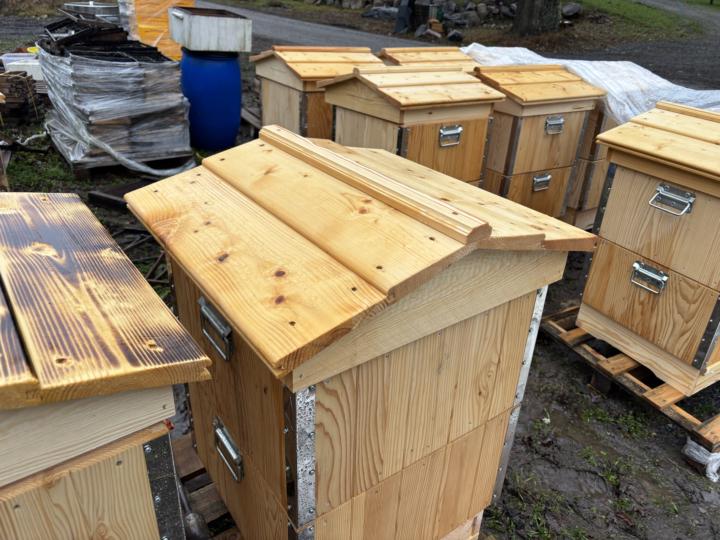
This is a couple of wooden hives I bought dirt cheap, they’re in the local format ”norsk” which means Norwegian. They are similar in size with Dadant for reference. I did some burning and lindseed oil, the hives are going places where I won’t be able to do as regular checkups as other more commercial hives, hence the bigger format. What kind of hives do you use?
0
0
My first post on Skool
1-3 of 3
powered by
The Beekeeper
skool.com/the-beekeeper-1771
Beekeeping without guesswork. Learn practical beekeeping from real experience, whether you keep a few hives or many.
Build your own community
Bring people together around your passion and get paid.
Powered by