
Write something

Jun 8 •
Margin Account: The Income Vehicle without getting into Trouble.
**I am not a financial advisor; this is my own personal research and experience with Margin Accounts** Wealthsimple Margin Account, is what I know and still learning as I go, Always learning I am. *Also too add. WS has PLOC which uses your TFSA as collateral, only loaning you upto 35%, so more conservative over a margin account. I'll do my best to answer any questions. Enjoy.
May 30 •
Dividend Investor: Now CC Income Investor
I'm a believer of, if I invest into a company, what do I get out of it? Dividend investor sees anything over 10% yield as high risk of a cut or share split if it keeps going up. The 5% yield mark was key. When I started investing back in April 2020, Covid Times and had lots of time on my hands. Friend said I should check out stock market and I did. I started researching into companies, how to invest, started at looking which Broker to go with (BMO Investor-line) and once that was setup, I funded the TFSA account slowly. Cash Savings transferred to Investing. I already had a few companies picked out by the time account opened, that I wanted to invest in. Also at this time, lot of things were happening and some actions hadn't come into play. Growth wasn't my thing, dividends were for I knew in my future I'll be needing income for retirement. Very first trade Cenovus @ $4.43 110 shares. Than came in others, BMO, BNS, TNT.UN, CHE.UN, HR.UN, EIF, BPY.UN, CHR, CPX than others over time. Than the learning curve came into effect. Dividend Cuts and Stops. Learning about DRIP (if you were short 1penny, it didn't happen) and how to factor in the trading fee to off set cost. So my buys were to me at the time, big. $9.95 fee killed any small trades. 2023 I switched over to Wealthsimple for they now got DRIP going and I moved everything over to them from the TFSA account. DRIP was total amount going into holding, fractional shares = Full Snowball effect was easy to see. But over this time, company takeover - buyout, going private, dividend increases, dividend cuts, dividend no more, stock splits (bad ones and good ones) yep hitting my yearly growth income. Can't forget the good old kicker, delisted. That is called, learning = knowledge. Why when I see a holding was worth $100 or $1400 years back but only a few dollars today, I ask why and I dig in, why the down fall. I see splits in its history, I move on, but if its just a crash, is it worth it? Bought into the local brewery, felt great walking in there to buy beer, I'm a shareholder receiving dividend but short lived for Carlsberg bought them out. All shareholders received cash for their shares.

May 14 •
My Portfolio
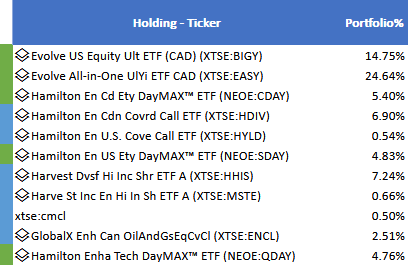
RRSP: Individual stocks TOP 4 HOLDINGS: US: AMZN, AVGO, GOOGL, MSFT. CANADA: BDT, BMO, BN, FINN TFSA TOP 3: HHIS, ZEQT, HDIV MARGIN TOP 3: EIT-UN, VFV, VDY CORPORATE TOP 3: HXS, HXT, XEQT I am in a unique position where I am winding down a company over the next 5 years so can pull dividends out of the company to live off of and grow my RSP, TFSA and Margin accounts. Got a combination of pure growth, dividends and covered calls and my main focus right now is minimizing tax implications.

Feb 27 •
Passive Income Portfolio
My goal is to generate a passive income where I can live off. My wife is unable to work so I'm trying to build this as fast as I'm able to. Currently I am attempting to add $500 a month. This is all in my TFSA. My current CC and Weighting of the portfolio is as follows: UTES 3% CALL 3% BANK 3% CANY 5% SIXY 5% BIGY 2% USCL 4% ENCL 4% HDIV 4% HYLD 4% CDAY 4.5% SDAY 4.5% QDAY 4% HHIC 4% HPYT 4% HHIS 2% PLTE 2% RDDY 2% CNYE 2% MSTE 2% CRCY 2% SHHI 1% IWMY 1% QQQY 2% USOY 1% TQQY 1% YSPY 1% BLOX 1% QDTE 1% WPAY 2% RDTE 2% AVGW 1% COIW 1% HOOW 2% NVDW 1% AMZW 1% PLTW 2% PLTY 1% CONY 1% LFGY 1% HOOY 2% MSTY 2% ULTY 2% I started back in June 2025 Making my first monthly dividend of $0.16 now I am currently making $122 a month. Only have 5k So far but trying to stay consistent. Any tips and tricks would greatly be appreciated

May 1 •
Transition to Retirement..
I’ve been a single-stock investor since I was 18 and only recently, at 56, discovered the world of passive income investing (PII). It’s been a major mindset shift for me moving from concentrated positions to building income-focused retirement planning. My big question is around RRSPs and the eventual RRIF conversion at age 71. From what I understand, when I convert my RRSP to a RRIF, I’ll be forced into minimum annual withdrawals, which could increase taxable income and potentially create a bigger tax burden than I’d like. I’m concerned about taking a significant financial “hit” during that transition. For those who’ve been through this or planned ahead well: - Is converting RRSP to RRIF itself a taxable event, or is the tax hit mainly from the mandatory withdrawals? - Are there smart strategies to reduce the tax impact before 71 (gradual drawdowns, partial RRSP withdrawals, RRSP meltdown, etc.)? - If you hold mostly income-producing ETFs or dividend-focused investments inside the RRSP, does that change the best strategy? - Is it smarter to begin strategically drawing down RRSP earlier in retirement to smooth taxes rather than waiting? I’m trying to avoid a scenario where decades of compounding gets unnecessarily eroded by poor decumulation planning. Would really appreciate hearing how others have optimized this transition without getting hammered on taxes.
1-17 of 17
powered by

skool.com/the-1m-club-7454
A $1 investment with the highest potential ROI you will ever find.
Suggested communities
Powered by