

Apr 23 •
How agent outputs compound (or don't)
Most agent outputs land in two places: the terminal and a markdown file. Both are readable by a human. Neither is queryable by the next agent. The pattern worth knowing: write outputs to JSON lines, not prose. One JSON object per run, appended to a file. The next agent reads the last ten rows and makes a decision without parsing paragraphs. A concrete version: a skill that checks content quality writes a row with the score and any violations. The skill that runs next session reads that row and knows whether to alert or skip. No markdown parsing. Just a tail and a pattern match on score. The difference between an agent that informs and one that compounds is the shape of its output. What format are you using when one agent needs to hand state to the next?
3
0
Apr 12 •
Claude Code Mastery -- Free Course + Weekly Meetup
Claude Code Mastery is live in the classroom. Six modules covering agent skills, the Claude API, MCP configuration, and remote execution from your phone. Each module pairs an Anthropic Academy foundation course with a practical lesson. The Anthropic courses cover the theory. The practical lessons show how to apply it on a real machine with real files. Weekly meetup every Wednesday at 1 PM Eastern. Check-ins, concept walkthroughs, live Q&A, and accountability. Recording posted after each session. Start here: https://www.skool.com/snappy/classroom When you finish all six modules and the four Anthropic Academy courses, post with #claude-code-complete and your email to claim your certificate.
5
0
Apr 7 •
I'm back. Snappy is now the OS for agentic building.
Two months heads-down. No posts, no noise. Here's why. I've been building the agentic systems that Claude Code itself now uses — skills, MCPs, orchestration patterns, the whole stack for controlling real AI agents on real work. Not demos. Not threads. Systems that ship. Snappy's positioning is sharper now: Build and control agents to get huge results. Not "MCP integration." Not "Xano MCP." Those are tools inside the bigger thing. The bigger thing is agentic building — developers and technical founders learning to stand up agents they actually control, using skills, MCPs, Claude Code, Xano, and the rest of the stack, so the work compounds instead of evaporating. If you've been here a while, you'll notice changes over the next week: - The AG Grid / WeWeb module is coming down. It's no longer the point. - The classroom is being rebuilt around four tracks: Agentic Building 101, Skills That Compound, MCP as a Power Tool, and Build & Control Agents End-to-End. - MCP Wednesday is back on. - All roads point to snappy.ai. YouTube, newsletter, blog, LinkedIn, Xano — one stack, one direction. Here's what I want from you this week: 1. Drop a comment with the one agentic system you're stuck building. Be specific. "I want an agent that does X, and it keeps breaking at Y." 2. If you're new, post in Introductions. Tell me what you're shipping and what stack you're on. 3. If you've been lurking — come back. The wave is about to break and I'd rather you ride it with a system than watch it from the shore. You built it. You're stuck. Let's fix that, live on your screen. Without the hype tax. I burn the hours so you don't. See you in the feed. — Robert
Feb 26 •
The one MCP pattern that saves me hours every week
I used to restart Claude sessions all the time because I'd hit context limits or need to switch tasks. Every restart meant re-explaining my setup, tech stack, and what I was building. Then I started treating MCP servers like my 'external brain'. Instead of cramming everything into chat context, I built a simple MCP that reads my project docs, database schemas, and recent decisions from files. Now Claude just asks the MCP when it needs context. Now I can work on the same project across 10+ sessions without losing continuity. Claude remembers everything because the MCP remembers everything. Anyone else structuring their MCP servers this way? Would love to hear other patterns people are using.
3
0
Nov '25 •
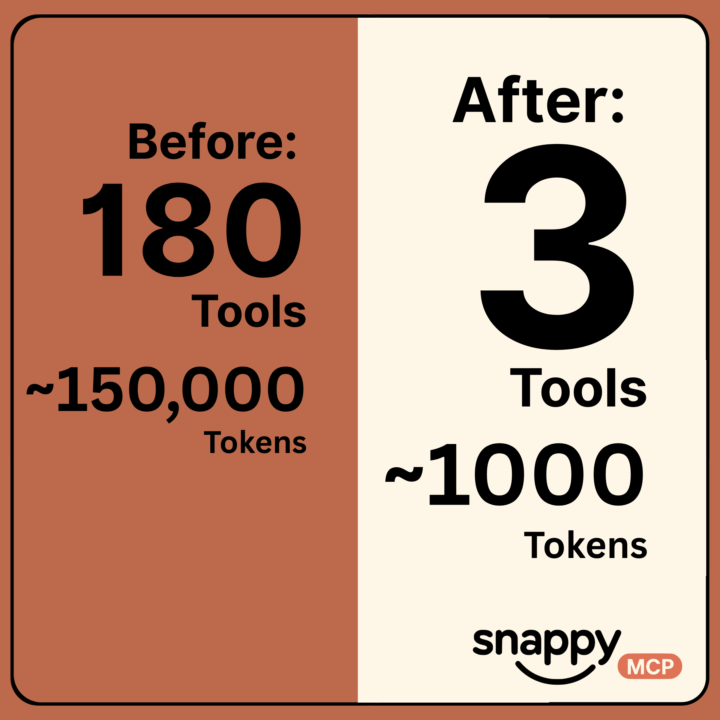
From 180 tools and 150,000 tokens to 1000 tokens and 3 tools!
Thanks to a great idea from Ray Deck, I have reduced the number of tools in the snappy.ai Xano MCP from ~180 tools and ~150,000 tokens to ~1000 tokens and 3 core tools: 1. Gemini Flash Powered Search - "What tools do I have?" (Semantic search across all tools - e.g., "create table", "list functions") 2. Info - "Tell me more about that specific tool" (returns parameters, examples, docs) 3. Execute - "Do it" (runs the tool with the right parameters) Now the initial handshake costs only ~1000 tokens instead of 150,000. Claude discovers tools as needed rather than loading everything upfront. This pattern should work for any MCP with dozens or hundreds of tools. Instead of exposing everything at once, create a search/discovery layer that lets Claude Code find what it needs when it needs it!
1-28 of 28
skool.com/snappy
Faster than vibe coding. Private AI tools to ship real systems while others prompt. We build businesses, not demos.
Leaderboard (30-day)
1

+2
2

+1
Powered by