
Write something

Mar 11 •
The Three Levels of Understanding Prana
1. Prana as the Force that Sustains Life (Physiological Level) At the most accessible level, prana refers to the vital force that maintains the functions of the living body. It governs breathing, circulation, digestion, metabolism, sensory perception, and nervous system activity. Breath is the most direct and observable expression of prana within the body, which is why yogic practice uses breath as the primary doorway for regulating it. When prana moves in a balanced and steady way, the body functions efficiently, and the nervous system remains stable. When prana becomes disturbed or irregular, physiological imbalance and mental agitation arise. Through practices such as asana and pranayama, the practitioner learns to stabilise this vital force so that the body and mind operate with greater coherence. This understanding appears clearly in the Prashna Upanishad c. 400-200 BCE, which describes prana as the force that sustains all functions of life. 2. Prana as the Bridge Between Body and Mind (Subtle Energetic Level) At a subtler level, prana functions as the link between the physical body and the mind. Yogic teachings explain that the movement of prana and the movement of thought are closely connected. Regulation of the breath, therefore, becomes a practical method for stabilising the mental field. When prana becomes disturbed, the mind becomes restless. When prana becomes steady, the mind becomes quiet. For this reason, classical yoga teaches that regulating the breath stabilises the mind. This principle is reflected in the teachings of the Hatha Yoga Pradipika, which explains that when prana flows steadily through the subtle channels of the body, the fluctuations of the mind begin to settle. This is why pranayama sits between asana and meditation in the eightfold path (Ashtanga): it refines the energetic system so that attention can become stable enough for concentration and meditation. 3. Prana as Universal Intelligence (Cosmic Level) At the deepest level of the teaching, prana is understood as the dynamic expression of the intelligence that governs the entire universe.
1
0
Feb 4 •
The Three Obstacles to Clear Awareness
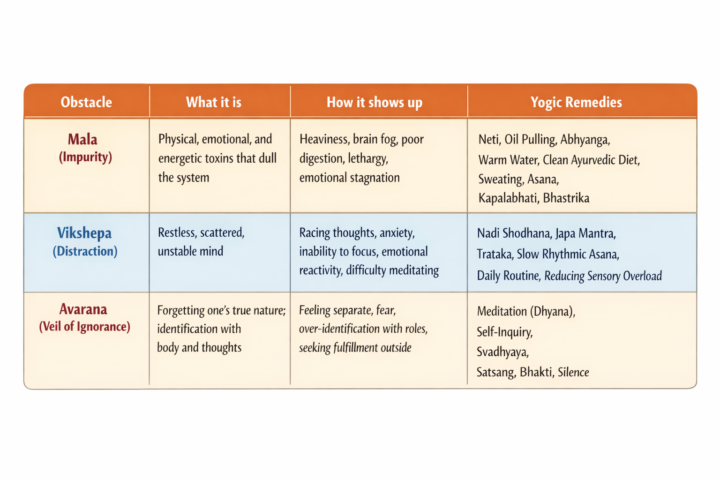
Vikshepa, Mala, and Avarana: The Three Obstacles to Clear Awareness In the stillness of the Self, awareness is luminous and steady. Yet three veils obscure this clarity: Mala – the impurity Vikshepa – the scattering of the mind Avarana – the veil of ignorance These veils arise within the body, mind, and consciousness, and their removal is the purpose of Yoga. Vikshepa – The Scattering of the Mind Vikshepa is the mind thrown outward, scattered in many directions. It draws attention to thoughts, sensations, memories, and reactions. It is restless motion, born of Rajo Guna. Vikshepa describes a very specific movement of consciousness: The mind is being thrown outward, away from itself. (Vikṣhepa means to scatter in many directions.)This is the restless motion that pulls attention into thoughts, sensations, memories, plans, and reactions. It is the reason attention fragments and inner stillness feels distant. Examples: This is the force that makes us: -reach for your phone when you intended to meditate -think about five things while doing one -replay conversations -worry about the future -feel unable to sit still -feel mentally “noisy” even in a quiet room Manifestation: Attention moves from task to task Conversations and events are replayed within Worries of the future arise unbidden The body cannot rest, the mind cannot settle Observation: Vikshepa is first seen in the breath, then in the mind. Remedy – Ekāgratā One-Pointedness Steady practices draw the mind inward: →Mantra repetition (Japa) →Pranayama →Meditation (Dhyana) →Devotion (Bhakti) →Trataka (candle gazing) →Daily rhythm and consistent routine Each practice gathers the scattered attention, training the mind to dwell with one object. Mala — The Impurity Mala is the accumulation of physical, emotional, and energetic toxins. It shows up as heaviness, dullness, lethargy, brain fog, emotional residue, and poor digestion. Mala is the accumulation of toxins in the body, mind, and energy. Examples:
3
0
Jan 20 •
The Koshas
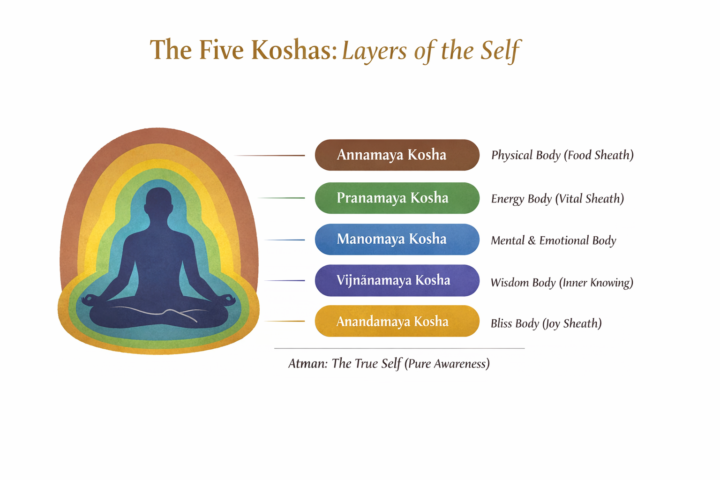
In Vedic and yogic wisdom, the human being is not seen as just a body or a mind. We are understood as layers of experience, known as the Koshas. The word kosha means sheath or veil. These layers cover the true Self (Atman), like layers of clothing. Healing and awakening the koshas focus on understanding these layers, caring for them, and learning not to mistake them for who we truly are. This teaching comes directly from the Taittiriya Upanishad and is one of the most reliable frameworks we have for holistic health, self-inquiry, and spiritual maturity. The Five Koshas -Pancha Koshas 1. Annamaya Kosha The Physical / Food Body Anna means food. This is the physical body formed from what we eat and how we live. It includes bones, muscles, organs, skin, and all biological structures. Ayurvedic focus: Diet (ahara), lifestyle (vihara), sleep, movement. Key reflection: You have a body, but you are not the body. 2. Pranamaya Kosha The Energy / Vital Body Prāṇa is the life force that animates the body. Prāṇa flows through subtle channels called nāḍīs and is regulated by the five prāṇas. Key reflection: Energy links the body and the mind. 3. Manomaya Kosha The Mental & Emotional Body Manas is the thinking, sensing, and reacting mind. Ayurvedic lens: Strongly influenced by the gunas: - Sattva – clarity - Rajas – agitation - Tamas – heaviness Key reflection: Thoughts arise in awareness, but awareness is not thought. 4. Vijñānamaya Kosha The Wisdom & Discernment Body Vijñāna means higher knowing or discernment. Here, awareness begins to step back and see clearly. Key reflection: You can observe the mind itself. 5. Ānandamaya Kosha The Bliss Body ( Ānanda means bliss) Key reflection: Even bliss is not the Self. It is the subtlest veil. It is quiet, expansive, and content without reason. Beyond the Koshas: The True Self (Ātman) The Upanishads remind us: Neti, neti — “Not this, not this.” You are not: →The body →The breath →The mind →The intellect →Even the bliss
2
0
1-3 of 3
powered by

skool.com/sevendirections-6208
Learn timeless Ayurveda and Yoga practices to nourish your body, steady the mind, and live with more vitality and ease.
Suggested communities
Powered by