
Write something

Jul 23 •
Low Dose Naltrexone
I just posted a new classroom course on LDN! I was going to keep it here, but it felt more appropriate in the course module. I'll likely be adding even more to it because there's really a ton of data that can be shared. I'll keep the carousel post here to reference though. Overall, the TLDR; The potential upside is high, and the downside is inconsequential. This alone makes it worth considering for those who deal with chronic pain or have an autoimmune condition like Hashimoto's. By no means is this a cure or a silver bullet, but mechanistically the theory is sound and grounded in evidence. Have you heard of LDN or Naltrexone at all?
Jul 1 •
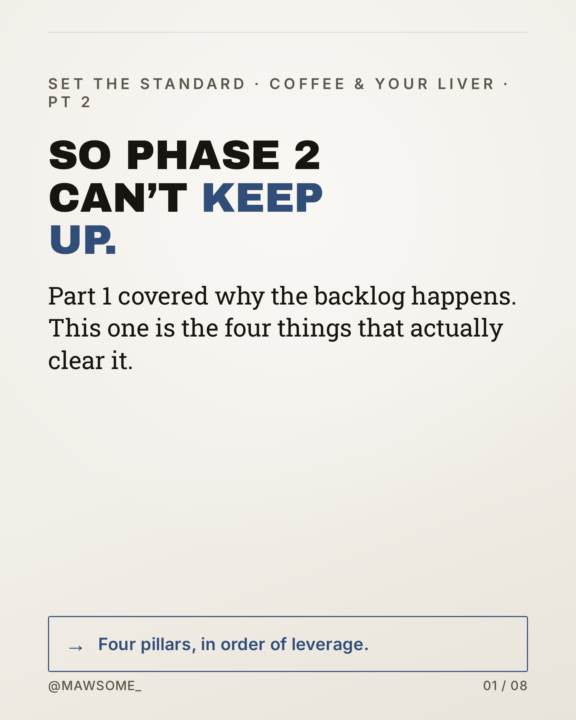
Part 2 - Detox phase series (Digestible version)
Here's the second carousel that comes along with the detox phases. Again, more to come in a bit of a deep dive in the classroom where we'll explore how caffeine can be a proxy for a fast or slow phase 1 detox, and specifically which enzyme is responsible for it. The takeaway here is that the default 'fix' is usually adding a glutathione injection, or taking NAC, NMN, NMR, without managing the foundations. Glutathione is used up in both phases because in some phase one cytochrome P450 complexes, glutathione is used. While we can synthesize glutathione endogenously via glycine, cysteine, and glutamic acid, there's still a finite amount. We use glutathione to detoxify many fat-soluble toxins and carcinogens making them water soluble. It circulates in the blood and grabs onto these chemicals and pulls them out of the blood into the liver, then to the gallbladder > gut > and then flushed down the toilet. All that to say, glutathione can be used up in phase 1 and not have an adequate amount for phase 2, which it's definitely needed in. Reduce the amount of toxins in and increase the necessary cofactors for phase 2. Sulfur foods are mentioned BUT- if you're someone that has sensitivities to these foods or you have SIBO, this can literally wreck you. Don't just add these for the sake of chasing this particular suggestion only to make your gut worse- then you're really in a bad position. More to come on GI dysfunction later. Will have the other parts of this series up soon. Enjoy!
3
0
Jun 28 •
Liver Detox Phase 1 & 2 Series coming
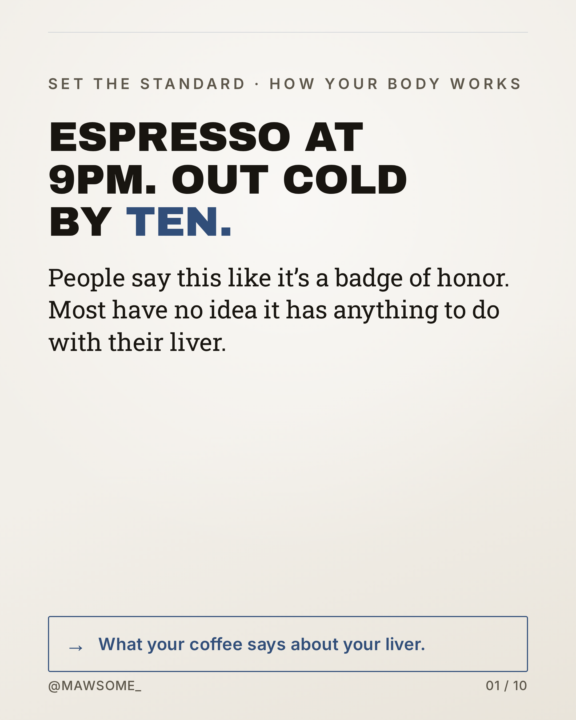
This is the digestible version of what's to come in the classroom. I'll keep this in mind when it comes to future posts because I too like to keep things simple and relatable. This is the 'elevator pitch' or conversation. Where this stemmed from is listening to a lecture in one of my courses about liver detox phases. It's a LOT to breakdown, which is why a full module will be built out for it in the classroom. I find this incredibly interesting and am curious if anyone here is the type that can drink coffee late into the evening without issue. Or, are you the opposite? Maybe you'd be interested in knowing that the same enzyme (CYP1A2) is responsible for clearing caffeine and is also the primary enzyme responsible for clearing & metabolizing estrogen. Even more interesting, estrogen also inhibits this enzyme. Which should leave you thinking about how this influences women at different phases in life, as well as those on birth control. Fascinating stuff, but will expand on this in the next two series as well as in the classroom. Just want you all to know I thoroughly appreciate you being part of this community!
May 6 •
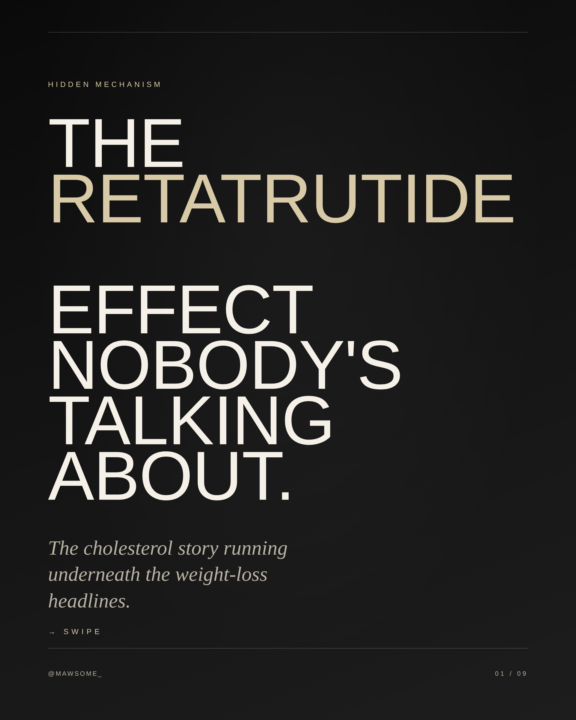
Retatrutide's lipid lowering effect independent of LDLR
By this point we've all heard about Reta/Retatrutide. Safe to say by now it's also predominately known as a tool that simply helps with fat loss. Sometimes it doesn't even go beyond that for people to jump on board. There are some other really awesome mechanisms that are less spoken about when it comes to glucagon agonism, and that's the effect on lipid lowering via the ANGPTL 3/8 protein. Let's dive in: How is it actually lowering cholesterol? It's via the angiopoietin-like protein (ANGPTL 3/8). There are eight of these angiopoietin-like proteins (ANGPTL 1-8), and for lipid metabolism, three matter: - ANGPTL3: secreted by the liver, circulates systemically. It inhibits LPL in oxidative tissues (muscle, heart) and inhibits EL on the endothelium - ANGPTL4: secreted by adipose, liver, and heart. Inhibits LPL primarily in adipose during fasting. Inactivated by ANGPTL8 during feeding. - ANGPTL8: produced by liver and adipose. Acts as a molecular switch and pairs with ANGPTL4 to activate it forming (ANGPTL3/8). How ANGPTL 3/8 is regulated - Fed state (insulin is high). ANGPTL8 rises in liver & adipose. Liver ANGPTL8 binds with ANGPTL3 and creates the combo 3/8. This combination inhibits LPL in oxidative tissues (muscle, heart). Ultimately dietary fat is routed to adipose for storage - Fasted state (glucagon high) ANGPTL8 falls and ANGPTL4 suppresses LPL in adipose. ANGPTL3/8 also falls, freeing up LPL in muscle & heart, ultimately mobilizing fat into oxidative tissues for burning. Insulin induces hepatic ANGPTL3/8 secretion and glucagon suppresses it. This is why Reta, via the glucagon agonism, pulls on this system. What LPL does: It hydrolyzes (breaks down) stored triglycerides inside chylomicrons and VLDL particles. It releases free fatty acids that are taken up by the underlying tissue. When LPL is freed (ANGPTL3/8 low): triglyceride rich lipoproteins clear faster, plasma triglycerides fall, and remnant processing accelerates.
May 28 •
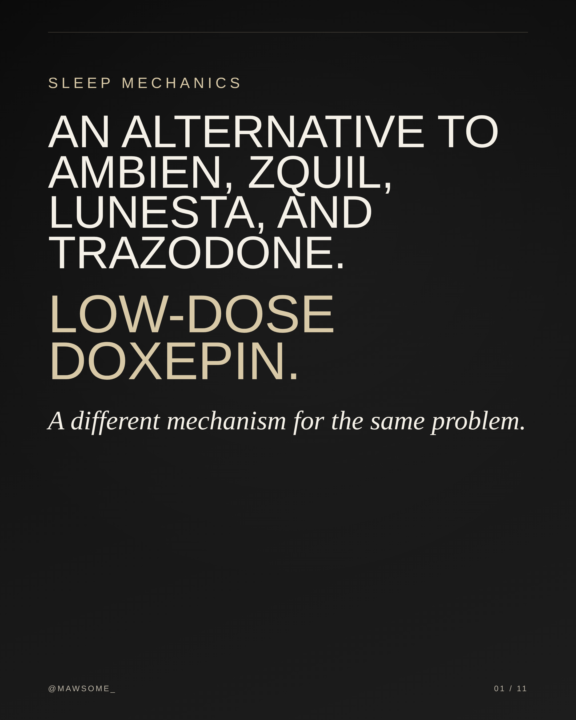
Trouble sleeping & Tried Everything? This might be your fix.
Low-dose Doxepin. I want to do a real deep dive on this one, because it's quietly become the most impactful thing in my recovery stack, and if it worked this well for me I’m sure at least one of you would experience the same. If you've ever been handed trazodone, Ambien, or told to just take some ZQuil, this is the conversation nobody had with you. What it actually is Doxepin is an old tricyclic antidepressant. At standard antidepressant doses (25–150 mg) it's a messy drug — it hits serotonergic, adrenergic, and cholinergic receptors all at once. That's the full tricyclic profile, and it's why most people think of it as heavy. But at ultra-low doses (3–6 mg), it becomes a completely different molecule. Those other receptors go quiet. What's left is a clean, selective H1 (histamine) antagonist — roughly seven times more potent at H1 than the classic over-the-counter antihistamine everyone reaches for. So you get the sleep-maintenance benefit of blocking histamine without the anticholinergic baggage that wrecks sleep architecture. Why it's different from everything else you've tried This is the part that matters. It is not a sedative and not a Z-drug. - It's not for sleep onset. The signal is on staying asleep — maintenance — not knocking you out faster. - It doesn't bulldoze your sleep architecture the way sedatives and Z-drugs do. You keep the deep, restorative stages instead of getting sedated into a shallow imitation of sleep. That last point is the whole game, and it's why it matters for body composition (more below). What the clinical data shows This isn't bro-science. A crossover RCT of 67 adults with primary insomnia (Roth et al., SLEEP 2007) tested doxepin 1, 3, and 6 mg against placebo: - −23 min wake after sleep onset (WASO) - +25–29 min total sleep time - Sleep efficiency 81% → 87% at 6 mg - Final third of the night: 80% → 89% efficiency That final-third number is the tell. It holds your sleep together through the back half of the night, which is exactly where most people fall apart.
1-6 of 6

Leaderboard (30-day)
1

+1
Powered by