
Write something

Feb 17 •
Vision Boards: 3 Things To Do — And 3 Things To Avoid
A vision board is not magic. It’s a focus tool. And like any tool, it either works because you use it properly… or it becomes clutter. Let’s keep this grounded. ✅ Three Things To Do 1. Make It Specific Enough to Act On “More money” is vague.“$1,200 per week in consistent revenue” is actionable. Your brain needs clarity. Your nervous system responds to detail. If you can’t see yourself taking steps toward it, it’s not clear enough. 2. Put It Where You’ll Actually See It Not in a drawer.Not hidden in a journal. Place it somewhere your eyes land naturally. Morning and evening are ideal — those psychological bookends matter. The point is repetition without force. 3. Pair It With One Daily Micro-Action Every item on your board should have a behavior attached. Dream house? Improve your credit .Better health? Walk 20 minutes. Stronger relationship? Initiate one honest conversation. Vision without movement creates frustration. Vison with movement builds momentum. ❌ Three Things Not To Do 1. Don’t Treat It Like a Wish List A vision board is not a cosmic Amazon cart. You are not ordering from the universe. You are clarifying direction for your own behavior. That shift alone changes everything. 2. Don’t Check It Obsessively If you stare at it asking, “Why isn’t this here yet?” You’re reinforcing lack. Glance. Align. Move. It should regulate you — not stress you. 3. Don’t Load It With 47 Goals Too many signals create noise. Pick 3–7 core focuses. Depth beats volume. Always. Final Thought A vision board does not create your life. Your decisions do. The board simply keeps your decisions pointed in the right direction. Use it as a compass — not a miracle machine. — Michael
2
0
Jan 22 •
The Space Between Intention and Evidence
Most people give up on journaling or vision boards in the quiet middle. Not at the beginning—when inspiration is high. And not at the end—when results are obvious. They give up in the space between intention and evidence. That space can feel uncomfortable. You’ve written the words. You’ve set the image. You’ve named what you want. But life hasn’t caught up yet. Here’s what many don’t realize: That space is where alignment is actually happening. Journaling isn’t meant to convince the universe. Vision boards aren’t meant to rush outcomes. They exist to change how you listen. When you journal consistently, patterns begin to surface—not because you’re forcing insight, but because your mind finally has room to speak honestly. When you revisit your vision board, it stops feeling like a wish list and starts feeling like a quiet agreement with yourself. Nothing flashy. Nothing dramatic. Just clarity settling in. If today feels like a “nothing changed” day, that doesn’t mean nothing is working, it often means something internal just clicked into place—and the outer world hasn’t reflected it yet. So today, don’t write to get something. Write to notice something. What feels different than it did a week ago? What no longer feels heavy? What feels oddly calm—even without proof? That’s the work. And it counts more than most people realize. — Michael
3
0
Dec '25 •
Why Writing Can Unlock Answers You Didn’t Know You Were Looking For
There’s something quietly powerful that happens when you write in a journal—especially when you’re not trying to “solve” anything. Many people think journaling is about expressing thoughts. In reality, it’s often about revealing them. When you write, you bypass the surface-level thinking mind—the part that rehearses conversations, worries about outcomes, or tries to stay in control. Writing slows your thoughts just enough for deeper material to rise. Patterns, connections, and emotional undercurrents begin to appear on the page, sometimes before you consciously realize they were there at all. In that sense, journaling doesn’t always give you answers. It gives your subconscious permission to work. Often, the issue you’re facing isn’t fully formed in your awareness yet. It exists as tension, restlessness, fatigue, or a vague sense that something is “off.” Writing provides a safe container for the subconscious to start organizing that information—without pressure, without judgment. And interestingly, this isn’t just philosophical or intuitive. Research supports it. Psychologist James Pennebaker and his colleagues found that expressive writing—writing freely about thoughts and feelings—can lead to improved emotional clarity, reduced stress, and even better problem-solving over time. Participants often reported insights emerging after writing, not during it, suggesting that the subconscious continued processing in the background. Neuroscience studies have also shown that writing by hand activates networks in the brain associated with memory integration and meaning-making. When thoughts move from mind to page, the brain treats them differently—less like noise, more like information worth organizing. This is why journaling often leads to “aha” moments later in the day…or solutions that arrive unexpectedly…or a calm certainty that replaces confusion. You didn’t force Clarity, you made space for it. So if you’re journaling and wondering whether it’s “doing anything,” trust this:
Nov '25 •
A Subtle Shift in Your Vision
Your journal and your vision board aren’t just tools — they’re mirrors. They reflect who you’ve been… who you’re becoming… and sometimes, who you’re finally ready to stop being. Today, I want to invite you into something simple: Choose one part of your life you’re ready to see differently. Not fix. Not force. Just… see differently. Maybe it’s a relationship. Maybe it’s your confidence. Maybe it’s a long-held dream you’ve pushed aside. Or maybe it’s something quiet, something only you would notice. Take a moment and write about that shift — even if it’s small. Or add one new image, one new word, one new symbol to your vision board that reflects this new way of seeing. You’re not just capturing a moment. You're shaping your direction. Whenever you’re ready, share what shifted for you today.
Nov '25 •
When Your Vision Board Becomes More Than Pictures
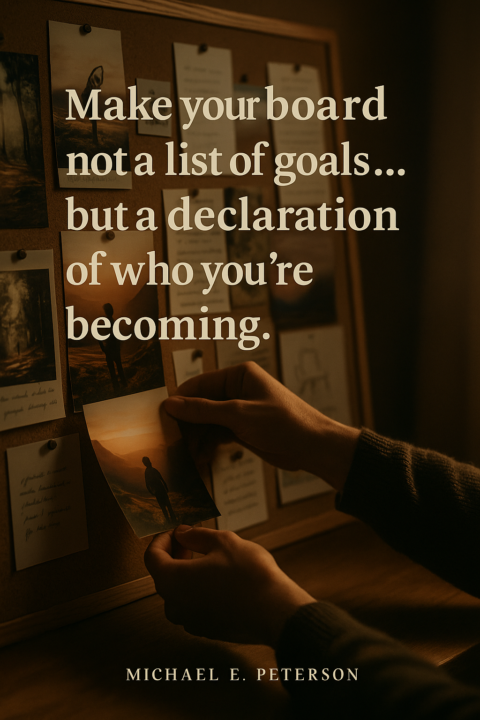
Most people fill their vision boards with things they want — the dream house, the perfect relationship, the number in their bank account. But a powerful vision board isn’t about decoration — it’s about alignment. Every image, every word, every color you choose should do two things: 1️⃣ Evoke your vision — it should stir something in you, emotionally and energetically. 2️⃣ Support your vision — it should remind you of who you are becoming, not just what you’re chasing. When you look at your board, it shouldn’t feel like a wish list, it should feel like a reflection — a mirror of the life you’re stepping into. If a picture doesn’t move you, if a word doesn’t resonate, it doesn’t belong there. Your board isn’t about impressing anyone else — it’s a sacred space between you and the version of you that already lives that reality. So today, take a few minutes to sit with your board. Ask yourself: - Does this image represent what I truly desire, or what I’ve been told to want? - Does it help me feel my future — or just think about it? - Does it hold energy that uplifts, inspires, or strengthens me? The most magnetic vision boards are alive — they pulse with the emotion of a life already in motion. ✨ Make your board not a list of goals… but a declaration of who you’re becoming.
2
0
1-10 of 10
skool.com/psychic-graffiti-manifesting-4972
A space for seekers to explore energy, intuition, and manifestation with clarity, purpose, and truth.
Leaderboard (30-day)
1

+2
2

+1
Powered by