
Write something

15d •
Week 2 Hole/Concept Breakdown (Early)
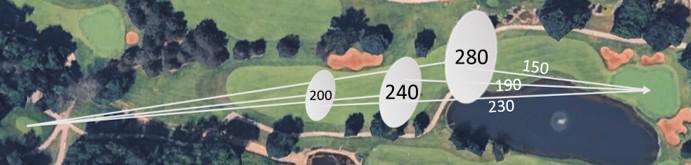
I am breaking down this week's concept early! This is hole 18 at my home course, Millwood Golf and Raquet Club. A great hole, which measures roughly 430 yards with a very teachable risk to reward concept. 1. The target number to hit on this hole is around 240-245 from that tee box. 2. This number clears the possibility of fairway bunker or water hazard off the tee with a good swing. 3. Leaves a manageable number to the center of the green while taking out as much trouble as possible. If you were to hit your well struck drive 280, half of your shot dispersion is in the water hazard. Penalty shots are the #1 cause of double/triple bogeys. If you were to hit your drive into the fairway bunker, the average 10 handicap player in that position would average 4-4.5 strokes to get the ball in the hole from the bunker. The harder a swing off the tee, the wider of a dispersion pattern, therefore bringing more trouble into play. The best golfers in the world do not swing 100% on every swing due to this, they train their entire life swinging roughly 80-85%. Hard, but still in control. In your opinion, given that the 240-yard shot off the tee is the lowest probability of double or worse, what option do you think is the highest probability for double or worse?
0
0
16d •
Tee Box Decision Breakdown
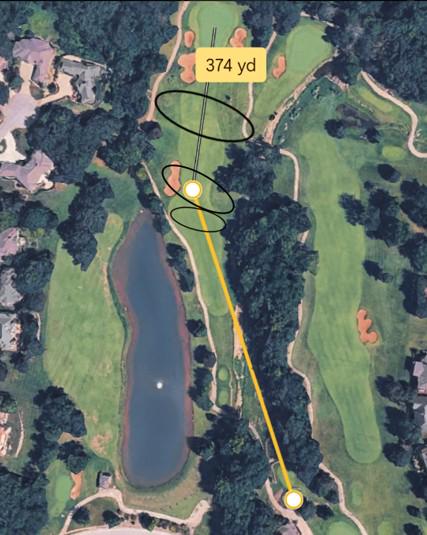
This is hole #1 at Millwood Golf and Racquet Club in Springfield, MO. This hole is a perfect risk to reward shot tee shot decision that needs to be thought about. 1. This hole only plays roughly 375 yards, so a short, relatively easy par 4. 2. The fairway is not the widest, but the rough is forgiving before you start flirting with the creek on the right and the OB on the left. 3. The circles are shot dispersions with different clubs. How they work is a separate issue, but the top circle is driver (300yds), 2nd is a wood or hybrid (250yds), and bottom is a longer iron (200-225yds). 4. This hole looks daunting from the tee, making you think that you should try to miss the bunker with a shot that ends up even with it. But this play actually is the hardest shot to pull off because the fairway width is the narrowest even with the fairway bunker. 5. The circles with the most room for error are circles #1 and #3 because of the wider fairway, and no risk of ending up in the bunker. WE ALL HATE FAIRWAY BUNKERS! So, this hole either demands a smart layup tee shot around 150 yards to the center, or a confident driver up past the bunker to leave a short wedge shot onto the green. Hitting the fairway with 150 yards to the pin or the rough with 75 yards to the pin have a much less likelihood of making double then trying to hit the slim part of the fairway at 260 and ending up in the fairway bunker. These decisions either get your round off to a GREAT start, or one that will make you wish you had a mulligan in your back pocket. Reflecting on yourself, which is the likely option for you when stepping up to a shot like this?
Poll
1 member has voted
17d •
Why We Don't Auto-Hit Driver
Most golfers stand on the tee and ask one question: “How far can I hit this?” Inside this community, we ask a better one: “What’s the smartest way to play this hole?” This community isn’t about swing changes or chasing perfect shots. It’s about learning how to dissect a hole, manage risk vs reward, and make decisions that actually lower scores over time. The goal is simple: Fewer doubles More stress-free pars Smarter birdie chances These are 5 points of emphasis to take into consideration for every hole to be played: 1. Let the Hole Shape Dictate the Strategy 2. Identify the No-Go Zones 3. Compare Risk vs Reward (With Math, Not Ego) 4. Trust Your Shot Pattern, Not Your Intent 5. Commit Fully to the Smart Play Adding all of these into your process before beginning the play of a hole will not only help make play of the hole more smoothly but make the game more stress free by giving yourself more chances for birdies and take away a lot of risk of those dreaded double bogeys.
0
0
18d •
Week 1: Smarter Tee Shot Decisions
This week we’re focusing on tee shot decisions, not swing mechanics. Most double bogeys start on the tee because of ego, not ability. One simple rule to start using immediately: If trouble brings double into play, the longest club is usually the wrong choice. This week, pay attention to: • Where your miss actually goes • Which holes punish driver • When position beats distance If you have a hole where driver keeps costing you strokes, post it in Member Scenarios and we’ll break it down.
0
0
1-4 of 4
powered by

skool.com/plr-golf-6424
“Helping mid-handicap golfers make smarter decisions, avoid blow-up holes, and shoot lower scores.
Suggested communities
Powered by