8d (edited) • Interests 🎨
Climbing the Tower of Babbel
When I turned 18, I was faced with the sophisticated choice every American teenager is meant to make with extreme clairvoyance and levelheadedness.
Go to college
or
Go to work
In the contemporary professional climate, both choices are laden with their own respective risk. Over-qualification seems to be a phenomenon in the developed world, while higher education offers unparalleled social & educational development, it continues to be framed as the “safe bet” in the prevailing narrative.
Influenced by my father's "get up & go" old school American bootstrap values, I decided take the road less traveled and get to work.
I moved around the continental US for a while, exploring different career paths trying to find my place.
I held a couple different jobs, I was:
- a bouncer at a famous Jersey Shore nightclub
- a Los Angeles mailroom clerk
- a roadie for a Hasidic DJ for weddings in Brooklyn
- a hillbilly carpenter
- an assembly-line worker in a solar panel factory
But after a while, I eventually got my "big break."
At 21, I was hired as a junior project manager for a residential construction company in the upscale neighborhood of Rumson, NJ. I was making what felt like serious money at the time: $16.50 an hour.
Very quickly in my new position, I realized that I had a lot to learn.
I had some experience with woodwork & light electrical, but I was employed by a general contractor. I needed to know a little of everything to communicate between subs, keep track of projects, and be a point of contact for the homeowner.
I had no particular edge, so I got to looking.
I began to realize that (at least within the northern Jersey shore area) different cultures occupied different trades in the construction industry.
It tended to loosely follow this structure:
- Millwork & Finishing: Eastern European (Slavs, Poles, Slovaks)
- Framing, Gypsum, & Roofing: Latinos (Mexicans, Guatemalans, Salvadorians)
- Flooring: Brazilians
- Masonry: European Portugueses
- HVAC, Electrical, Plumbing, & Insulation: Americans
Since my role was to help my boss coordinate all of this, I chose to specialize in communication.
After spending everyday talking with all of these subs, solving disputes between them, & representing them to the homeowner, I eventually became very skilled in languages.
It was interesting how it created an English "Pidgin" language on the job sites, similar to how international crews on boats communicate with each other.
It eventually sparked my interest how these languages even came to the "New World", & I became fascinated with the age of exploration. I read fervently about Magellan, de Gama, Colombus, Hudson.
For the past couple years now, I've been developing this skill, & it's opened the world up to me. Especially new ways of thinking about things, & understanding people on a deeper level living in Mexico, Brazil, Portugal, & Spain.
Portuguese is my strongest foreign language, closely followed by Spanish.
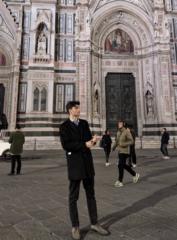
I live in Italy now, where I'm doing a Master's degree in Marketing while studying both Italian & Latin.
I’m fascinated by the way the Romance languages interact, their quirks, their shared roots, and their subtle divergences. The same idea can take on entirely different shapes depending on where you are.
But it also revealed something to me that a lot of people in today's world miss.
I find English to be the most beautiful & interesting language on Earth.
Almost every common concept in English has both a Germanic and a Latin counterpart, and the choice between them is rarely neutral.
The Germanic words tend to be concrete, physical, and tied to lived experience. They come from the language of labor, home, and survival.
The Latin words arrive later, through education, law, religion, and administration. They sound more abstract, formal, and distant.
A carpenter doesn’t fabricate a structure; he builds it.
He doesn’t commence a task; he starts it.
He doesn’t perform a modification; he fixes something that’s broken.
The Germanic vocabulary lives at eye level, close to the hands. It names things you can touch: wood, beam, board, nail, saw, roof. These are short words, often one syllable, shaped by mouths that had to speak quickly over noise and weather.
The Latin equivalents - construction, material, structure, fabrication - operate one step removed. They describe the same reality, but from above, as if looking down from a drawing or a contract rather than standing on the job site.
This dual vocabulary allows English to do something unusual. It lets us describe the same act in two registers at once: the physical and the conceptual. A house can be built by workers and constructed by a firm. One word belongs to the body; the other to the institution.
That split mirrors the history of English itself: a Germanic language spoken by laborers, overlaid with Latin and French by clergy, lawyers, and administrators.
English never chose between them. It kept both.
10
12 comments
Climbing the Tower of Babbel

skool.com/notes
The nationwide network for mortgage note investing: learn the best (and under-the-radar) way to profit from Distressed & Cash-Flowing Real Estate.
Leaderboard (30-day)
1

🔥
+424
2

+275
3

+261
4

+74
5

+70
Powered by