

5d •
Laying the Foundations for Location Freedom — Transitioning from Corporate
Hi everyone 👋 My direction is to build location freedom. This year, I’m laying the foundations to transition from corporate finance and create a non-location-dependent business. After 25 years in the corporate world, this feels like a conscious and well-timed shift. I’ve already reduced my working hours and I’m retraining while setting up my business, with the goal of completing this transition this year in a thoughtful, intentional way. For those of you who’ve already made the move (or are in the middle of it): What did you personally find hardest during your transition to location freedom? And what do you wish you had known earlier? I’d really appreciate your insights.

5d •
English Loses Appeal as China’s International Schools Scale Back
A recent blog (below) has raised concerns that English language learning is losing its appeal, and some schools around China are starting to scale back there businesses, as Chinese families curb there enthusiasm towards English being an essential tool as the gateway into Western Universities and schools. Where the stay raise teachers stress levels, for me it screams more students will seek alternative ways of learning English. Plus the report goes on to say that STEM (STEAM) subjects are now becoming a mainstay of what Chinese families are seeking for their younger children, again another subject to which to offer services too. Prestige Fades as International Schools Scale Back China’s international school market, which expanded rapidly for more than a decade, is now entering a period of contraction. As concerns grow over school governance and the perceived return on investment, enrollment momentum has slowed noticeably. Not long ago, families in major urban centers such as Shanghai, Beijing, and Shenzhen routinely paid tuition fees exceeding 300,000 yuan per year in hopes of securing admission to leading overseas universities. That enthusiasm has since cooled. Education sector data shows that the total number of international schools in China began declining in 2023 for the first time. Several high-profile institutions run by overseas organizations from Europe and North America have either shut down or reduced their presence. In mid-2024, a large international academy in Shenzhen closed abruptly despite enrolling more than a thousand students. When refunds were delayed, groups of parents organized public demonstrations demanding reimbursement. Since then, the city’s international school count has fallen sharply from its previous peak. Reports also suggest that at least one foreign education group operating multiple campuses nationwide is reassessing its footprint. Staffing Challenges Intensify Amid Geopolitical and Pandemic Aftershocks Geopolitical friction between China and the United States, combined with the long-term effects of pandemic-era restrictions, has significantly reduced the number of experienced foreign educators willing to work in China. Industry observers report a sharp decline in the proportion of teachers who are native English speakers compared with pre-pandemic levels. Frequent staff turnover has become a growing concern. In some schools, parents report that subject teachers are replaced repeatedly within short periods, disrupting academic continuity and weakening instructional quality. As the expatriate population shrinks, the student mix has also changed. Non-Asian international students now represent a much smaller share of enrollment, prompting debate over whether some schools can still maintain a genuinely international environment. At the same time, disputes involving student safety and discrimination have attracted attention online. Parents have raised complaints about inadequate oversight and unresolved bullying incidents, further undermining trust in school administration.


8d •
Internet behaviour of westerners in China?
I tried to post this in the Warrior Forum, but the admins rejected it stating that their forum isn't for surveys. I am looking into the internet behaviour of Westerners who live within China. I appreciate that due to the great firewall and some other restrictions, Google, Facebook, and other large western sites are not accessible without the use of a VPN or the right Esim. However, I would like to know what westerners' typical behaviours are, when accessing the internet in Mainland China. Do they typically: 1. Access their western EMAIL; Can they access their Gmail inbox (or similar) on their phone or computer [with or without a VPN]? 2. Access a China-friendly EMAIL instead, while in China? 3. Use Google to perform regular Web Searches [with or without a VPN]? 4. Use Baidu [Chinese search engine] to perform regular Web Searches [with or without a VPN]? 5. And; what Social Media sites (like Facebook, etc) do they access on a regular basis [with or without a VPN]? Any feedback would be welcome. Thanks for reading

15d •
Merry Christmas, everyone! 🎄
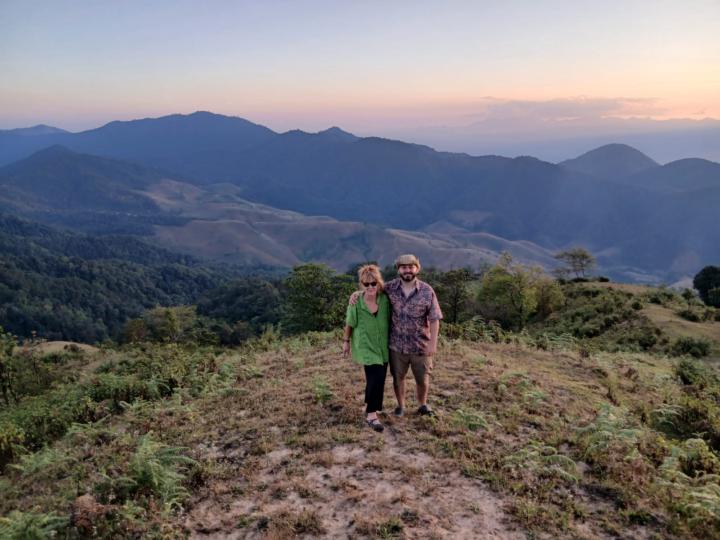
I finally found enough signal to send this out! We’ve been spending Christmas week deep in my wife’s village where there is absolutely no cell service or internet. It’s been amazing to completely unplug, and I was even able to bring my mum along for the trip. I’m posting a few photos of our time off the grid below. Now that I’m reconnected... what is everyone doing for their Christmas?
12d •
Old Thailand brought back to life
So I have a huge collection of photos from Thailand back in the day. Thought it would be cool to use AI to bring them to life 😃

1-30 of 942

Leaderboard (30-day)
1
+49
2

+32
3

+27
4
+26
5

+14
Powered by