

6h •
Affirmations 101: The Why, What and How answered.
Affirmations get a bad reputation because most people are taught to use them wrong. Let's break down what's actually happening, why they fail, and what to do instead. The Science Behind It Your brain has a filter called the Reticular Activating System (RAS). Its job is to decide what's important enough for you to notice out of the millions of data points around you at any moment. Repeated statements — said with real belief — train that filter to start noticing evidence that matches them. This is why two people can be in the same room and one sees opportunity while the other sees obstacles. It's not luck. It's the RAS at work. But here's the part most affirmation practices leave out: your nervous system doesn't respond to words. It responds to patterns and felt safety. If your body is in a stress response while you're saying "I am wealthy and safe," your nervous system reads that as a mismatch — not a truth. And a mismatch doesn't get encoded as belief. Common Ways Affirmations Are Practiced - Saying a fixed statement in the mirror daily ("I am a millionaire") - Writing the same sentence repeatedly in a journal - Repeating affirmations passively in the background while doing something else - Using very general, big-leap statements borrowed from social media When and Why It Doesn't Work - The statement is too big a leap. If it contradicts what you currently believe, your brain will argue back every time you say it. - It's said in a dysregulated state. Rushed, anxious, or distracted repetition doesn't encode the same way as regulated, present repetition. - It's used to bypass a feeling. Saying "I am not anxious" while anxious is suppression, not affirmation. - There's no evidence attached. Repetition alone doesn't build belief. Repetition plus proof does. What To Do When It Doesn't Work 1. Change the statement. Instead of "I am a millionaire," try "I am capable of figuring this out." It should feel believable, not aspirational fiction. 2. Regulate before you affirm. A few slow breaths or a grounding moment before you say it changes how your nervous system receives it. 3. Attach evidence. After saying it, name one small real thing from your life that supports it. 4. Feel first, affirm second. Process what's actually there before reaching for the identity you're building toward.
Poll
1 member has voted

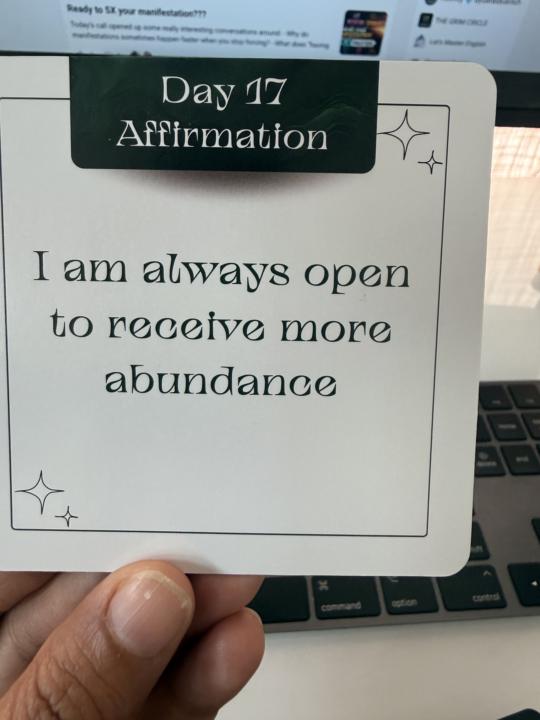
Mar 2 •
Let’s Reflect
Comment the first thought that comes to your mind And then I will guide you from there ..
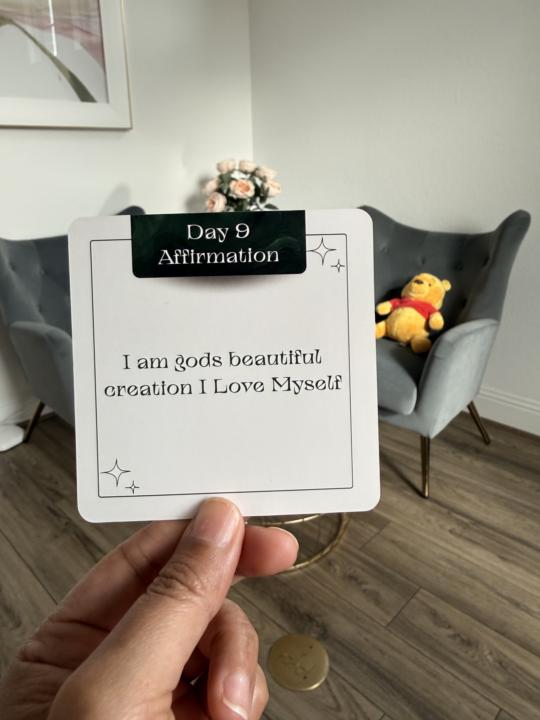
Dec '25 •
Affirmation of the day and the Method
Hey ladies the affirmation for the day is posted below. This is how I want you all to go about it: The idea for affirmation is repetition for sure , however I also want you all to be aware of what thought comes to you when you say it? “ Neah that’s not true” “Or if only it loved me” “ well I love many other stuff I am not selfish to love money” “ this is false” “You might feel resistance in saying it out loud” Just notice stuff and share here, it’s great information we will take it from there to alchemize it in our favour Love Aparna

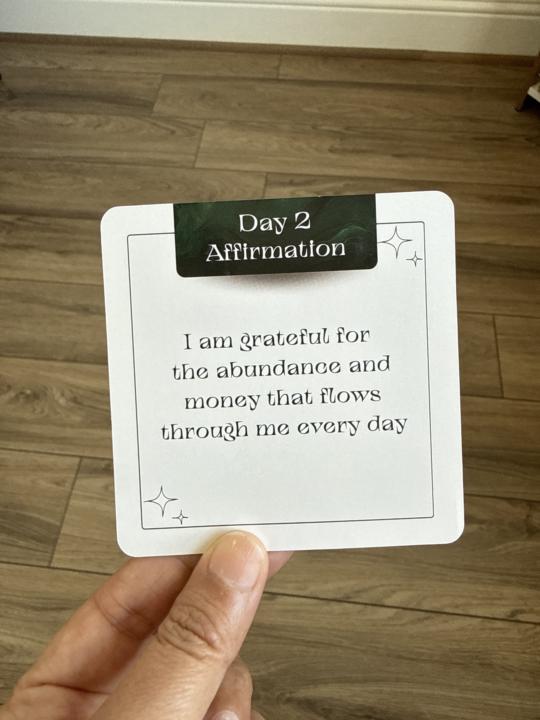
Dec '25 •
Affirmation of the day
Keep the awareness s/w on repeat this one and share what comes up? Another nicer way to keep the critical mind at peace is to change the affirmation into a question. In this case what form of abundance is flowing through me that I am grateful for? I also recommend keeping gratitude notes on your phone and atleast 1once preferably 2wice a days add some thing to it .. it can be as simple as clean air Do share what you notice ..
2
0
1-5 of 5
powered by

skool.com/nextlevelmanifestors-1225
Manifestation that actually works — because it starts with the nervous system. For women entrepreneurs. Neuroscience and Energy backed Business Coach
Suggested communities
Powered by