
Write something

Apr 13 •
Hi everyone.
Hello and welcome to the news members. Just passing to share a new experience. Does any one used Ghee’s butter in any type of formulation?!? I did and must say what a fast harden soap type... Now I’ll try to use in a facial cream because it’s fatty acid profile it’s amazing for hiper pigmentation issue. If you tried, I would love to know your experience. Happy formulations everyone 🫶🏾

Mar 31 •
Hi friends, hope y”all ok.
Hello everyone, how are you doing? A warm welcome to all the new members! I’d love to share another soap experience with you. Recently, I tried making a menthol salt soap bar, but I lost three batches because I forgot to cut the soap in time. Salt bars harden very quickly, so it’s important to check them within 4–5 hours after pouring. I left mine for 12 hours, and unfortunately, the soap crumbled apart. So, if you plan to make a salt bar, please keep this in mind and avoid the same mistake. I’ve also had a few questions about the amount of water used in soap making, so here’s a helpful tip: In soap making, we use a water-to-lye ratio. The minimum amount of water needed is equal to the amount of lye, which is called a 1:1 ratio. Some soap makers recommend a 2:1 water-to-lye ratio for the cold process and 3:1 for a hot process, but this is not a strict rule. The amount of water you use is completely up to your preference. Personally, I prefer using less water because it shortens the curing time and helps prevent glycerin rivers. My formulation also depends on what I want to create, whether it’s detailed designs, layers, or a simple soap. It also depends on the types of fats I use. If I use a higher amount of saturated fats (solid at room temperature), I may use more water. If I use more unsaturated fats (liquid at room temperature), I tend to use less water. I know many of you have experience in soap making, and I would love to hear your thoughts. What water ratio do you usually use? And don’t forget to share your soaps or any other formulations. Love Petra, Afro-Beauty Academy
2
0
Mar 25 •
Tip for you.
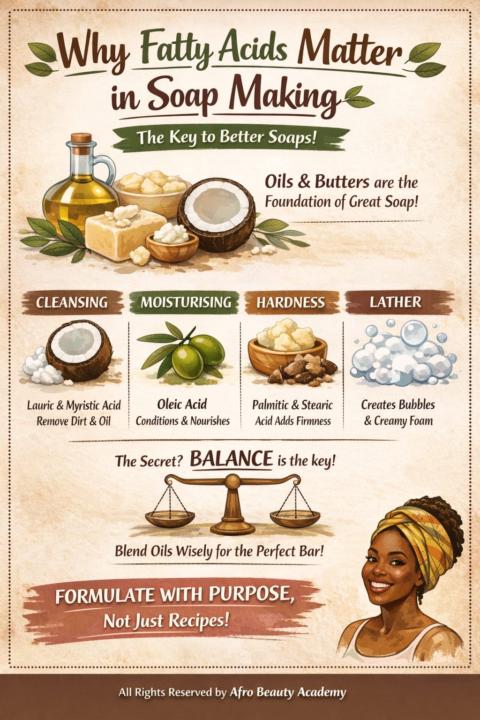
Hi my friend, how are you all doing? First, I wish to give the new members a very worm welcome. I am extremely excited to have you all on board. Now, let talk about fatty acids. What are they?!? A fatty acid is a carboxylic acid with an aliphatic chain, which is either saturated or unsaturated. 🌿 Why Fatty Acids Matter in Soap Making 🌿 When it comes to creating beautiful, high-quality handmade soap, understanding fatty acids is a game changer. Oils and butters are not just ingredients—they are the foundation of your soap. Each one is made up of different fatty acids, and these determine how your soap will perform. ✨ Why are fatty acids so important? Because they have different qualities and properties. Example: ✔️ Cleansing – Fatty acids like lauric and myristic (found in coconut oil) help remove dirt and excess oil ✔️ Moisturising – Oleic acid (in olive oil) gives your soap a gentle, conditioning feel ✔️ Hardness – Palmitic and stearic acids (in butters like shea) make your soap firm and long-lasting ✔️ Lather – fatty acids like MYRISTIC ACID and LAURIC ACID create fluffy bubbles, while RICINOLEIC ACID gives creamy, stable foam. 💡 The secret for a good soap? Balance and synergy. Too much cleansing can dry the skin, while too much conditioning can make soap soft and short lasting. The magic happens when you blend oils wisely to create the perfect bar. 🌸 Remember: Every oil and butter brings something unique to your formulation. Learning fatty acids helps you formulate with purpose, not just follow recipes. ✨ This is how you go from beginner to confident soap formulator. Happy Formulations. 💛 Petra, Afro Beauty Academy
Mar 9 •
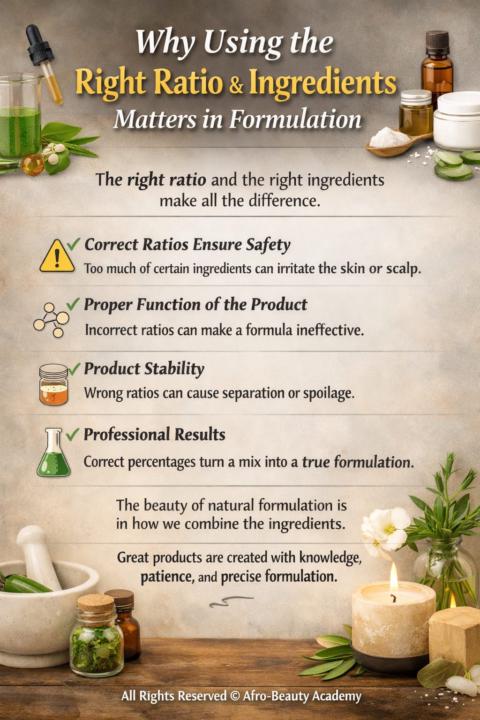
Why Using the Right Ratio & Ingredients Matters in Formulation
Hi everybody. Why Using the Right Ratio & Ingredients Matters in Formulation When creating skincare, haircare, or soap products, the right ratio and the right ingredients make all the difference. Many beginners believe that if an ingredient is natural, they can use any amount. But in formulation, balance is everything. ✔ Correct Ratios Ensure Safety Too much of certain ingredients (like essential oils, acids, or active ingredients) can irritate the skin or scalp. ✔ Proper Function of the Product Each ingredient has a role , some moisturize, some stabilize, and others preserve the product. If the ratio is wrong, the formula may not work as expected. ✔ Product Stability Incorrect ratios can cause separation, spoilage, or reduce the shelf life of your product. ✔ Professional Results Using the correct ingredients in the correct percentage is what separates a homemade mixture from a professional formulation. As formulators, we must respect the science behind every ingredient. The beauty of natural formulation is not only in the ingredients we choose, but in how we combine them. ✨ Remember: Great products are created with knowledge, patience, and precise formulation. ✨Always make sure your scale its working properly. Sense the Castile soap I formulated 4 new recipes soaps. Now have soaps till 2040 🤭. Happy formulations. Can’t wait to see your creations. Stay tune Love Petra Afro-Beauty Academy❤️❤️
Feb 7 •
🧼 Soap Making Tip of the Day
Great soap starts with one simple rule: measure all your ingredients, don’t guess! Soap making is chemistry, and every gram matters. Using a digital scale ensures your oils, butters, and lye are perfectly balanced—giving you a safe, beautiful bar every time. Whether you’re a beginner or already experimenting with recipes, treat every batch like a mini science project: ✔ Weigh accurately ✔ Take notes ✔ Learn from each batch Creativity + precision = amazing handmade soap 💚 — Afro Beauty Academy
1-6 of 6
powered by
skool.com/natural-formulations-8210
"Become a confident natural formulator. Create safe, effective skin & hair care products with step-by-step guidance. Join beginner-friendly community!
Suggested communities
Powered by