
Write something

Feb 2 •
This is How Batman Must Feel
I casually open my inbox early this Sunday afternoon, when amongst the usual promotions and updates from software I’ve long since forgotten I downloaded, one email makes me sit up and set my tea down on the table with a loud clack. Sunday 25th Jan, 12.31: Victor – What do you think about retake classes? “Victor? Jeez, I haven’t spoken to him since the summer!” This is classic Victor. For the next 20 minutes we exchange a rapid barrage of emails, by the end of which we have booked his classes for the next week. All 5.5 hours of them! You see, the first time Victor contacted me, he was in a similar tight spot. Tasked with teaching a university course in English at short notice, he found himself woefully underprepared and massively under pressure. This is what I like to call a BSEE – Big Scary English Emergency. It’s the best motivator known to humankind for starting English classes. And this time, Victor found himself in a similarly dramatic predicament. About halfway through his 3-hour private class on Wednesday (which was a surprisingly comfortable experience for both of us), I realised we had something in common. Victor and I both like to do our speaking practice in bursts of high intensity. Don’t get me wrong. Both Victor and I can be very consistent in attending weekly classes. But when we have the time, we both love to turn up the intensity. Back in the summer of 2016, when I was trying to go from zero Portuguese speaking experience to conversational, I did up to 5 hours of conversation a week. It was a mix of classes with teachers and language exchanges with a lovely guy from Rio de Janeiro. And more recently, after 15 years without speaking Mandarin Chinese, I’ve slowly increased my practice from 2 hours a week in September to 4-6 hours a week today. I think I must like the adrenaline. Or the rapid progress. I’m not sure. But I’ve seen both approaches work well for learners. Marta, for example, was a student of mine and an incredibly busy HR manager. Every week, same day, same time, she came to her 1-hour conversation class without fail. Eventually, she completed well over 100 hours this way. It was only when she gave birth to her first baby that this schedule finally became unmanageable.
1
0

Jan 24 •
Teaching English in the ‘Most Depressing’ Week of the Year 😉
For some, learning English is a serious matter. But try telling that to Gema and Ion. It’s a cold and grey Wednesday afternoon, but the moment Gema joins my Google Meet it is obvious today is not a day for negativity. She bounces in wearing a big beaming smile and a neon blue wig, and I’m instantly in a better mood. “Did you remember our plan for today?” she asks, pointing at my rather drab grey jumper. “Oh no! Sorry, I forgot!” You see, last week we discovered that the 3rd week in January is the most depressing week of the year, at least according to the article we read. “Screw that!” we both decided. So instead of letting the winter blues take control, we hatched a plan to dress up in our craziest, most colourful clothes this week in an attempt to cheer ourselves up. But we would say nothing to Ion. “I just want to see his reaction,” said Gema, with a mischievous glint in her eye. I quickly run to my wardrobe and grab the most colourful thing in there – a multicoloured snood – and stick it on my head. Seconds later Ion joins us. He isn’t usually lost for words, but I think we managed it this time. Five minutes later, as Ion is sharing some micronews, he suddenly stops in mid sentence and starts to laugh. I’m busy writing something in our shared Google doc, so at first, I don’t know why he’s laughing. I open the Google Meet window again and I see it. Gema’s grin is even wider now. Perched atop her head is a unicorn horn and an array of brightly coloured flowers. I’ve spoken with these English students for a combined total of over 200 hours, but THIS is the moment we discover the special filters in Google Meet. For the next half hour we explore ALL of them. After many “Oohs” and “Aaahs”, Gema finally settles on an aquatic background complete with an animated octopus resting on top of her blue wig. Ion finally settles on the pirate filter. We all agree that the black beard really suits him. I’m torn between the film noir detective and the handlebar-moustached cowboy, but it is the cowboy that wins in the end.
3
0

Jan 3 •
A Tiny English Mistake That Survived For 30 Years
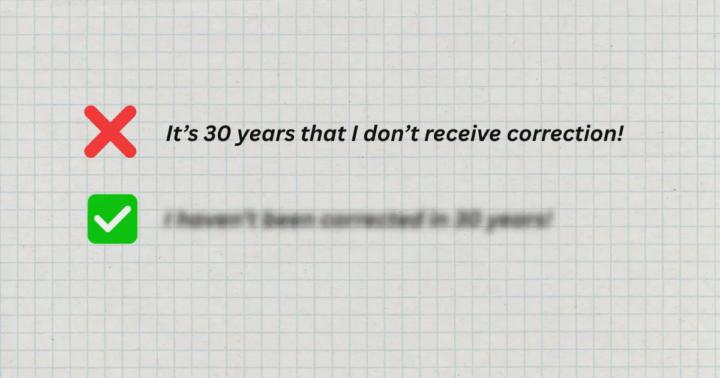
“I haven’t been corrected in English for 30 years!” marvelled Stefania, as I adjusted something she said to make it sound more natural. To be fair, what she actually said was closer to: “It’s 30 years that I don’t receive correction” which, as a slightly ungrammatical English sentence, I also had to correct. Towards the end of our 1-hour conversations, just before we correct any mistakes together, I like to repeat the point that 95% of our mistakes will be corrected by reading and listening. It’s kind of an annoying mantra of mine. This isn’t an empty promise or motivational fluff. It’s exactly how we learn our first languages. We hear something often enough, and eventually the wrong versions just stop sounding right. But Stefania had hit the other 5%. Without explicit correction, or feedback in some other form, it is unlikely she ever would have noticed her error. I’ve forgotten the actual mistake Stefania made, but here’s how it happened: Learners see and hear lots of correct English sentences. 👀👂 ➜ ✅✅✅ But they never see “This sentence is impossible in English.” 🙈 🚫❌ So their brain thinks, “I don’t hear this much, but maybe it’s still OK.” 🤔🤷♂️ For Stefania, she was able to communicate her ideas extremely well for years. Decades even. But she was never told that her Italian sentence pattern in English was wrong. Without correction, the old Italian pattern stays. You used to need a teacher, or a particularly pedantic English speaker willing to risk a punch to the jaw to point out your errors. But these days, with AI and grammar-checking software, even the most insidious 5% of errors have nowhere left to hide.
1
0
Dec '25 •
Almost Rich: Two Family Stories
A student of mine, Stefania*, surprised me with the story of her family lineage this week. We had been talking about her hometown, the birthplace of a famous Amaretto brand, when she revealed that the brand in question was actually founded by her family. “You must be rich then?” I joked. She gave a little wry smile before lamenting that her side of the family had sold their share of the company a long time ago. Long before the real money was made. This family connection is now so weak that they turned down a job application she once made without so much as an interview. Remarkably, my brother-in-law has almost the exact same story. In his case, his family line sold their share of a now internationally famous honey brand. To an observer from the UK, my brother-in-law would instantly be labelled as ‘posh’ – a term loaded with connotations of class and generational wealth. His pronunciation, vocabulary choices, and even his dress sense act as clues to his background. Stefania would never describe herself as one of ‘them’, but she also occasionally mixes with Italy’s ‘posh’ society. As she tells me in our conversations, the norms of behaviour and morality don’t seem to apply in quite the same way for many of these ultra-wealthy individuals. The thing that impresses me about Stefania and my brother-in-law however, is that they are both such down-to-earth, hard-working, likeable people who have cut their own paths in life. It’s also a pleasure to spend time in their company. But the question I ask myself is this: would they be such good people if they had inherited family wealth? I really don’t know the answer. *Name changed to protect identity.

1-4 of 4
powered by

skool.com/my-english-habit-8831
Finally understand native speakers! One video (and popcorn) at a time.
Suggested communities
Powered by