
Pinned

Mar 20 •
Most people are still building websites…
Built something different. 👉 https://youtu.be/hBgxtN4hI40 An AI worker that lives on your website and actually does the work: talks to users understands context captures intent improves over time Not a chatbot. Not a static page. ---------------------------------------------------------------------------------------------------------------------------------------------------------- This shift is happening now: Websites → AI workers Clicking → Conversing Browsing → Getting things done ---------------------------------------------------------------------------------------------------------------------------------------------------------- Best part? Minutes to deploy — not weeks. So now: solo builders can compete with teams small businesses can automate front desk + sales your site becomes an active system, not a brochure ---------------------------------------------------------------------------------------------------------------------------------------------------------- I’m building this with Zulu Launchpad and testing it live. Curious 👇 If you had an AI worker today… what’s the first job you’d give it? ---------------------------------------------------------------------------------------------------------------------------------------------------------- 🚀 CTA: Join tomorrow’s Builder Session → get access to Zulu Launchpad Use it. Land clients. Charge ~$100/mo per site. #AIagents #AIautomation #NoCode #StartupTools #EdgeAI #Web3
Pinned
Mar 7 •
Quick update for the Lab.
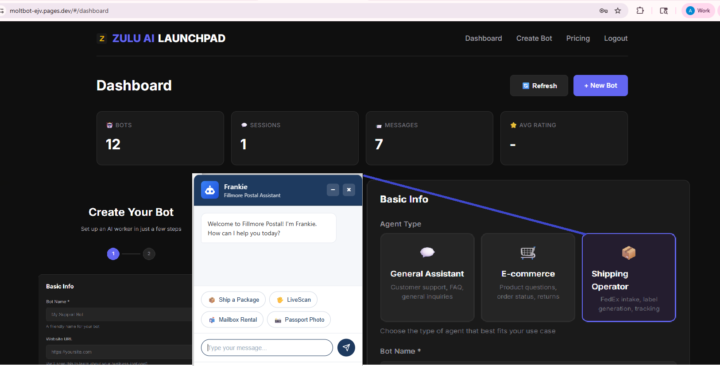
Recently someone reached out and offered to buy the AI + Automation Lab. I took it as a compliment — it means what we’re building here has real value. But the answer was no. The Lab was never meant to be flipped or turned into another subscription funnel. The goal has always been to build a place where people can learn, experiment, and ship real AI systems together. That’s also why the community will remain free forever. The only cost of admission is participation. What I’m more excited about right now is what we demoed on the Builder call today: ZULU Launchpad. Launchpad is the tool we’re building to help members here modernize websites with agentic AI. Instead of just learning about automation, you’ll be able to actually deploy AI workers for businesses — answering questions, guiding customers, and automating operations. My hope is that many of you use this to start your own AI implementation services and make real money helping businesses adopt AI. So the Lab isn’t just a community. It’s becoming a builder network for deploying agentic systems in the real world. We’ll keep building this in public and shipping together. More demos of ZULU Launchpad coming soon. Let’s get to work.


Oct '25 •
Open Ai agent
Hello, I am sandra. I joined out of curiosity for the new open Ai agents flow. Words on the street says it is easier than n8n. I have tried multiple times to learn n8n and it just seems so difficult. To the experts in the room can I have simple executions with gpt agent flow? Thank you

🔥
22d •
The hidden cost of building alone
There’s something I’ve been thinking about lately. The hardest part of building software today isn’t always the code. It’s navigating the ecosystem around it. You scan open-source projects and discover unexpected dependencies, hidden doors, licensing layers, telemetry, token economics, and architectures designed around extraction. You move to cloud tools and slowly realize that your work, your prompts, your workflows, your experiments, and sometimes even your skills are becoming part of someone else’s learning and business engine. And as a solo builder, you’re expected to keep producing faster and faster — while the value you create is constantly flowing upward. That creates a strange paradox: **We are given more powerful tools than ever, while becoming increasingly dependent on systems we don’t control.** I’ve been feeling this deeply while building my own systems. I’m not trying to build another machine that extracts attention, data, money, or cognitive energy from people. I’m trying to build something regenerative — technology that gives some of that capacity back. Something that helps people protect their autonomy, their attention, their cognitive stability, and ultimately their ability to create. Maybe that’s why building it feels so difficult. You’re not just building software. You’re pushing against an entire economic pattern. And sometimes it feels like Big Tech is very good at feeding on the people who have the least room to spare. I don’t have a perfect answer yet. I’m just convinced that the next generation of builders has to ask a different question: **What if our systems were designed to regenerate value instead of extracting it?** That’s the direction I’m choosing to explore. Quietly. Seriously. One system at a time. 🌱
1
0
1-30 of 117
skool.com/my-ai-automation-lab
Build AI agents, automations, and businesses. Stop using AI for tasks. Start architecting systems that work without you.
Leaderboard (30-day)
1
🔥
+1
2

+1
Powered by