
Write something

4d •
KubeQuest and how it made my most productive week yet
In my learning journey, I never used to place much emphasis on setting weekly goals. This time I did, and it changed the trajectory of how I learned. For the week of December 1 to December 7, I defined three goals that I wanted to complete. Having a clear structure kept me organized and significantly improved my efficiency. 1. Finish the Ansible series I had started 2. Extend my homelab by repairing a laptop last booted in 2020 3. Install Talos on the newly fixed laptop These focused goals prevented me from jumping between unrelated tasks and helped me make more progress in one week than I would typically make in a month. I achieved all three goals and even went further. I set up a multi node Kubernetes cluster in my homelab, enabled secure remote access to my Talos cluster from any network using Tailscale, and documented the process in a blog while exploring how Tailscale functions underneath. I encourage everyone in this community to take part in KubeQuest and experience how much your productivity improves when you commit to specific weekly objectives. Thank you @Mischa van den Burg , @Stefan Van den berg and the entire KubeCraft community for this initiative.
2d •
Google Nest Project Update
Breaking Through the First Wall Small win? Nah. This was a legit milestone. After wrestling through Google’s documentation, OAuth flows, and GCP setup, I finally pulled live JSON data from my Nest thermostat using curl. Seeing that blob show up in my terminal… felt like cracking a safe. What I learned along the way: - Navigating GCP I had to set up a full project in Google Cloud, enable APIs, link my Google Home account, and wire the whole thing together. This alone gave me a solid crash course in GCP’s structure and permissions model. - OAuth (finally clicked) Most of my past auth work has been SAML. OAuth has similar concepts, but the flow is different enough that you can’t fake it. Walking through the token exchange and scopes gave me a much clearer understanding of why modern API integrations work the way they do. - Real device integration → real data Once I completed the OAuth flow and hit the endpoint, getting that thermostat status back as JSON felt huge. That’s the “OK, now the real work begins” moment. What’s next? Now that I can authenticate and pull data, I’m starting the fun part: - Build small Python helper functions to clean and parse the data - Wrap it with FastAPI for a proper backend service - Store readings in Postgres - Visualize everything in Grafana - Run the whole stack in my local K3s cluster - Eventually test automated deployments + scaling This hits DevOps, APIs, cloud, auth flows, Python, infrastructure, and observability, all of the things I actually enjoy working on. What’s the coolest real-world device or API you’ve integrated into your homelab?
2
0

8d •
Minecraft Project Progress in my Homelab
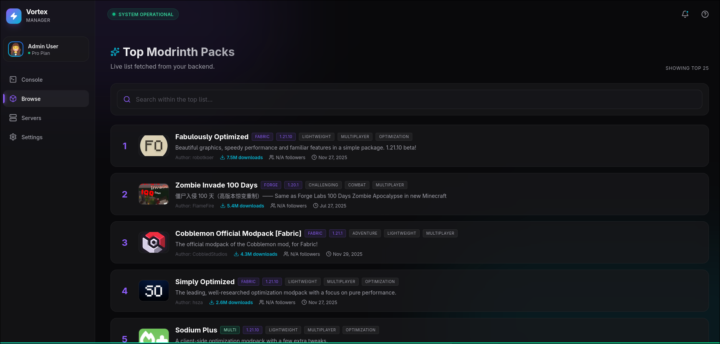
Just recently we saw what Gemini 3 Pro can do for websites. I decided that i have to use this to my advantage to build the Minecraft Server Management Dashboard of my dreams. I wanted to have my own project that i manage in a Development Environment and later send it to a Test, Production Environments to understand the big picture ideas. I got these ideas from a book i recently finished called The Phoenix Project, i'll make another post for it later in the future. So far i'm pulling modpacks via Modrinth API and be able to show every modpack's descriptions so i can understand what are their contents. Even though i'm gonna work on the website itself simultaneously, this week goals are: - On every push to Github repo, Github Actions runs tests and build docker images for backend & frontend individually then runs the containers on my server pc - Give it a domain name via reverse proxy with Nginx - Expose the metrics from containers and put them in Prometheus so i can watch them on Grafana I tweak and setup the website with AI and i like how it looks so far but the automation, the DevOps part excites me the most 😂 Can't wait to see how everything works by itself without me doing anything 😎 If you have any recommendations for DevOps structure, i'd love to hear them out. This will be my long term project for my homelab but i think it will be worth doing since it's so much fun!

6d •
The Upwork story continues...
After signing my first client with a very low budget, an old colleague contacted me on LinkedIn saying he needed help with some DevOps work. I told him I could do it — but only through Upwork because I needed help building reviews. It wasn’t a high-profile or high-budget project, but I signed him anyway. After completing these jobs, I got 5-star reviews and hit 100% JSS. And Client #1 started a long-term collaboration with me. Then the day came that every freelancer waits for — a client reached out to me on their own, without any proposal. We signed a contract on my terms. I’m now working with them and expecting more work ahead. I’m still in my struggling phase, but I love my small wins.A girl who knew nothing about freelancing left her job and started something completely new with high goals, big thinking and a persistent attitude. I believe these are small steps toward my bigger vision. I’d be more than happy if any of you take your first difficult step because of this story and if anyone needs help, I’d love to support you.

10d •
I set up DNS Filtering using my rasberry pi
Today I got my Microsd card for the Rasberry pi started reading documentation on pihole as well as a few linux commands for it to get working. Even though it is a small project im currently learning how to use unbound to locally resolve dns queries. It such a nice feeling when things start working.
1-30 of 44
skool.com/mischa
Only for DevOps Engineers
Get hired to build the future
Use the Community, Blueprint and the KubeCraft Roadmap
Leaderboard (30-day)
1

+250
2

+195
3
+87
4
+79
5

+79
Powered by