

11d •
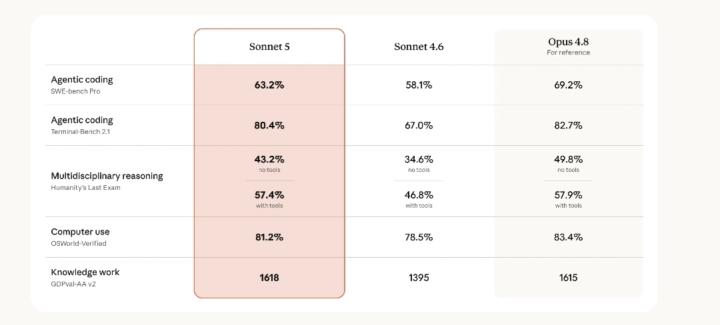
Sonnet 5
One look at these numbers and you'll see just what a good affordable model this is. 40-60% less token usage than Opus 4.8

6d •
/goal vs /loop
In Claude Code, the two most powerful commands for autonomous execution are /goal and /loop. While they might sound similar on the surface, they serve entirely different purposes. Both let Claude work without you having to hit "approve" after every step. /goal: The "Run Until Done" Engine The /goal command tells Claude Code exactly what "done" looks like and sets it loose to grind away until that condition is satisfied. How it works: Normally, Claude completes a single action and waits for your feedback. When you use /goal, you bypass this. You provide a measurable finish line (e.g., /goal the test suite passes with 0 errors). After every action Claude takes, a smaller, fast model (like Claude 3.5 Haiku) acts as an independent evaluator. It checks the current state of your code against your goal. If the answer is "no," the evaluator sends Claude back to work with guidance on what is still missing. When to use it: Use /goal when the task is iterative, sequential, and has a measurable end state. - Refactoring: /goal split this massive file into focused modules until each is under 300 lines. - Debugging: /goal fix the build pipeline until the exit code is 0. The catch: Because it loops until completion, a vaguely defined goal can result in Claude burning through tokens for hours. Always give it a finish line that a machine can objectively verify (like a passing test or a specific terminal output). /loop: The "Always On" Scheduled Worker While /goal is about finishing a one-time project, /loop is about creating automated habits. It allows you to schedule Claude to perform tasks at specific intervals without you needing to be in the terminal. How it works: You give Claude a time interval and a prompt. For example: /loop 30m check the issue tracker and triage new bugs. Claude will wake up every 30 minutes, perform the task, and then go back to sleep. You can even customize a .claude/loop.md file in your project to act as a default set of instructions for the loop to execute.
3
0
6d •
How LLMs Think
Andrej Karpathy just exposed how LLMs actually think: "LLMs don't want to succeed. They want to imitate." Karpathy reveals the full psychology of LLMs.
1
0

1-30 of 192
powered by

skool.com/mindx-academy-2491
A community for veteran and beginner entrepreneurs fueled by the challenge of building things that make a difference.
Suggested communities
Powered by