

18h •
🧪 Lab Fact Friday
Did you know? Clostridium spores are built for SURVIVAL 👀 Spores can help the organism withstand harsh environmental conditions that vegetative bacterial cells may not survive. 💡 Important reminder: A bacterial SPORE is not a reproductive structure. 👉 It’s a survival structure. That small distinction can show up in microbiology questions 🔬
0
0
2d •
🧪 Bench Tip | Suspected Anaerobes
Specimen collection MATTERS. Anaerobes don’t exactly appreciate a long sightseeing tour through oxygen. When an anaerobic infection is suspected: 🔬 Proper specimen collection 🔬 Appropriate anaerobic transport 🔬 Prompt processing …can directly affect organism recovery. 💡 Deep tissue or aspirated material is generally more useful than a superficial swab when evaluating a suspected anaerobic infection. The best identification system in the world can’t identify an organism that never survived specimen collection.
1
0
8d •
🧪 Lab Fact Friday
Did you know? The yellow “sulfur granules” seen in Actinomyces infections don’t actually contain sulfur. They’re compact collections of bacterial filaments mixed with inflammatory debris that simply resemble sulfur granules to the naked eye. 💡 That’s why they’re called “sulfur granules”...it’s their appearance, not their composition!
1
0
9d •
🧪 Bench Tip | Actinomyces
One of the easiest mistakes is confusing Actinomyces with Nocardia because both appear as branching Gram-positive rods. Here’s the shortcut: ✔️ Actinomyces = Anaerobic + Not acid-fast ✔️ Nocardia = Aerobic + Modified Acid-Fast positive 💡 When you see branching rods, always ask: “Is it aerobic or anaerobic?” “Is it acid-fast or not?” Those two questions can quickly narrow your identification.
1
0

16d •
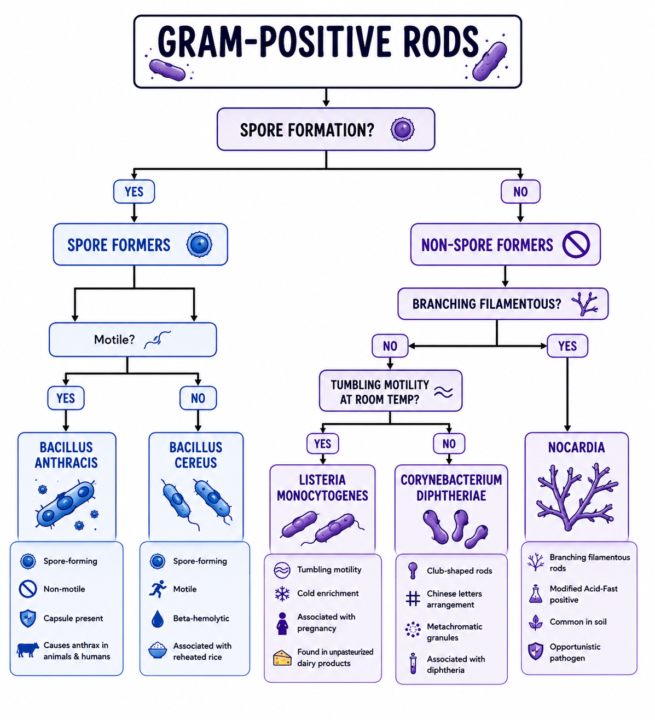
🧫 Gram-Positive Rod Family Tree 🌳
One of the easiest ways to remember organisms is to group them by their key characteristics instead of trying to memorize each one individually. Here’s a simple way to organize the five aerobic Gram-positive rods we’ve covered so far: 🍄 Spore-formers • Bacillus anthracis • Bacillus cereus 🚫 Non-spore-formers • Corynebacterium diphtheriae • Listeria monocytogenes • Nocordia spp. Once you recognize these larger groups, identifying organisms on exams becomes much easier. 💡 This one chart can help you answer a surprising number of ASCP (M) and AMT microbiology questions by narrowing down your differential before you even think about biochemical tests. 👇 What’s your favorite way to organize Gram-positive rods when you’re studying?
1
0
1-26 of 26
powered by

skool.com/microbiology-with-dede-5731
Learn microbiology the easy way. Structured notes, quizzes, and support to help you prepare for the ASCP (M) exam and other lab certifications.
Suggested communities
Powered by