
Write something

9h •
Happy birthday America ! 🇺🇸 250 years is worth something to celebrate!!
How about 25% off the site ?

10d •
Research peptides explained
If you’ve ever wondered how the heck peptides are being sold online without a prescription, here’s the red-pill answer: research-use loopholes are the only way to get around Big Pharma’s patent chokehold on nature. 🧬 Natural Molecules Can’t Be Patented—So They’re IgnoredMost peptides are not synthetic drugs—they’re naturally occurring molecules found in your body. Examples:BPC-157 – derived from gastric juices Thymosin Alpha-1 – from the thymus gland GHK-Cu – copper-binding peptide in human plasma Here’s the thing: you can’t patent nature. That means drug companies can’t make billions off most of these molecules—so they don’t invest in clinical trials. No trials = no FDA approval. No approval = no prescriptions. So what happens? These powerful, well-documented peptides are left in limbo—not illegal, but not pharmaceutical. That’s where research-only peptides come in. ⚖️ The Legal Grey Area: “For Research Use Only” To bypass this bottleneck, biotech companies manufacture peptides under the “For Research Use Only” label. This lets them sell the molecules: Without making medical claims Without violating FDA marketing laws Without needing a prescription It’s not a scam—it’s a workaround. An open channel for researchers, biohackers, and clinicians who want to explore the frontier of bioregulation without waiting 20 years for Big Pharma to greenlight it .But here’s the catch: you take on all the risk. When you buy a research peptide, you’re not a patient. You’re a researcher. No one will tell you how to use it. You must: - Study it - Understand the biology - Design your own protocol - - If you mess it up? That’s on you. If you get amazing results? Also on you. That’s why education, community, and supplier trust are everything. - - 💊 Why This System Matters - If these research pathways didn’t exist, you’d never have access to 90% of the peptides people are using today. You’d be stuck with overpriced, underperforming pharmaceuticals designed around patents, not performance.Supporting high-quality, ethical research suppliers protects this fragile ecosystem. It keeps the door open for everyone—athletes, doctors, longevity seekers, trauma survivors—anyone looking for healing outside the slow, restrictive system. - - ⚠️ Why Suppliers Can’t Tell You How to Use Peptides - Here’s the thing that trips up a lot of rookies: legit research peptide suppliers cannot legally tell you how to use the products.That means: - No dosing instructions - No medical advice - No injection guides - No “this will heal your shoulder, bro” - - And that’s not because they don’t know—it’s because if they do, they instantly cross the legal line into “unlicensed pharmaceutical sales.” The FDA will nuke them off the map faster than you can say “GLP-1 agonist.” - So the burden falls on you, the researcher. When you buy peptides under “Research Use Only,” you’re assuming all responsibility and liability. You’re not a patient—you’re a lab tech with skin in the game. Literally. - This is the legal loophole that allows private experimentation without needing a doctor or prescription. It's also why there’s a thriving peptide underground—because most of what actually works hasn’t made it through the slow, rigged funnel of FDA approval. - 🧠 Why It’s Critical to Support Ethical SuppliersIf you value access to affordable peptides, you must support clean, compliant suppliers who: - Use ISO- or GMP-certified labs - Perform 3rd-party testing for identity and purity - Avoid illegal marketing tactics - - - Otherwise, the industry dies. Or worse—Big Pharma monopolizes it. You think favorite name brand weight loss peptide is expensive now? Imagine paying $1,200/month for a 5mg peptide that costs $80 to make. - Every sketchy tiktok peptide pusher makes it easier for regulators to shut this world down. Every smart customer who buys from vetted sources keeps the door open for everyone else. - Your supplier can’t legally tell you how to use peptides—that’s your job. Learn, research, connect with trusted communities, and don’t ask vendors to break the law. Support honest suppliers to keep the pipeline alive and keep Big Pharma from hijacking

20d •
Reta 5mg/Cagri 5 mg dosing, etc vs Reta 10 mg
Kristen, I've done extremely well on my first round of Tirz but I am really curious about the Reta 5 mg/Cagri 5mg. Can you give me your take on this and the dosing please? Or would the Reta 10 mg be better? and if I stay on Tirz do I stay at the 10 mg or go to 20 mg, etc? How is that step up process? Thanks Kristen. Trying to figure out which way to go for my next order
21d •
Out until June 24th
Hey everyone! I will be out of town June 13th-24th so u wanted to let everyone know that if they need a refill or wanted to get anything, I would get your order in today or tomorrow to reduce a delay in shipment. Lalania will be able to ship some items during that time, but just in case, let’s get it out asap. Thank you all for being in this community! We appreciate you dearly!
1
0
25d •
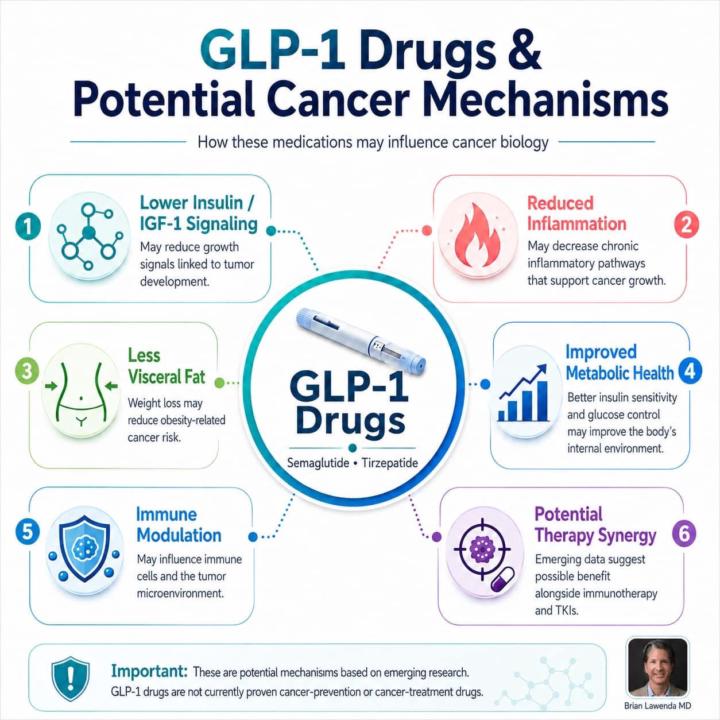
Could glp-1 reduce cancer risk?
The GLP-1 cancer story keeps getting more interesting. These drugs started as diabetes medications. Then they transformed obesity treatment. Now researchers are asking a bigger question: Could GLP-1 medications also reduce cancer risk, slow cancer progression, or even improve the effectiveness of cancer treatments? A new Washington Post article highlights several studies presented at ASCO looking at GLP-1 drugs such as Ozempic, Wegovy, and Mounjaro in cancer prevention, progression, and survival. https://www.washingtonpost.com/health/2026/06/03/science-around-glp-1-drugs-cancer-is-suddenly-getting-lot-more-interesting/ The numbers are worth paying attention to: * More than 40 ASCO studies, abstracts, oral presentations, and posters examined GLP-1 drugs and cancer. * Obesity is associated with 13 different cancers. * A University of Pennsylvania study of more than 100,000 women found GLP-1 users were about 30% less likely to develop breast cancer. * A breast cancer analysis of more than 137,000 patients found 5-year survival of nearly 96% in GLP-1 users, compared with about 90% in similar nonusers. * A study of 10,225 patients across seven solid tumors found GLP-1 use was associated with lower progression to stage IV disease. * The strongest metastatic-progression signals were seen in lung, breast, colorectal, and liver cancers, with risk reductions in the range of about 31% to 50%. * In chronic pancreatitis, GLP-1 use was associated with a more than 50% lower risk of pancreatic cancer. * One acute myeloid leukemia analysis found a 63% lower risk among GLP-1 users. * In metastatic colorectal cancer patients receiving immunotherapy, GLP-1 use was associated with lower mortality at 3 years, 5 years, and beyond. * In more than 25,000 patients with metastatic non-small cell lung cancer treated with targeted therapies called TKIs, GLP-1 users had 5-year survival of 63%, compared with 40% among nonusers.
2
0
1-30 of 32
powered by

skool.com/luxx-lounge-6140
We are here to educate, inspire and bridge the gap with wellness and medicine. Telehealth platform launching in 7 days. Share your excitement for peps
Suggested communities
Powered by