
Write something

9d •
If the dog gets it, you get it.
https://lourensbreytenbach.substack.com/ Most students do not have a learning problem. They have a highlighter problem. They reread. They paint the page yellow. And Pink. Light-avo (i don't know!) They walk away feeling busy. Then the exam paper is blank. That is not laziness. That is the fluency illusion. Recognising a sentence on an open page is not the same job as retrieving it when the book is closed. Memory is not a photocopier. It is a path. It only stays flat if you walk it. Three small moves. Close the book. Write the heading. Produce the idea from memory. Fifteen minutes is enough. The discomfort is the work. Come back later. Not one heroic Thursday. Short visits as the idea starts to fade. Tomorrow. Then next week. Teach it in your own words. Pick one idea. Explain it as if the listener is ten. No borrowed phrases. The sentence you cannot finish is the exact gap. Open the book only for that gap. Then say it again, shorter. That last one is the Feynman technique. It looks like play. It is the most honest test in the room. If you cannot make it simple, you do not own it yet. Keep the marker. Use it as a prompt, not as the main event. A yellow rectangle with no words left is a souvenir of time spent, not a memory. Keen is a gift. Keen without a method just paints the furniture. Close the book. Say it simply. Leave. Come back. That is the whole craft. https://lourensbreytenbach.com/sharelink

Aug 10 •
Homework – dirty dishes or a clean outfit?
Hi Everybody! We are talking about HOMEWORK today - NOT a favourite topic! But worth talking about. I wrote a longish article (2 pages) about the topic for you. Download it here. Here's what's inside: - 🍽️The Dishwashing Analogy: Why Delaying Homework is a Cognitive Disaster - 6 Lifelong Benefits of Doing Homework Properly and Quickly - What do you think is your biggest obstacle to starting your homework immediately after class—is it the distraction of your phone, or simply feeling too tired to begin? If you're a teacher - have this chat with your kids. - I also have a new video on youtube video about it.
1
0
Aug 2 •
FREE Ebook
Hi everyone - my study methods ebook (Worth $20) is FREE for two more days https://pages.lourensbreytenbach.com/ssgg It's 11 p.m. The page is still blank. There's an exam tomorrow. Your chest is tight. Your notes are a blur. You've read the same paragraph four times and remember none of it — and underneath it all, a quiet voice keeps whispering: maybe I'm just not smart enough. Just stop right there. You are smart enough. You always were. You were just never handed the right map. Here it is. Don't Panic is not another motivational speech or a "just try harder" lecture. It's a calm, science-backed survival guide that finally explains why capable, hardworking students freeze under pressure — and hands you a step-by-step system to study with less stress, less guilt, and far more that actually sticks. Written by Lourens Breytenbach — a teacher and school leader who has spent over thirty years watching bright teenagers panic, and showing them the way back to solid ground — this book replaces burnout with methods that match how your brain really works when it feels under threat. Imagine sitting down to study and feeling calm. Walking into the exam room steady instead of shaking. Closing the book and knowing it stayed in. That's not a personality you're born with. It's a skill — and this book teaches it. Inside, you'll discover: - Why panic isn't a flaw — it's your brain's ancient alarm system misfiring, and how to switch it off and break the cycle of shame that keeps you stuck - The 90-second rule that defuses exam anxiety before it hijacks you - Why "just focus" and "try harder" backfire in survival mode — and the surprising thing that works instead - How to turn your desk and your daily routine into quiet signals of calm and focus — no iron willpower required - What real studying actually looks like: the Blurting Method, the Feynman Technique, active recall, and spaced repetition that makes knowledge stick for good
Jul 24 •
The Teacher Boundary Phrasebook
Print this article. Pin pages in the staffroom. Pass it to the teacher who is having the week you had last term. That is what it is for. Personal Story - The “42-Situation”: About 20 years ago I was in a situation similar to the one in the cartoon where two very aggressive parents, whose son had failed mathematics dismally, came to see me at the parents’ conference. It was near the end of the evening and I was really tired and exhausted and I didn’t have any more energy left to handle difficult questions. When they started attacking me and asking me difficult questions like, “Why is it that my child is the only one failing in your class?” I looked up and I saw the boy standing next to them. I looked him in his eyes and I said to him, “Arnold (that’s not his name), what is 6 × 7?” He looked at his parents and they looked at him and he couldn’t answer the question. Needless to say, I leaned back in my chair and without saying the words I rested my case. The evening was over. Here are a few very well-researched responses that are based on the best practices recommended by experts in these difficult and challenging scenarios. When a Parent Comes at You For the gate, the email, the threat, and the WhatsApp group — the moments when a parent arrives angry and you must stay professional. 1. The shouting parent at the school gate “I can hear that you’re upset, and I want to talk to you properly. Let’s step into the office where we can both think clearly.” This buys you 30 seconds and moves the conversation away from public view. Walk toward a doorway with at least one witness. Never debate at the gate. 2. The email accusing you of bias “Thank you for raising this. Bias is a serious concern, so I want to give it a serious response. Could we set up a meeting where I can show you the assessment criteria, the marking rubric, and the comparable work from the rest of the class?” This responds without conceding. It moves the parent from accusation to evidence-based meeting. Always reply within 24 hours, always copy your HOD, always keep the email tone neutral.
0
0
Jul 15 •
Study mistakes adults make
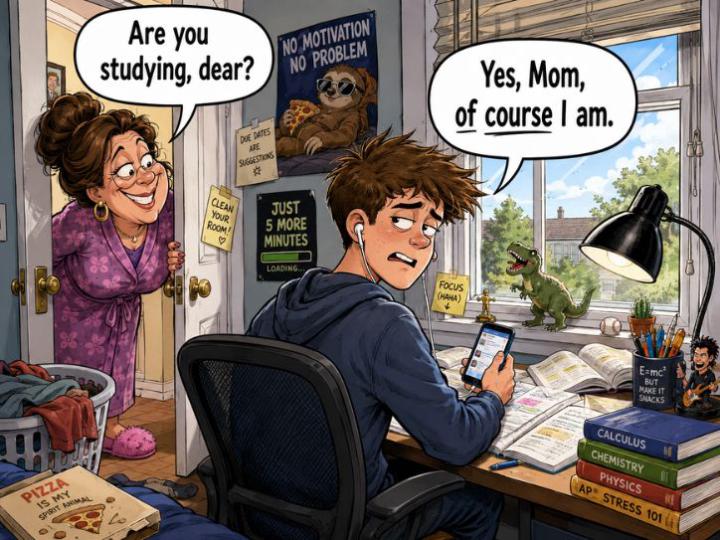
One of the biggest mistakes adults make with teenagers is thinking the problem is simply a lack of motivation. After many years in the classroom, I’ve seen the same pattern over and over. Most teens already know they should study. They know exams count. They know their marks open doors. They feel the pressure from parents and teachers. Yet many still can’t get started. I've been reading up on this very broadly and I've been doing lots of searches online using all the clever robots to figure out what the problem is. They all come forward with the same thing: It’s not that they don’t know what to do. It’s that they don’t have a proper system. When I was at school the system involved a relatively long stick! Now we can't use any wooden objects on learners anymore ... so, how do you get them to focus? By threatening them? It won't work. By nagging? It makes you look week. You see, we tell them “go study” as if that’s enough. But they’re sitting there facing six subjects, messy notes, unfinished work, social drama, phone notifications, and the heavy feeling that they’re already behind. What looks like laziness is usually just overwhelm. That’s why real progress comes from simple, practical systems instead of waiting for some big motivational spark. I've been learning about anchors instead of study planners and I really like the idea because an anchor doesn't slot in five hours on a Monday or a Tuesday and say, "Study in that hour. I'm going to study biology or life science as they call it now." What an anchor does is it goes like this: at 3pm I'm going to take my phone and look at it for 20 minutes on a timer. When the timer goes off I'm going to eat something and have a drink. At 15:30 I have to sit at my desk and my maths book has to be open and I'm going to do maths for 30 minutes. If the 30 minutes becomes 40, great. If it doesn't, that's also great. At least I started." Here are some more direct anchors: Put the phone away.
1-6 of 6
powered by

skool.com/lourens-breytenbach-academy-7872
Lourens Breytenbach's Learning and Support Community for Parents, Teachers and life-long Learners.
Suggested communities
Powered by