
Write something

1d •
Before You Buy Another Supplement, Read This
Over the last five years I’ve developed a strong interest in nutritional neuroscience and how specific foods and supplements influence the body and brain. One concept that really changed how I evaluate supplements is bioavailability. Before I understood this, I mostly chose supplements based on brand popularity or marketing. But brand recognition alone doesn’t guarantee that your body can effectively absorb and use what’s inside the capsule or powder. I also learned that some products include fillers, binders, or low grade forms of nutrients that may reduce how efficiently the active ingredient is absorbed. That doesn’t automatically make them “bad,” but it can affect overall value. Bioavailability refers to how much of a nutrient is actually absorbed into the bloodstream and becomes available for the body to use. It’s influenced by several factors: • The chemical form of the nutrient • Dosage • Delivery method • What you take it with (for example, fat soluble vitamins with dietary fat) • Your digestion and metabolism Understanding this shifted my approach. Instead of just asking “Is this brand popular?”, I started asking: • What form of the nutrient is used? • Is the dose evidence based? • Is there transparency in testing and labeling? • Does this form have good absorption data behind it? It doesn’t mean the most expensive supplement is always better or that cheaper ones are useless, but it does mean quality, formulation, and context matter. Have you ever looked into whether the supplements you’re taking are in forms your body can actually absorb and use effectively?

21d •
Dopamine, Done Differently
A few years back I started looking for ways to reduce how dependent I felt on Ritalin. That led me down the rabbit hole of experimenting with different compounds to support focus and mental clarity. The one that genuinely stood out for me was L-tyrosine. It wasn’t a magic switch, but I noticed a clearer sense of control and concentration that felt more stable and longer lasting. Here’s the science in simple terms: L-tyrosine is an amino acid the body uses to produce key neurotransmitters, including dopamine and noradrenaline. These chemicals play a major role in motivation, attention, and executive function. Tyrosine is converted into L-DOPA and then into dopamine, which the brain relies on to regulate focus and drive. ADHD is closely linked to dopamine imbalance in the prefrontal cortex, which controls attention, planning, and impulse control. Unlike stimulants that force dopamine release, L-tyrosine supports the brain by providing the building blocks needed to produce dopamine and noradrenaline naturally. Over time, this can help stabilize focus, support sustained attention, reduce mental fatigue from task switching, and create a stronger sense of control rather than relying on stimulation. For many, this results in focus that feels more natural and consistent, with fewer crashes and more predictable mental energy throughout the day. Question for the group: What have you found that genuinely helps you manage focus over the long term? Supplements, routines, training, or mindset shifts. What has actually made a difference for you?
0
0

Nov '25 •
Hydration Is Brain Fuel 💧
Lately I have been paying more attention to how staying hydrated affects the way I think and feel. It is surprising how something so simple can throw you off without you realising it. For a long time I misunderstood my body’s messaging. Whenever I felt a drop in energy or a sense of mental heaviness, I assumed it meant I needed coffee. What I thought was a caffeine craving was actually my body telling me I was thirsty. I never stopped to consider how much coffee can dehydrate the body. Coffee has its place, but using it instead of water was doing me a real disservice. Looking back, a lot of the fogginess, irritability, and lack of focus I felt on certain days had nothing to do with stress or sleep. Most of the time my body simply needed water. The signs were subtle, but they were there long before I felt thirsty. Once I became more intentional with hydration, especially on busy days or training days, I noticed a real shift. 🔥My mood improved. 🔥My focus sharpened. 🔥My energy felt more stable. Nothing dramatic, just the difference between feeling out of rhythm and feeling aligned. Today’s focus 🗓️ Drink a little more water than you usually do. Notice how your mind responds.

Nov '25 •
Have You Felt the Gut-Brain Link?
For most of my life, I thought gut health was just a wellness buzzword. But the more I’ve learned, the clearer it has become that what happens in the gut does not stay in the gut. It directly affects how we think, feel, and perform. Your gut is home to trillions of microbes that produce neurotransmitters like serotonin, dopamine, and GABA, the same chemicals that regulate your mood, focus, and energy. When your gut is inflamed, sluggish, or out of balance, your brain feels it. You can eat clean, sleep well, and still feel foggy if your digestion is off. When I started paying attention to how food made me feel mentally rather than just physically, everything changed. I began to notice patterns, sugar crashes that hit like brain fog, meals that left me sharp for hours, and others that made me feel drained. I’m curious, have you ever noticed a clear link between what you eat and your mental clarity, mood, or focus? What foods or habits have been game changers for your gut health? • Something that boosted energy or focus? • A food you cut out that made a big difference? • A small change that made you feel lighter or clearer mentally? 🧠Today’s focus 🧠 Pay attention to how your food affects your focus. Your gut might be speaking louder than you realise.
0
0

Oct '25 •
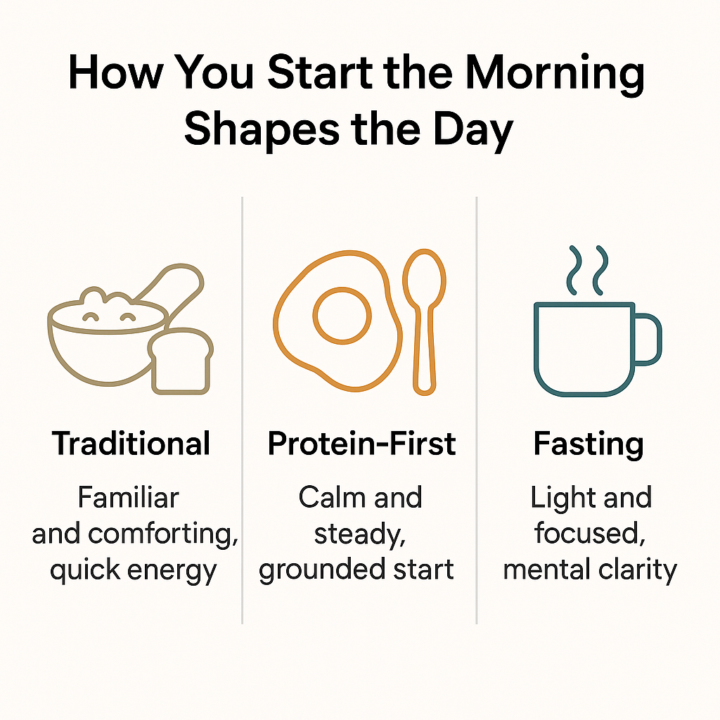
How You Start the Morning Shapes the Day
Breakfast habits are interesting. Most of us stick to whatever we grew up with or whatever feels easiest, without thinking much about how it shapes our focus, patience, or energy. Over time, I’ve noticed there are three main ways people kick off their day: 1. Traditional Breakfast Toast. Cereal. Fruit. Maybe a quick pastry with coffee if the morning is busy. It feels familiar and comforting, but often leads to: • Hunger creeping in quickly • Extra caffeine to stay alert • A noticeable dip in patience and focus mid morning • Low energy when the day starts getting demanding It works fine for some seasons of life. But when you are juggling work, family, and mental load, the cracks show quickly. 2. Protein-Focused Breakfast Eggs. Greek yogurt. A protein smoothie. Cottage cheese. Leftovers. Simple, steady fuel. This approach often brings: • Better focus • Stable mood • Stronger mental stamina • Less snacking and less reliance on caffeine • A calmer, more grounded start to the day For high-demand mornings, this one is powerful. 3. Intermittent Fasting Coffee or water in the morning, work first, eating later. This approach has been my default for my entire adult life. A 15 hour fasting window and a 4 hour eating window has always worked well for me. It keeps me mentally light, sharp, and switched on. Fasting can be an incredible tool, especially when sleep and stress are in a good place. In tougher seasons though, fasting can sometimes show up as: • Irritability • Higher stress response • Afternoon energy dips • Late-day cravings Like anything, it depends on what your nervous system is carrying. 🎯 The real takeaway There is no single “right” breakfast routine. The question is simple: Which approach gives you calm energy, steady mood, and clarity for the life you are building right now?
1-8 of 8
powered by
skool.com/living-longer-4981
Dad life + ADHD + business = chaos. Here we swap tools, habits & supps to find more focus, energy & balance.
Suggested communities
Powered by