
Write something

May 23 •
Identity work is powerful - it addresses the root, not just the symptom.
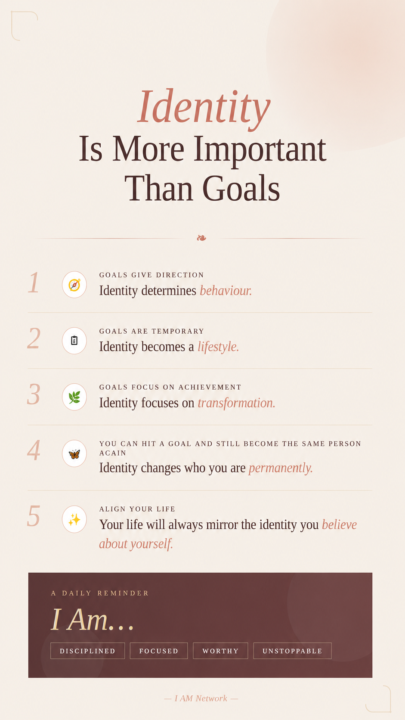
Most people try to change their lives by changing their circumstances: - a new job, - a new relationship, - a new routine, - new goals. But sustainable change does not begin with behavior. It begins with identity. A person will always struggle to create a different future if they still see themselves through the lens of their past pain, failures, rejection, trauma, or limitations. When someone says: - “I don’t know who I am anymore.” - “I feel lost.” - “I don’t know where my life is going.” - “I feel stuck.” - “I keep repeating the same patterns.” …they are not only experiencing confusion. They are experiencing an identity crisis. An identity shift happens when a you move from: - surviving → becoming, - reacting → leading, - self-doubt → self-awareness, - limitation → possibility, - old labels → intentional identity. Because once identity changes: - decisions change, - standards change, - boundaries change, - habits change, - relationships change, - confidence changes. People do not consistently act against who they believe they are. If someone unconsciously believes: - “I am not worthy,” - “I always fail,” - “I am invisible,” - “I am broken,” …their life will eventually mirror those beliefs. But when they begin to say: - “I am capable.” - “I am resilient.” - “I am becoming.” - “I am disciplined.” - “I am worthy of peace and success.” …their nervous system, behavior, and choices begin aligning with that identity. Goals can motivate temporarily. Identity sustains transformation permanently. This is why identity coaching is especially important for: - people in transition, - professionals facing burnout, - individuals recovering from rejection or disappointment, - people rebuilding after loss, - executives who have lost themselves in performance, - anyone feeling disconnected from purpose. An identity shift gives people: - clarity, - emotional grounding, - direction, - self-leadership, - and a renewed sense of meaning.
May 14 •
Becoming is Uncomfortable
I AM BECOMING This version of me is not final. It’s in progress. 👉 I am evolving 👉 I am learning 👉 I am adjusting — without quitting Because becoming is uncomfortable. It stretches me. It challenges me. It exposes where I still need to grow. That’s the point. I am not here to stay the same. I am here to transform. Day by day. Action by action. 𝗜 𝗔𝗠 𝗕𝗘𝗖𝗢𝗠𝗜𝗡𝗚 And I don’t go backwards.
May 20 •
“Choice” and “change” aren’t competing forces
They operate at different levels of causality. Choice is the driver. Change is the outcome. If you’re asking which is more impactful, the answer is choice, because it’s upstream. - Choice is a decision point — a cognitive commitment that redirects behavior. - Change is a state shift — the visible result of repeated choices over time. You can experience temporary change without conscious choice (e.g., external pressure, crisis, environment shifts), but it rarely sustains. It regresses because there’s no internal ownership. On the other hand: - A single, well-defined choice can initiate a cascade of aligned actions. - Consistent choices compound into identity-level change. In coaching terms: - Choice = agency - Change = evidence of agency applied over time Here’s the practical distinction: - If someone says, “I want to change,” they’re describing a desired outcome. - If they say, “I choose to…,” they’re activating control. That’s why people often stay stuck—they’re emotionally attached to change but avoid the responsibility embedded in choice. Impact hierarchy: 1. Clarity of choice 2. Consistency of aligned actions 3. Resulting change Without choice, change is accidental or short-lived. With choice, change becomes inevitable—provided there’s follow-through. “Your life doesn’t change when you want it to. It changes when you choose differently—and keep choosing differently.”
2
0
May 14 •
I AM THE CHANGE
I was waiting for something outside of me to change. My circumstances My finances My relationships My opportunities My motivation - (very carefully using this term) But nothing changed…Because I was waiting instead of becoming. The truth is: 👉 The change is not coming. 👉 The change is YOU. Not someday. Not when life gets easier. Not when you “feel ready.” Right now. Because every breakthrough starts with a decision: ⚡ To stop blaming ⚡ To stop delaying ⚡ To stop negotiating with excuses And then? Action Not massive action - Consistent action. Move your body Fuel your mind properly Execute your priorities Control your environment Regulate your emotions Follow through - not with perfection with consistency Track your proof Because change does not happen by hoping. It happens when your behaviour no longer matches the person you used to be. So today, ask yourself: Am I waiting for my life to change…Or am I becoming the reason it does? 𝗜 𝗔𝗠 𝗧𝗛𝗘 𝗖𝗛𝗔𝗡𝗚𝗘 And today — I prove it.
1-4 of 4
powered by
skool.com/life-mastery-coaching-1728
Coaching from lived transformation, not theory. Guiding those who feel invisible, stuck , those who are exhausted from living for everyone else.
Suggested communities
Powered by