
Write something

Jul 2 •
ORTHOPAEDICS OSCE SIMULATOR
🦴 Orthopaedics OSCE Simulator — Case #2 Welcome back! Today’s station is designed to test your clinical reasoning rather than your memory. Station A 68-year-old woman slips in her bathroom and is unable to bear weight on her right leg. On examination: - The right lower limb is shortened. - The limb is externally rotated. - Tenderness is present over the groin. - Distal neurovascular examination is normal. Your Tasks 1. What is your most likely diagnosis? 2. List three differential diagnoses. 3. Which X-rays would you request? 4. What classification would you use if your diagnosis is confirmed? 5. Outline your initial management in the Emergency Department. 6. What are the definitive treatment options, and how do they depend on patient factors? 7. Name three important complications if treatment is delayed. Rules ⏱️ Treat this like a real OSCE. - Answer in the comments. - Don’t Google. - Explain your reasoning where possible. - I’ll post detailed feedback and a model answer tomorrow. Good luck! Life in Orthopaedics Learning one case at a time.
0
0
Jun 25 •
🦴 Orthopaedic OSCE Simulator
Case 001 — Question 1 📞 2:17 AM You are the first orthopaedic resident on call. A 24-year-old male has been brought to the Emergency Department following a motorcycle accident. He complains of severe pain in his right leg. Primary Survey (ATLS):✅ Airway patent ✅ Breathing adequate ✅ Circulation stable ✅ GCS 15/15 Secondary survey reveals: • Closed injury to the right leg • Marked swelling • Unable to bear weight • No other obvious injuries An X-ray confirms a closed fracture shaft of the tibia. The Emergency Physician turns towards you. 👨⚕️ “Doctor, what’s your first priority?” Choose ONE: A. Apply an above-knee slab B. Request an urgent MRI C. Perform and document a complete neurovascular examination D. Schedule the patient for intramedullary nailing 👇 Comment only ONE option (A, B, C or D) before scrolling tomorrow. No editing. No Google. Think like the surgeon on call. Tomorrow, we’ll reveal the correct answer and see what happens next. The best surgeons aren’t the ones who know every answer. They’re the ones who ask the right question first. — Dr Arnav Kadian Life in Orthopaedics Where Healing Meets Movement 🦋
Jun 24 •
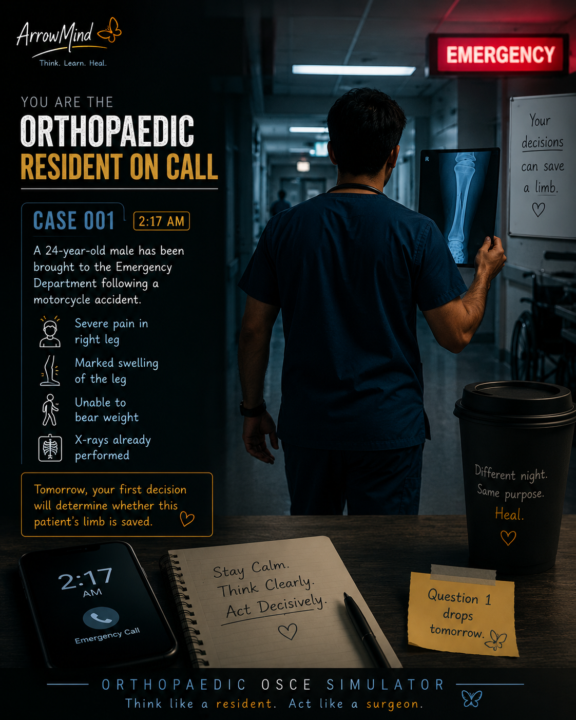
🦴 You Are The Orthopaedic Resident On Call
CASE 001 📞 2:17 AM Your phone rings. A 24-year-old male has been brought to the Emergency Department following a motorcycle accident. The casualty medical officer sounds concerned. You grab your stethoscope and walk downstairs. The patient is awake. Alert. Complaining of severe pain in his right leg. Initial assessment reveals: • Closed injury • Marked swelling of the leg • Unable to bear weight • No obvious injuries elsewhere X-rays have already been performed. You are handed the films. Tomorrow, your first decision will determine whether this patient’s limb is saved. 👨⚕️ What would be the FIRST thing you do after reaching the patient? Don’t answer yet. Question 1 drops tomorrow. Welcome to the Orthopaedic OSCE Simulator. Think like a resident. Act like a surgeon. 🦋 — Dr Arnav Kadian Life in Orthopaedics Where Healing Meets Movement
0
0
Jun 24 •
The Consultant’s Mind — Episode 1
A Painful Knee Case 65-year-old female Chief complaint: - Right knee pain for 5 years History: - Gradually progressive - Worse while walking - Worse while climbing stairs - Relieved partially by rest No: - Fever - Weight loss - Night pain - Recent trauma Examination: - Varus deformity - Medial joint line tenderness - Crepitus present - ROM: 0–110° Investigations: - ESR normal - CRP normal The Question Before looking at any X-rays: What are you thinking? What are your top 3 differential diagnoses? What additional questions would you ask? 👇 Comment before scrolling further. Consultant’s Thought Process This is where the learning happens. Step 1 Could this be infection? Unlikely. Why? - Long duration - No fever - No constitutional symptoms - ESR/CRP normal Infection moves down the list. Step 2 Could this be inflammatory arthritis? Possible. But less likely. Why? - No morning stiffness history - No small joint involvement - Varus deformity suggests compartment wear Step 3 Could this be malignancy? Always think about it. But: - No night pain - No weight loss - Long indolent course Less likely. Step 4 Most likely diagnosis? Medial compartment osteoarthritis of the knee Why? - Age - Progressive pain - Varus deformity - Medial joint tenderness - Crepitus All point in the same direction. The Lesson A consultant rarely jumps to the diagnosis. A consultant first asks: What dangerous things must I exclude? Only then: What is most likely? Discussion Question What X-ray findings would you expect in this patient? 🦴 Comment below before the next post reveals the imaging.
0
0
Jun 23 •
Read Any Orthopaedic X-ray in 30 Seconds
Most students look at an X-ray and immediately ask: “Sir, what is the diagnosis?” Instead, ask these 5 questions: 1️⃣ Is it the correct X-ray? Which bone?Which side?Which view? Never start interpreting before orienting yourself. 2️⃣ Is there a fracture? Look carefully at: • Cortex • Joint surfaces • Alignment Follow the bone completely from one end to the other. 3️⃣ If there is a fracture, where is it? Think: 📍 Proximal 📍 Middle 📍 Distal Then ask: 📍 Extra-articular? 📍 Intra-articular? 4️⃣ What is the pattern? Ask: • Transverse? • Oblique? • Spiral? • Comminuted? The fracture pattern often reveals the mechanism of injury. 5️⃣ What could I miss? Always check: ✅ Joint dislocation ✅ Neurovascular risk ✅ Additional fractures ✅ Open injury clues 🎯 The 30-Second Rule Don’t memorize fractures. Learn a system. A system works on every X-ray. Memorization works on only one. 🦴 Clinical Pearl The most dangerous mistake in Orthopaedics is not missing the fracture. It’s stopping after finding the first one. What is the most difficult X-ray you’ve ever had to interpret? Drop it below. 👇 — Dr Arnav Kadian Life in Orthopaedics Where Healing Meets Movement 🦋
1-9 of 9
powered by
skool.com/life-in-orthopaedics-1366
Welcome to Life in Orthopaedics.
Our goal is simple: to help you move from Ortho-phobic to Posting-Ready.
Learn. Discuss. Grow.
— Dr Arnav Kadian
Suggested communities
Powered by