
Write something

4d •
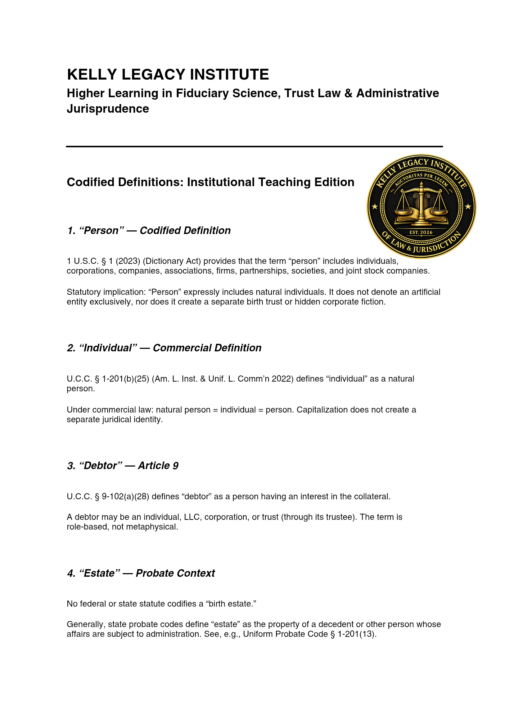
Codified Definitions
Scholars, Before we speak about jurisdiction, equity, secured status, or fiduciary administration, we must first discipline our language. Confusion in law does not begin with oppression. It begins with undefined terms. Today’s release — “Codified Definitions: Institutional Teaching Edition” — is foundational. Inside this document we examine, with citation: • The statutory meaning of “Person” (1 U.S.C. § 1) • The commercial definition of “Individual” (UCC § 1-201) • The role-based meaning of “Debtor” (UCC Article 9) • What an “Estate” actually is in probate law • What legally constitutes a “Trust” (Restatement § 2) • Legal vs. Equitable Title • The actual definition of “Transmitting Utility” • The statutory function of a Social Security number This is not theory. This is codification. If it cannot be cited, it cannot be administered. If it cannot be administered, it cannot be enforced. Many collapse structure because they argue metaphysics instead of statute. In this Institute, we do neither myth nor mysticism. We examine record. We examine code. We examine authority. Assignment: Read the document in full. Then answer in the comments: Where have you previously seen statutory language misinterpreted in a way that altered your understanding of legal identity? We are not here to react. We are here to refine. — Kelly Legacy Institute Higher Learning in Fiduciary Science & Administrative Jurisprudence
3d •
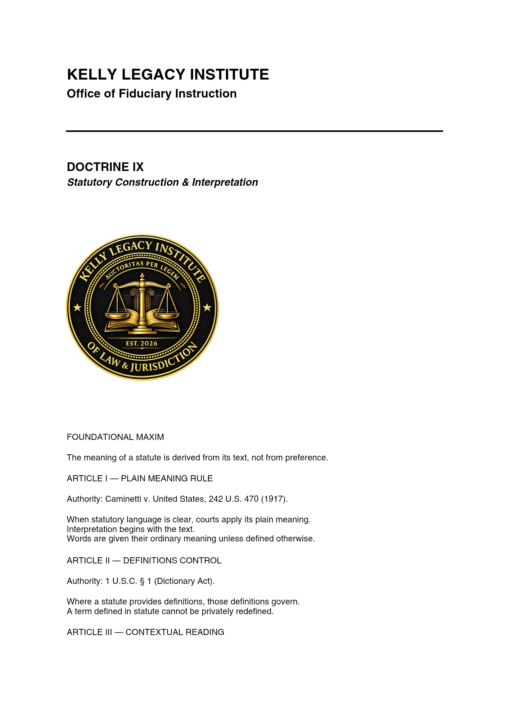
Statutory Construction & Interpretation.
Fiduciary Scholars, This is the interpretive key to the entire canon. Most legal error does not begin in court. It begins in reading. If you misread the statute, you misapply the remedy. Discipline requires: • Start with the text. • Identify defined terms. • Apply the plain meaning. • Read the statute as a whole. • Let the specific control the general. You do not extract phrases. You do not redefine words. You do not interpret by preference. Codification governs. When the language is clear the inquiry ends. When definitions are provided they control. When ambiguity exists structure resolves it. He who controls interpretation controls outcome. Study this doctrine carefully. It governs every other doctrine we’ve built. — Kelly Legacy Institute Auctoritas Per Legem Authority Through Law
3d •
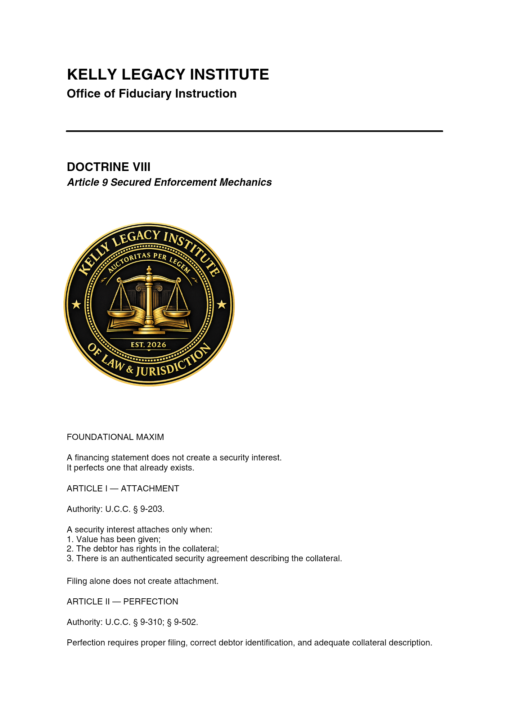
Article 9 — Secured Enforcement Mechanics.
Fiduciary Scholars, This is where many lose structure. A UCC filing does not create power. A financing statement does not create obligation. Perfection does not replace attachment. Security interest requires: • Value given • Debtor rights in collateral • Authenticated security agreement • Proper perfection • Lawful enforcement Remove one element the structure collapses. Article 9 governs consensual secured transactions. It does not override tax law. It does not override criminal statutes. It does not create private leverage by declaration. Most misuse Article 9 rhetorically. The disciplined scholar audits: • Was attachment valid under § 9-203? • Was perfection proper under § 9-310? • Is priority established under § 9-322? • Was enforcement commercially reasonable under § 9-610? Remedy lies in statutory defect not in theory. Study the mechanics. Master the architecture. Apply only where Article 9 actually governs. Next doctrine will integrate secured enforcement with federal consumer statutes. — Kelly Legacy Institute Auctoritas Per Legem Authority Through Law
3d •
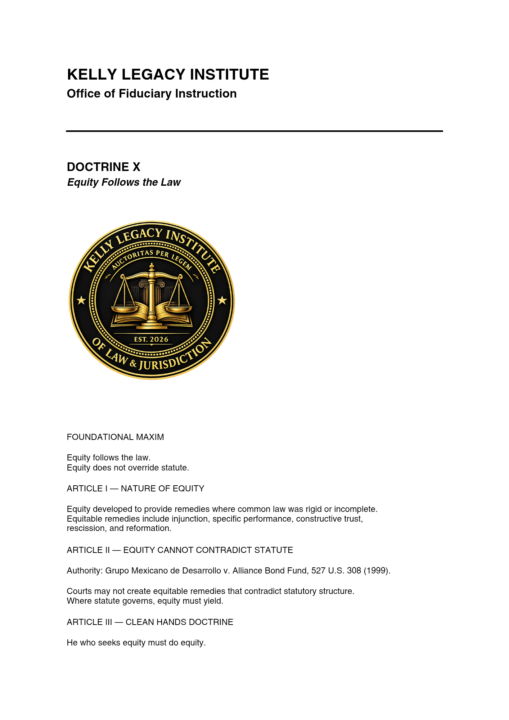
Equity Follows the Law.
Fiduciary Scholars, Doctrine X has been issued. This doctrine stabilizes the entire canon. Many attempt to escape statute by appealing to fairness. Many attempt to override code by invoking “equity.” That is structural error. Equity does not replace statute. It operates within it. If there is an adequate remedy at law equity does not intervene. If statute governs equity yields. If jurisdiction is absent equity cannot create it. Fairness is not a substitute for authority. Emotion is not a substitute for procedure. He who seeks equity must do equity. He who invokes equity must come with clean hands. Understand this clearly: Where statute speaks equity listens. Study this doctrine carefully. Without it, the prior doctrines can be misapplied. The canon is tightening. — Kelly Legacy Institute Auctoritas Per Legem Authority Through Law
2
0
3d •
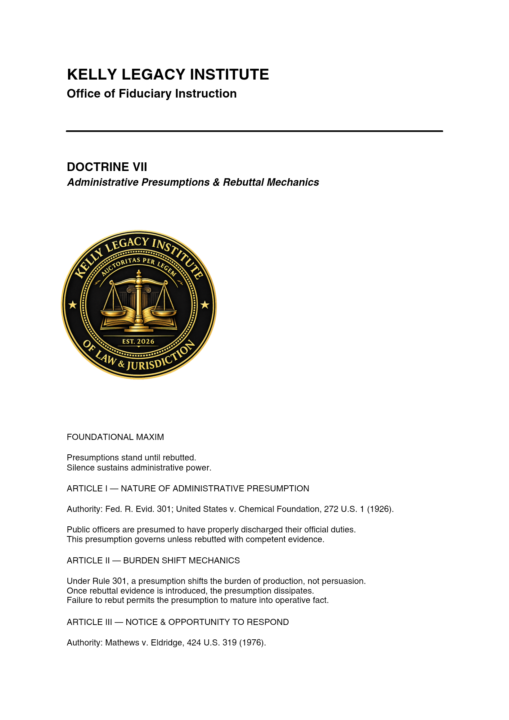
Administrative Presumptions & Rebuttal Mechanics.
Fiduciary Scholars, Most enforcement does not begin with force. It begins with presumption. A notice is mailed. A deadline is set. A response is not filed. A default enters. An assessment finalizes. And people say: “They had no authority.” Authority was sustained procedurally. Understand this clearly: Presumptions stand until rebutted. Silence sustains administrative power. If you do not respond within the prescribed timeframe, the system does not interpret that as resistance. It interprets it as acquiescence. Default is not moral guilt. It is procedural forfeiture. Rebuttal requires: • Timely action • Specific objection • Competent evidence • Record preservation Belief does not rebut. Emotion does not rebut. Posting online does not rebut. Only structured response restrains presumption. Study this doctrine carefully. Many lose not because they are wrong — but because they were silent when the record was forming. — Kelly Legacy Institute Auctoritas Per Legem Authority Through Law
1
0
1-15 of 15
powered by
skool.com/kelly-legacy-institute-9231
Private institute for the structured study of law, jurisdiction, record, and procedure.
Education only. No legal representation.
Suggested communities
Powered by