
Write something

2d •
Appearance, Special Appearance, and Waiver Mechanics
https://youtu.be/Uky6Oz1X1is?si=CB2OlEydtle4AnIM
4d •
Jurisdiction as a Threshold Requirement
Scholars, Before any tribunal may act, one question must be answered: Does it possess lawful authority? This lecture breaks down the four structural components of jurisdiction: • Subject-Matter Jurisdiction • Personal Jurisdiction • Territorial Jurisdiction • Procedural Posture We examine: — Why subject-matter jurisdiction cannot be waived — How personal jurisdiction is established — The role of service and minimum contacts — How administrative process matures into enforcement — Why failure to object can solidify defects Maxim Discussed: “Consent cures error.” This is not rhetoric. This is record analysis. Your assignment: 1. Watch the full lecture. 2. Identify which element of jurisdiction is most frequently misunderstood in lower tribunals. 3. Post your analytical distinction below. Classification precedes remedy. Doctrine before debate. https://youtube.com/shorts/nOrttcc_nQE?si=ajF80CveriIB1y9a
5d •
🏛 PJ LESSON — HISTORICAL FOUNDATION
Today’s focus: Pennoyer v. Neff and the origin of Personal Jurisdiction doctrine. Before “minimum contacts,” there was: • Presence in the forum • Domicile in the forum • Consent — implied or express Key Distinctions: • Presence = Physical presence or legal domicile. • Implied Consent = Stepping into the forum and invoking its protections. • Express Consent = Failure to timely object to jurisdiction. • Objection = Must be raised at the threshold — or it is waived. Remember: Personal Jurisdiction is about power over the person. Subject-Matter Jurisdiction is about power over the case. Confuse them — and you lose procedural leverage. In this lesson, analyze how courts articulate their own authority. Doctrine before debate. Classification before remedy. 📚 Assignment: 1. Define presence. 2. Explain implied vs. express consent. 3. Identify when objection must be raised. 4. Brief Pennoyer v. Neff in 5 sentences. 🏛 Kelly Legacy Institute of Law & Jurisdiction Precision. Procedure. Power. https://youtu.be/BRCQ7qYzQQk?si=ja7jyPwl17HJcP57
5d •
🎓📚 CLASS ASSIGNMENT — ANALYTICAL DISTINCTION 📚🎓
This video is assigned for analytical distinction. 🔎⚖️ Observe carefully how subject-matter jurisdiction is defined in conventional U.S. civil procedure: • 🏛 Authority over the category of case • 📜 Constitutionally and statutorily conferred • ⏳ Non-waivable and can be raised at any time As scholars, your task is not to adopt language blindly 🚫🧠 to understand how courts articulate their own authority. 🎙️⚖️ Study the structure. 🏗️ Identify the framework. 🧩 Trace the source of power. 📖 Classification precedes remedy. 🗂️➡️⚖️ 🏛 Kelly Legacy Institute of Law & Jurisdiction 📘 Doctrine before debate. 🔷 https://youtu.be/gPGhmXWPPYc?si=YgEMcL5KNRRHJnISbut
13d •
The Source of Authority: Power Must Be Traceable
Anybody can quote the UCC. Anybody can say “no jurisdiction.” Very few can: • Trace statutory delegation • Identify ultra vires action • Preserve objections procedurally • Distinguish express from tacit consent This Institute exists for that minority. Welcome to the work.

1-9 of 9
powered by
skool.com/kelly-legacy-institute-9231
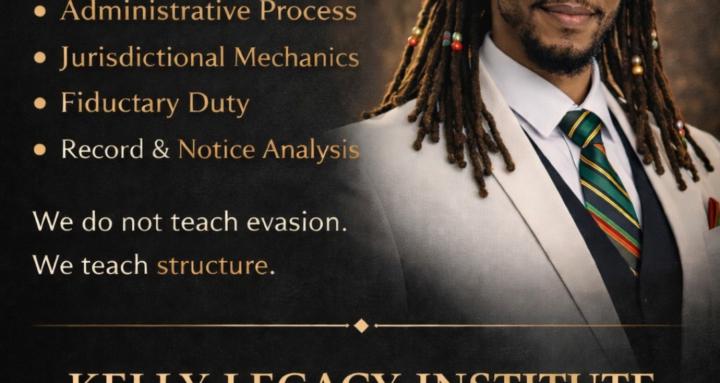
Private institute for the structured study of law, jurisdiction, record, and procedure.
Education only. No legal representation.
Suggested communities
Powered by