
Write something
30d •
More Income Isn't what Will Make You Rich
One of the biggest myths in personal finance is that becoming wealthy is simply a matter of earning more money. If that were true, every doctor, lawyer, executive, and software engineer would retire wealthy. We all know that's not how it works. Don't get me wrong—a higher salary is a tremendous advantage. It gives you a greater opportunity to build wealth. But it doesn't build wealth on its own. In fact, a higher salary comes with a hidden danger. The more you earn, the more credit becomes available to you. A bigger mortgage. A newer car. Higher credit card limits. Larger personal loans. The bank isn't measuring your wealth. It's measuring your ability to make the monthly payments. I've seen it happen many times. Someone gets a raise... And within a few months, they've upgraded their house, their car, and their lifestyle. Their income increased. So did their obligations. Financial freedom didn't. On the other hand, I've worked with families earning very modest incomes who consistently set aside part of every paycheck. They invested month after month, year after year. They weren't trying to look wealthy. They were quietly becoming wealthy. Over time, something remarkable happens. Your investments begin working alongside you. Then, eventually, they begin working for you. That's when wealth starts growing independently of your salary. A high salary doesn't make people wealthy. It simply gives them the opportunity to become wealthy. Consistent investing does—regardless of your income level. A very high salary spent every month rarely builds wealth. Worse yet, when every raise is matched by a bigger lifestyle and more debt simply because the bank is willing to finance it, a higher salary can actually delay financial freedom instead of accelerating it. Your salary determines your earning potential. Your financial habits determine your wealth. Question for discussion: If you received a 20% raise tomorrow, what would you do with it? Would it improve your lifestyle...
2
0

Jul 15 •
The Luck Myth: Why Some People Miss EVERY Opportunity
"I'm just unlucky." It's one of the most expensive beliefs a person can have. There's a beautiful story about Rabbi Abraham Ibn Ezra, one of the greatest Jewish scholars of the Middle Ages. Despite his extraordinary brilliance, he spent much of his life in poverty. According to tradition, his wealthy friend, Rabbi Judah Halevi, wanted to help him without embarrassing him. So he secretly placed a gold coin in Ibn Ezra's path. That morning, Ibn Ezra decided to wear a blindfold as an exercise in humility. He walked right over the coin. The point isn't that Ibn Ezra lacked luck. The point is that sometimes we unknowingly create the very conditions that prevent us from seeing the opportunities already in front of us. We all wear blindfolds. Negative beliefs. Fear. Cynicism. The conviction that success belongs to "other people." In Jewish thought, Shefa—divine abundance—is constantly flowing. Wealth, ideas, relationships, and opportunities are often already present. The real question is whether we've developed the awareness to recognize them. Before asking, "Why don't I have more opportunities?" Ask instead: "What blindfold am I still wearing?" 🎥 In this short video, I explore this powerful lesson through the story of Ibn Ezra and Rabbi Judah Halevi, and how it can completely change the way we think about luck, opportunity, and wealth. 📖 If you'd like to dive deeper, my book Think and Grow Rich Like a Jew explores the timeless Jewish principles behind building wealth with purpose.

Jul 24 •
Introduction_Gregory Miles
Shabbat Shalom, everyone! I am grateful to be in the company of like-minded people who share a desire to learn, grow, and deepen their understanding. Last week, I ordered a copy of Sami Benoliel’s book, Think And Grow Rich Like A Jew, which arrived yesterday, and I am excited to begin reading it. Too, I look forward to learning from him and from each of the members of this platform as we share knowledge, insight, and encouragement with one another.
Jul 3 •
On Personal and National Liberty
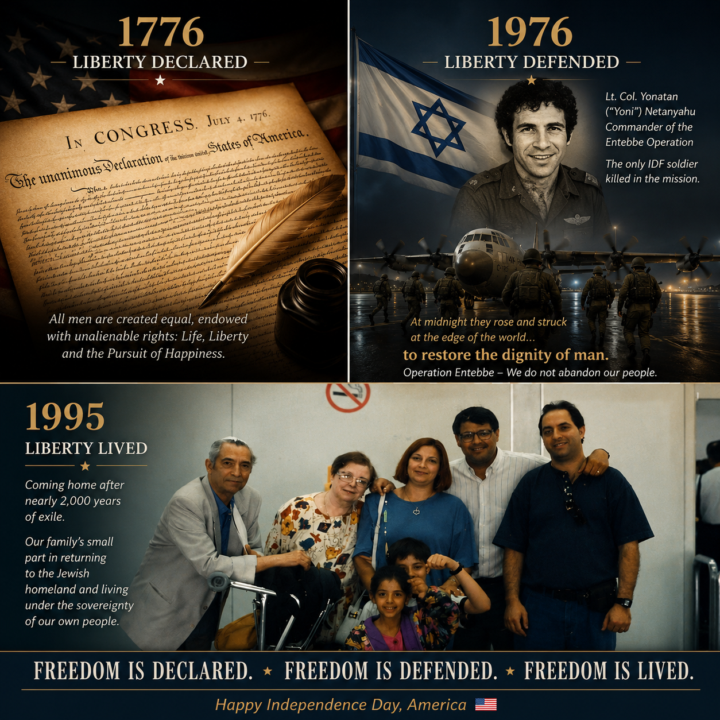
On this day in 1776, the United States declared its independence from Britain. It wasn't merely a political separation. It was a revolution in the way governments were understood. The American Declaration of Independence proclaimed that every human being is created equal, endowed by their Creator with certain inalienable rights—among them Life, Liberty, and the Pursuit of Happiness. Governments do not grant these rights. They exist to protect them. Their legitimacy comes only from the consent of the governed. That idea changed the Western world. I myself am not American. I was born in Canada and today live in Israel. Yet I have always deeply admired what the United States represents at its best: the idea that individual liberty is not granted by the state, but protected by it. There is a reason the Iranian regime has long referred to America as the "Great Satan" and Israel as the "Little Satan." Tyrants fear free societies because liberty threatens every system built on coercion, oppression, and fear. Exactly 200 years later, on July 4th, 1976, Israel demonstrated what those principles sometimes require. After Palestinian terrorists hijacked Air France Flight 139 and held more than one hundred Jewish and Israeli hostages at Entebbe Airport in Uganda, Israel launched one of the most daring rescue operations in modern military history. Israeli commandos flew over 2,500 miles under complete secrecy, rescued 102 hostages, eliminated the terrorists, and returned home. The operation was led by Lt. Col. Yonatan (Yoni) Netanyahu, the older brother of Israel's current Prime Minister, Benjamin Netanyahu. Yoni was the only Israeli soldier killed during the mission. An Israeli song about the operation contains a line that has always stayed with me: "At midnight they rose and struck at the edge of the world... to restore the dignity of man." I don't know of a better one-sentence summary of Operation Entebbe. It wasn't merely about rescuing hostages. It was about declaring that a free nation does not abandon its people, and that human dignity and liberty are worth crossing continents—and risking lives—to defend.
1
0
1-16 of 16
powered by

skool.com/jewish-wealth-mindset-8891
Transform your mindset, master money, and build wealth with purpose through timeless Jewish wisdom and community.
Suggested communities
Powered by