
Write something
Pinned

Feb 16 •
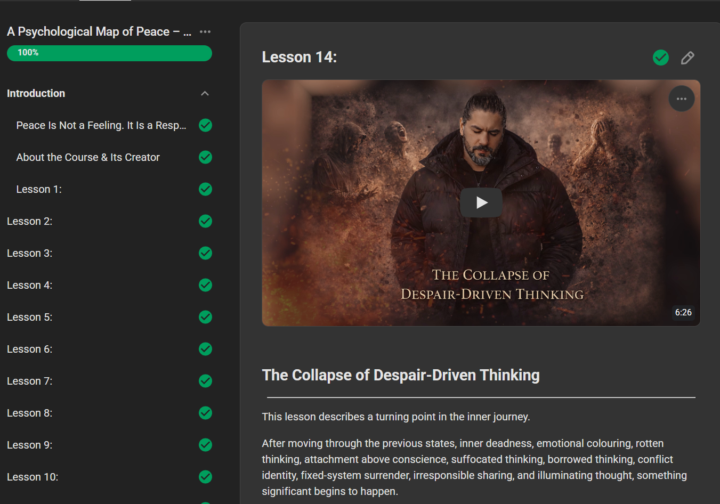
The Psychological Map of Peace Is Now Expanded
The course has now expanded with a stronger second layer. Detailed videos have been added to the Psychological Map, explaining each state of mind with clarity and structure. Along with the videos, there are written breakdowns, examples, and deeper explanations so that the concepts are not just understood intellectually but seen within yourself. This course is built in the light of the Quran as a book of psychology. It is not a religious preaching course. It is a structured psychological decoding of how peace is lost and how it is restored through conscience. Peace does not disappear randomly. It is stolen by fear driven thinking. It is distorted by attachment stronger than conscience. This course shows you the structure behind that. It is lifetime access. Once you enroll, you keep it. More material related to peace and inner accountability will continue to be added. Early supporters remain at the same price. Current price is approximately $70 US or £50 . If you have not enrolled yet, this is the time. Course link:https://www.skool.com/inner-accountability-9281/classroom Share it with those who are genuinely searching for clarity, because peace is no longer optional. It is necessary. Mr. Blank Label
Pinned
Feb 11 •
The Introduction Is Open
The Introduction Is Open Peace is not a feeling. It is responsibility. This Introduction lays the foundation for understanding Deen as inner accountability, Islam as sustainable peace, and the Quran as a psychological map rather than a ritual system. This is not about religion or labels. It is about conscience. If something within you is unsettled, restless, or searching for clarity, begin here. Move slowly. Reflect deeply. Peace does not begin by correcting the world. It begins by seeing what disturbs you within. Start the Introduction here:https://www.skool.com/inner-accountability-9281/classroom — Mr. Blank Label
Pinned
Feb 3 •
Read this before posting
This is not a social group. This is not a belief space. This is not a place for advice, preaching, or performance. This space exists to examine thought, behavior, and inner conflict through reflection and responsibility. Post only what you are willing to look at honestly within yourself. Speak in your own words. Observe your language. It reflects your thinking. No one here is an authority. No one here is to be followed. Nothing needs to be agreed with. If you are here to fix others, convince, teach, or seek validation, this space will feel uncomfortable.That is intentional. Read the rules before posting.Silence is allowed.
Feb 20 •
🚀 NEW COURSE COMING SOON
Real Success According to the Quran This is not about ritual.This is not about debate.This is not about inherited belief. This is about real success. The Quran begins with a complete formula for stability, clarity, and inner strength. Inside this course we will explore: • Your inner script (Al-Kitab) • The unseen forces shaping your life (Al-Ghayb) • What it truly means to be secure (Momin) • Disciplined awareness (Taqwa) • Trusting the gradual process of growth (Aakhirah) • The reality of true success (Falah) Success is not money. Success is not status. Success is inner alignment with your conscience. If you are serious about real transformation, prepare yourself. Details coming soon. Mr. Blank Label
Jun 6 •
The Moment We Mistake for Desire
The mind remembers the object. It forgets the state. A person meets someone, falls in love, achieves a goal, gains recognition, experiences pleasure, or reaches a long-awaited destination. Something meaningful is felt. Then the feeling disappears. The mind remembers the person. The mind remembers the event. The mind remembers the achievement. What it often forgets is the state that briefly appeared through them. And so the search begins again. Another relationship. Another achievement. Another promise. Another destination. Perhaps the confusion is not in what we seek. Perhaps the confusion is in where we think we found it. What if the object was never the source? What if the mind has been remembering the doorway and forgetting what it briefly opened onto? I've attached a PDF exploring this idea in greater depth. Curious to hear how others see it. — Mr. Blank Label
1-22 of 22
powered by

skool.com/inner-accountability-9281
A disciplined space to examine thought, behavior, and inner conflict through reflection, language, and responsibility. No beliefs. No authority.
Suggested communities
Powered by