
Pinned

21d •
🎉 Welcome to the Community!
📌 CLICK THIS MESSAGE AND READ ONCE This space is designed to help you reach your target grades efficiently, master tricky topics, and feel confident every step of the way. Everything here is built to make your studying smarter, your weak points stronger, and your results better. Here’s how the program works and how you should use it: WEEKLY MOCK EXAMS Each week, you’ll sit a mock exam online with your peers under exam-style conditions. This is intentional. The goal is to expose weak points early and to improve exam technique and confidence over time. On the same day, we run a past paper walkthrough where we go through that paper step by step. PAST PAPER WALKTHROUGHS Before the session, attempt the paper on your own - even if you can’t finish it. During the walkthrough, we’ll explain how to approach questions, how marks are awarded, and what examiners actually want. Recordings and fully worked solutions are uploaded after each session. MATH CLASSES & TARGETED SUPPORT Math classes are based on mock exam results, past paper performance, and recurring weaknesses students are facing. This keeps everything relevant and efficient. ASKING QUESTIONS & SUBMITTING WORK You’re encouraged to ask questions at any time and submit your work for feedback - either publicly or privately. Peer marking is encouraged because it improves exam awareness and technique. CALENDAR AND CLASSROOM Check the Calendar for all upcoming lessons and mocks. You’ll also receive an email reminder the day before each session. In the Classroom, you’ll find all papers, solutions, recordings, and study skills content. Bonus: We’ve included a Study Skills Course to help you learn how to study effectively. It covers memorization strategies, deep work, exam techniques and more. The goal here is simple: consistent practice, fast feedback, and smarter studying. If you’re ever unsure about anything, just ask and we'll guide you. Let’s keep this space focused, supportive, and productive 💪
6
0
10d •
How To Get Into Deep Work (Practice #1)
You may be struggling with deep work not because you can’t focus, but because your day is full of shallow work. Before you try to “focus harder,” you need to remove the things that quietly steal your attention. Here’s what to do: 1) Schedule Your Internet Time Don’t rely on willpower. Control access. - Set specific times to check messages, email, and social media - Avoid reacting to notifications during study blocks - Treat internet use as something you schedule, not something that interrupts you This protects your focus and stops constant context switching. 2) Plan Your Day (and Be Specific) Vague plans kill focus. Clear plans reduce mental effort. - Write down exactly what you’ll do, how long it’ll take, and when - Use a task list (Notion, Microsoft To Do) and a simple schedule to block time - Add short buffer blocks so delays don’t ruin your whole day A clear plan removes decision fatigue and makes deep work easier to start. 3) Know What’s Deep and What’s Shallow Not all tasks deserve your best energy. - Deep work = hard, focused, mentally demanding tasks - Shallow work = routine, easy, low-thinking tasks Do your hardest work when your brain is at its best (usually mornings). Don’t waste peak energy on easy tasks. 4) Set Slightly Uncomfortable Goals Too much time leads to slow, distracted work. - Shorten time limits on manageable tasks - Push yourself just enough to stay alert and focused - Challenging goals increase concentration and make deep work more effective Deep work doesn’t start with motivation. It starts by removing shallow work and designing your day around focus.
1
0
10d •
Spaced Repetition: Science Based Revision
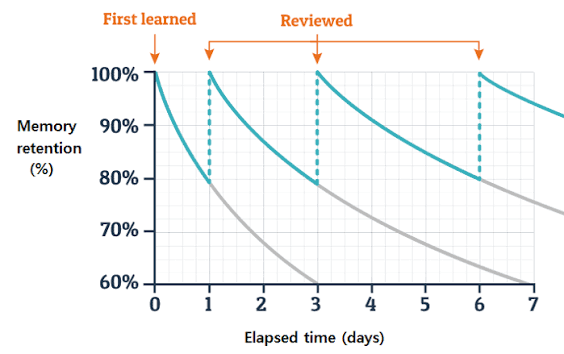
Spaced repetition is a study technique where you review information at increasing intervals. Instead of cramming, you reinforce your memory just before it starts to fade. Why It Works: - Based on the forgetting curve: memories naturally fade unless you revisit them. - By reviewing at the right times, you make your memory stronger and more durable. Typical Spacing Pattern: 1. Initial learning – first exposure to the material 2. Review after 1 day 3. Review after 3–4 days 4. Review after 1 week 5. Review after 2–4 weeks 6. Review after 2 months There are many tools you can find online to help track this. The Advantage Over Cramming: Cramming may help you pass a test today, but spaced repetition ensures you remember the material long-term. It strengthens your memory at the exact moments it’s most likely to fade.
1
0
11d •
How to Remember Everything You Read
Most underperforming students try to memorize by rereading notes or highlighting pages. It feels productive, but it’s one of the weakest ways to learn. What actually builds memory is active recall. Active recall means trying to remember information before you look at the answer. When you do this, your brain is forced to reconstruct what it knows - and that effort is what strengthens memory. Good ways to use active recall: - Test yourself without notes (The Blurting Technique) - Use flashcards (question → answer) - Explain a concept out loud from memory (The Feynman Technique) Here’s the part students misunderstand: If recalling feels hard, that’s a good sign. Difficulty during recall means your brain is working, and that work leads to stronger long-term retention. Easy review feels comfortable, but it fades quickly.
2
0
11d •
The RIGHT Way To Solve A Hard Problem
In exams and during revision, many students either force a question for too long or give up too quickly. Both mistakes come from not understanding how the brain actually solves problems. Your brain switches between two learning modes. Using them in the right order matters. 1) Focused Mode (Struggle here first) This is when you concentrate deeply. - Step-by-step thinking - Applying formulas and methods - Actively trying to solve the problem You need to spend real time here. If you skip this struggle, your brain has nothing solid to work with later. 2) Diffused Mode (Only after) This kicks in when you stop focusing: - Your mind relaxes - Your brain connects ideas in new ways That’s why this works: Work on a question seriously first. If you’re stuck, move on. When you return, the solution often becomes clearer. The rule: Struggle → step away → return. No struggle first = no insight later.
1
0
1-10 of 10
powered by

skool.com/igcse-edexcel-math-5163
Structured IGCSE Edexcel Maths support community with weekly past-paper walkthroughs and guided classes to improve confidence and results.
Suggested communities
Powered by