
Write something

9d •
Pressure Tests the Crown 👑
A powerful Indication can make it appear that control has changed. But appearance is not proof. ⚠️ Indication may seize the throne—but Correction tests whether the new ruler can keep it. 👑 Imagine buyers produce a strong bullish Indication: 🚀 Price displaces upward. 💥 Meaningful bearish structure is damaged. 🏴 Buyers claim new territory. 🔄 A potential change in control becomes visible. That is evidence. 🔎 But it is not the final verdict. ⚖️ Sellers must now receive another opportunity to challenge the claim. That opportunity arrives during Correction. 🔻 ❓ Can sellers reclaim the broken structure? ❓ Can they erase the displacement? ❓ Can they violate the low responsible for the bullish achievement? Or will buyers: 🛡️ Absorb the pressure? 🏰 Defend protected structure? ✅ Produce Continuation? This is where control becomes measurable. A ruler who can only advance—but cannot defend—is not securely in control. The same principle applies to bearish conditions. 📉 A bearish Indication may seize control, but the following Correction allows buyers to challenge that claim. Sellers must defend the high responsible for the bearish achievement and prove that bullish pressure cannot reclaim the territory they lost. 🎯 The chart trigger: CAN THE CLAIMANT KEEP THE CROWN? 👑 🚫 Do not call the first aggressive move control. ⏳ Wait for opposition. 👁️ Watch the defense. ⚖️ Demand the verdict. 👑 Indication seizes the throne. 🛡️ Correction tests the crown. ✅ Continuation confirms the ruler. No defense. No control. No proof. No trade. 💬 Skool discussion question: What specific evidence would convince you that the claimant successfully defended the crown?
2
0

15d •
🚨 INDICATION: THE MARKET MAKES ITS CLAIM
A large candle is not automatically Indication. Fast movement is not automatically Indication. A wick through a level is not automatically Indication. True Indication must create a meaningful structural consequence. 💥 Before the move, the chart supported a reasonable expectation. One side appeared to control price. A meaningful high, low, support, or resistance level helped define that control. Then something changed. Genuine Indication should: ✅ Break a meaningful structural level ✅ Defeat a level the controlling side was expected to defend ✅ Disrupt the previous market expectation ✅ Show decisive displacement or acceptance ✅ Create structural damage that Correction can test Think of Indication as the market making a claim: “The previous condition may no longer be valid.” But a claim is not a completed trade. Indication creates a new hypothesis. It does not guarantee that the new controlling side can defend what it broke. That is why the first candle is not the trade. 🛑 Before labeling movement as Indication, ask: 🔍 What meaningful structure was damaged? 🔍 Which previous expectation was disrupted? 🔍 What must now hold during Correction? 🔍 If price returns through the damaged area, is the claim still valid? If you cannot identify the structural consequence, you may be reacting to movement instead of reading evidence. 📌 CHART ASSIGNMENT: Find three aggressive moves on Gold. For each move, write: 1. What level was broken? 2. Why was that level meaningful? 3. What expectation existed before the break? 4. How did the move change that expectation? 5. What would Correction need to defend? If nothing important changed, do not call it Indication. ⚖️ THE RULE: INDICATION MAKES THE CLAIM. Movement attracts attention. Structural damage earns investigation. 💬 Comment below: What must a move damage before you are willing to call it Indication?
0
0

19d •
Power Leaves a Mark
A large candle may look powerful. But appearance is not evidence. Genuine strength changes something meaningful. It breaks an important boundary, damages existing structure, disrupts the previous expectation, or forces us to read the chart differently. That is the difference between movement and Indication: Movement travels. Power alters. After watching the video, study your chart and ask: What did this move alter? If you cannot identify a meaningful consequence, do not call it strength simply because it moved quickly or traveled far. Classroom challenge Find one aggressive move on Gold and post your answer below: 1. What meaningful structure did it alter? 2. What evidence did it leave behind? 3. Was it a genuine Indication—or merely movement? Power leaves a mark. If there is no mark, keep demanding proof. No Proof. No Trade.
1
0

Jun 30 •
💥 "Did the Move Damage Anything?"
One of the most important questions you'll ever ask when trading ICC. Most traders see a big candle and immediately think: "That's the move!" Professionals ask a different question... 🤔 Did the move actually damage anything? ❌ Damage does NOT mean: - 📏 The candle was big. - ⚡ The move was fast. - 📈 Price traveled a long distance. None of those things prove anything. ✅ Damage means: Did this move actually weaken the opposing side's structure? Ask yourself: - 🔹 Did it break meaningful market structure? - 🔹 Did it invalidate the opposing side's auction? - 🔹 Did it create real displacement? - 🔹 Did it force the other side to lose control? - 🔹 Did the auction story actually change? If the answer is NO... Nothing changed. 🟢 Bullish Example The market has been making: ⬇️ Lower Highs ⬇️ Lower Lows Then buyers step in. Price rallies aggressively... But here's the real question: ❓Did buyers break a meaningful Lower High? ❓Did they damage the bearish structure? If not... It wasn't an Indication. It was simply movement. 🔴 Bearish Example The market has been making: ⬆️ Higher Highs ⬆️ Higher Lows Then sellers produce a strong bearish move. Now ask: ❓Did they break a meaningful Higher Low? ❓Did buyers lose structural control? ❓Did the auction change? If yes... Now you're seeing evidence. 🎯 The ICC Mindset Amateurs ask: "Was that a big candle?" Professionals ask: "What did that move actually accomplish?" That's the difference. ✅ ICC Damage Checklist Before calling something an Indication, ask: ✔️ Did it break meaningful structure? ✔️ Did it invalidate the opposing side? ✔️ Was there convincing displacement? ✔️ Did the auction narrative change? ✔️ Would professionals now question who is in control? If the answer is NO... 🚫 It didn't damage anything. And if it didn't damage anything... 🚫 It isn't an Indication. Which means... ❌ No Indication ➡️ No Correction ➡️ No Continuation ➡️ No Trade. 🏆 Remember: Movement is not evidence. Damage is evidence.
0
0

May 20 •
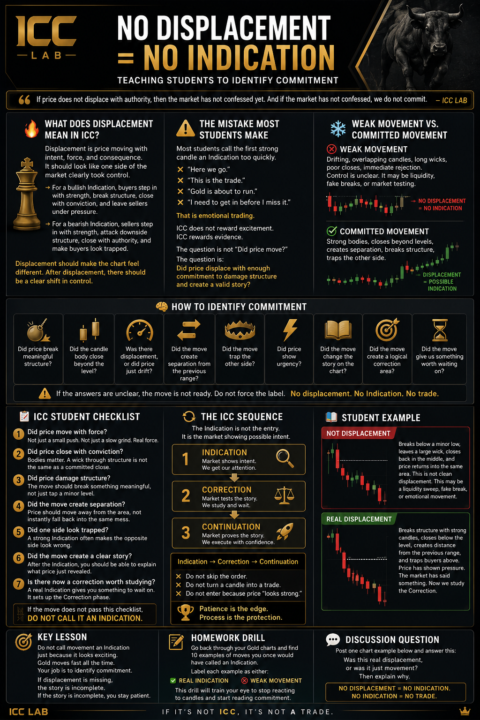
No Displacement = No Indication
In ICC, we are not looking for random movement. We are looking for commitment. That means before we call something an Indication, price must show that one side of the market has stepped in with enough force to create structural consequence. A candle can be big and still mean nothing. A move can be fast and still be emotional noise. A wick can sweep liquidity and still fail to shift control. That is why this rule matters: No displacement = no Indication. If price does not displace with authority, then the market has not confessed yet. And if the market has not confessed, we do not commit. 🔥 What Does Displacement Mean in ICC? Displacement is not just price moving up or down. Displacement is price moving with intent, force, and consequence. It should look like one side of the market clearly took control. For a bullish Indication, displacement should show buyers stepping in with strength. You want to see price push through meaningful structure, close with conviction, and leave sellers under pressure. For a bearish Indication, displacement should show sellers stepping in with strength. You want to see price attack downside structure, close with authority, and make buyers look trapped. Displacement should make the chart feel different. Before displacement, price may look balanced, messy, corrective, or uncertain. After displacement, there should be a clear shift in control. That shift is what gives the Indication meaning. ⚠️ The Mistake Most Students Make Most students call the first strong candle an Indication too quickly. They see a candle move fast and immediately think: “Here we go.”“This is the trade.”“Gold is about to run.”“I need to get in before I miss it.” That is emotional trading. ICC does not reward excitement. ICC rewards evidence. A strong candle may get your attention, but it does not automatically give you permission. The question is not: “Did price move?” The question is: Did price displace with enough commitment to damage structure and create a valid story?
1
0
1-8 of 8

Leaderboard (30-day)
1

+2
Powered by