

6d •
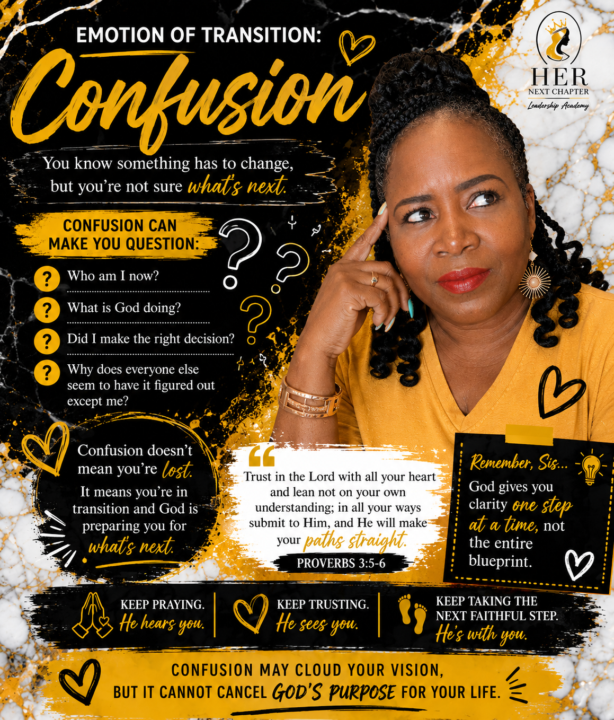
FEELINGS of Transition - CONFUSION
Hey Sis… have you ever felt confused during a season of transition? One day you know exactly where you’re headed…The next day you’re wondering if you’re even on the right path. Confusion can make you question: ✨ Who am I now? ✨ What is God doing? ✨ Did I make the right decision? ✨ Why does everyone else seem to have it figured out except me? But here’s what I’ve learned… Confusion doesn’t always mean you’re lost.Sometimes it simply means you’re leaving behind the life you once knew, but you haven’t fully stepped into the one God is preparing for you. Think about it. A caterpillar probably doesn’t understand the process while it’s inside the cocoon—but transformation is still happening. God often gives us clarity one step at a time, not the entire blueprint. So if you’re feeling confused today, don’t mistake it for failure. Keep praying.Keep trusting.Keep taking the next faithful step. Eventually, what feels confusing today will become part of your testimony tomorrow. 📖 “Trust in the Lord with all your heart and lean not on your own understanding; in all your ways submit to Him, and He will make your paths straight.” — Proverbs 3:5–6 Let’s talk about it:What area of your life feels the most confusing right now, and what is one small step of faith you can take this week despite not having all the answers? Remember, Sis… Confusion may cloud your vision, but it cannot cancel God’s purpose for your life. 🌻
2d •
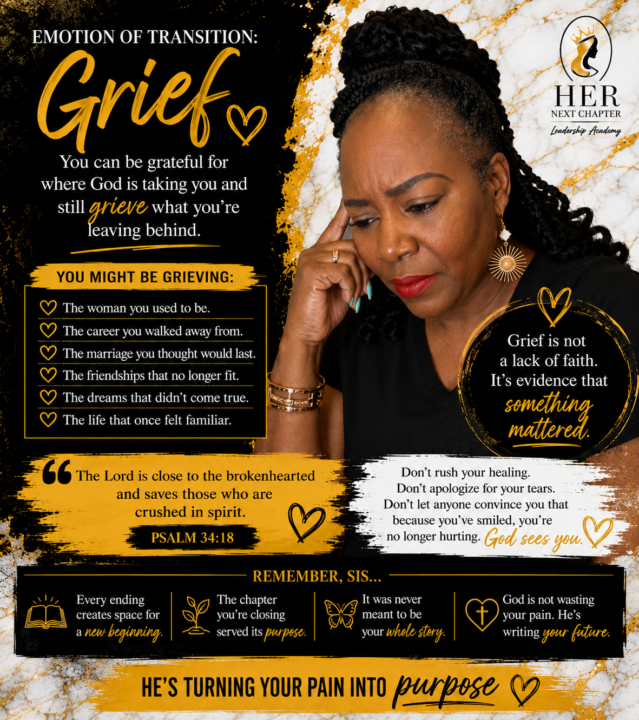
Emotions of Transition - GRIEF
Hey Sis… let’s talk about something we don’t always acknowledge during transition… GRIEF. Grief isn’t only about losing someone you love. Sometimes you’re grieving… - The woman you used to be. - The career you walked away from. - The marriage you thought would last forever. - The friendships that no longer fit your season. - The dreams that didn’t unfold the way you imagined. - The life that once felt familiar. And that’s okay. Many women feel guilty for grieving what they had while believing God for what’s next. But the truth is… You can be grateful for where God is taking you and still grieve what you’re leaving behind. Grief is not a lack of faith. It’s evidence that something mattered. Don’t rush your healing.Don’t apologize for your tears.Don’t let anyone convince you that because you’ve smiled, you’re no longer hurting. God isn’t asking you to pretend you’re okay. He’s inviting you to bring every broken piece to Him. 📖 “The Lord is close to the brokenhearted and saves those who are crushed in spirit.” — Psalm 34:18 Remember, Sis… Every ending creates space for a new beginning. The chapter you’re closing served its purpose, but it was never meant to be your whole story. 💛 Reflection Question:What have you been grieving in this season that you’ve never given yourself permission to acknowledge? I’d love to pray with you. Share as much or as little as you’re comfortable sharing in the comments. You’re not walking through this transition alone. 🤍
17d •
Exchanging A Spirit of Heaviness
For many believers, exchanging a spirit of heaviness for a garment of praise is not about pretending everything is fine. It’s about intentionally choosing to turn toward God in the middle of pain, disappointment, grief, or weariness. This promise comes from The Book of Isaiah 61:3, where God promises to give His people “the garment of praise instead of a spirit of heaviness.” Here are some practical ways to make that exchange: 1. Acknowledge the Heaviness God isn’t asking you to deny your feelings. Be honest about what you’re carrying. Ask yourself: - What is weighing on my heart? - What am I afraid of? - What am I trying to carry alone? 2. Bring It to God in Prayer Release your burdens to Him. 1 Peter 5:7 reminds us:“Cast all your anxiety on Him because He cares for you.” Tell God exactly how you feel. He can handle your tears, questions, and frustrations. 3. Choose Praise Before You Feel Like Praising Praise is often an act of faith, not a feeling. You can praise God by: - Thanking Him for His faithfulness. - Speaking His promises aloud. - Worshiping through music. - Remembering how He has brought you through before. Praise shifts your focus from the size of your problem to the greatness of your God. 4. Replace Negative Thoughts with God’s Truth When heaviness whispers: - “You’re alone.” Answer with: - “God will never leave me nor forsake me.” When fear says: - “You’ll never get through this.” Answer with: - “I can do all things through Christ who strengthens me.” 5. Surround Yourself with Encouragement Don’t isolate yourself. Connect with: - Faith-filled friends. - Your church community. - Trusted mentors. - Communities like Her Next Chapter Academy, where women can encourage one another and remind each other of God’s promises. 6. Remember That Praise Is a Garment Just as you intentionally put on clothes each day, you can intentionally “put on” praise. Some days that may look like: - Saying, “Lord, I trust You.” - Playing worship music while cooking. - Writing down three things you’re grateful for. - Declaring, “God is still good, even in this season.”
14d •
DURING the Stages of Transition
Now that we are familiar with THE STAGES OF TRANSITION we are going to start talking about THE EMOTIONS OF TRANSITION. I’ve really wanted to dive into this because I understand a couple things about this topic: 🥺 You can’t heal from what you continue to hide. 🫣 You can’t control what you refuse to confront. Our emotions and thoughts go hand in hand when it comes to transition. They feed off each other. So if we aren’t intentional about controlling them and not allowing them to control us, the enemy will use them against us to keep us stuck, stagnant and sitting on the sidelines of life, waiting to get in the game. So this is what we’re going to do! Work on them! Face them head on! Embrace them! Give ourselves grace through them but make them, like our thoughts, line up and obey! I believe in you!!! We got this!!!

17d •
Imposter Syndrome is Real
I was just sitting here watching a movie with my hubby and I started thinking about a training I did this week. I did an analysis on my social media pages that told me my static posts don’t do as well and I need to start doing reels to get more views. I hesitated! I didn’t want to! But I had to remember that my assignment is not about me! Even though I do lives Mon-Fri I was nervous! But why? Where did that come from? So me, being who I am, decided to dig a little deeper because I know I’m not the only one who suffers with this at times. I wanted you to be aware of the damage it does to us as women. Imposter syndrome can be especially damaging to women because it causes us to question our value, minimize our accomplishments, and delay stepping into opportunities we are fully capable of handling. Over time, it doesn’t just affect confidence—it can impact careers, relationships, health, and purpose. Here are some of the ways imposter syndrome affects women: 1. It Causes Women to Play Small Many women shrink their dreams, remain silent, or avoid leadership positions because they believe they aren’t “ready enough” or “qualified enough.” Result: Missed opportunities and unrealized potential. 2. It Creates Chronic Self-Doubt Even successful women may believe they “just got lucky” or fear being exposed as a fraud. Result: Constant anxiety and inability to celebrate victories. 3. It Leads to Perfectionism Women with imposter syndrome often feel they must prove themselves by doing everything perfectly. Result: Burnout, exhaustion, and unrealistic expectations. 4. It Makes Comparison a Lifestyle Instead of appreciating their own journey, they constantly compare themselves to others. Result: Jealousy, discouragement, and loss of joy. 5. It Causes Overworking and People-Pleasing Trying to earn validation, many women overcommit and struggle to say no. Result: Stress, resentment, and emotional depletion. 6. It Silences Their Voice Women may hesitate to share their ideas, tell their stories, or pursue their calling because they don’t feel “good enough.”

1-7 of 7
powered by

skool.com/her-next-chapter-academy-2980
7 Stages of Transition
S.H.I.F.T. Framework
Group coaching
1:1 coaching
Women
•Leaving corporate
•Empty nest
•Spiritual renewal
•God-given purpose
Suggested communities
Powered by