
Write something

Jan 6 •
chlorophyll during flowering
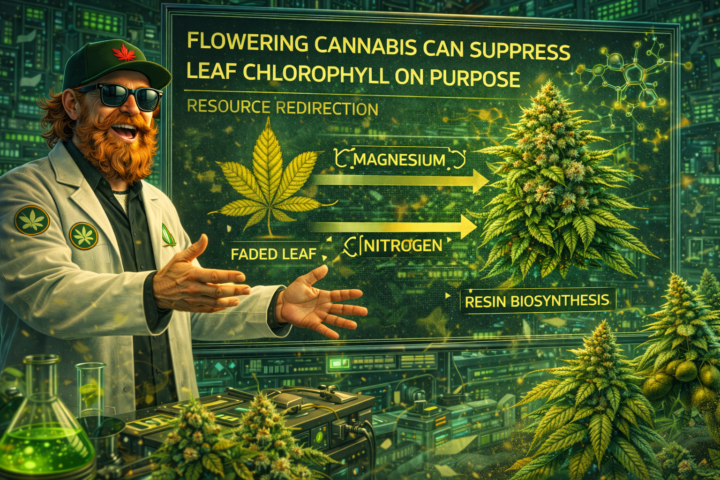
Cannabis fact of the day Flowering cannabis can suppress leaf chlorophyll on purpose When cannabis enters flowering, many growers assume fading leaves are a sign of deficiency or decline. In reality, cannabis can intentionally reduce chlorophyll in selected leaves as a strategic metabolic decision. This is not failure. It is redirection. Chlorophyll production is expensive. It requires large amounts of nitrogen and magnesium, both of which are also critical for enzymatic activity, energy transfer, and secondary metabolite production. As flowering intensifies, the plant faces a resource allocation problem. It cannot maximize photosynthesis and resin biosynthesis at the same time without compromise. So it chooses. Rather than evenly reducing chlorophyll across the canopy, cannabis selectively downregulates chlorophyll in specific leaves, often older fans that have already paid back their construction cost. By reducing chlorophyll synthesis in these leaves, the plant frees up magnesium from the chlorophyll molecule itself and nitrogen from associated proteins. These elements are then redirected toward rapidly developing floral tissues and the biochemical machinery responsible for resin production. This process is hormonally controlled. Shifts in cytokinin and senescence signaling allow certain leaves to remain green while others are quietly cannibalized. The plant is not starving. It is reallocating. At the same time, photosynthesis does not collapse because remaining active leaves and even green floral tissues compensate for the loss. Cannabis does not need maximum photosynthetic output in late flower. It needs targeted energy delivery. Magnesium plays a particularly interesting role here. While magnesium sits at the center of the chlorophyll molecule, it is also essential for ATP activation and terpene synthesis enzymes. By pulling magnesium out of chlorophyll pools, the plant enhances its ability to fuel resin gland activity. Nitrogen follows a similar path, shifting away from leaf expansion and toward amino acid driven metabolic pathways inside the flower.
1
0
Dec '25 •
Silica
Cannabis Fact of the Day Silica is one of those inputs that never gets the headline, yet it quietly rewires how a cannabis plant behaves. It’s not a nutrient in the classic sense like nitrogen or potassium. Think of silica as a systems engineer. It doesn’t build the plant, it teaches the plant how to hold itself together under pressure. Once absorbed, silica is deposited into cell walls as amorphous silica gel, reinforcing tissues from the inside out. This thickening of the cell wall changes how cells stretch, divide, and signal. Stronger walls don’t just mean sturdier stems; they alter hormonal traffic. Auxins, the hormones responsible for apical dominance and directional growth, move more predictably through reinforced tissues. That’s why silica-fed plants often show tighter internodes and more disciplined structure without being chemically “stunted.” Silica also has a quiet but important relationship with gibberellins. Gibberellins push elongation and rapid growth, sometimes too much if nitrogen is high. Silica tempers that response. It doesn’t shut gibberellins down; it keeps them from running wild. The result is growth that’s fast but controlled, thick instead of leggy, intentional instead of floppy. Where silica really shines is stress signaling. When a plant experiences heat, drought, salinity, or pest pressure, it releases stress hormones like abscisic acid and jasmonates. Silica reduces how loudly those alarms ring. By physically reinforcing cells and improving water-use efficiency, silica lowers perceived stress, meaning the plant doesn’t divert as much energy into survival mode. More energy stays allocated to growth, root expansion, and later, secondary metabolites. Ethylene is another hormone silica indirectly keeps in check. Ethylene spikes during stress and senescence, accelerating aging and leaf drop. Silica-treated plants often show delayed senescence because stress-induced ethylene production is reduced. Leaves stay greener longer, photosynthesis stays online, and the plant doesn’t panic when conditions swing.

Dec '25 •
Stress memory
Cannabis Fact of the Day Plants Remember Stress and Adjust Their Chemistry Later🤔🤔 Cannabis doesn’t just react to stress in the moment it remembers it. Long after the stress is gone, the plant carries a biochemical memory that quietly reshapes how it grows, smells, and produces resin weeks later. This phenomenon is called stress imprinting, and almost nobody talks about how much it affects final quality. When a cannabis plant experiences early stress irregular watering, root restriction, temperature swings, light inconsistency, or nutrient imbalance it activates defensive signaling pathways. Hormones like abscisic acid and ethylene spike, telling the plant, Resources might be limited. Plan accordingly. Even after conditions improve, that internal message doesn’t fully reset. Instead, the plant rewrites its priorities. A stress-imprinted plant often becomes more conservative with energy later in life. It may still grow well and even yield decently, but its internal chemistry shifts toward efficiency over luxury. Luxury chemistry is where terpenes, minor cannabinoids, flavonoids, and aromatic complexity live. This is why two clones grown under identical flower conditions can finish completely differently. One smells deeper, smoother, more layered. The other smells sharp or hollow. The difference isn’t nutrients or light it’s memory. One plant trusted its environment early. The other learned caution. Stress memory also explains why fixing problems late doesn’t fully restore quality. You can correct EC, dial in VPD, or stabilize lighting, but the plant already adjusted its long-term strategy. It’s not being stubborn it’s being adaptive. Interestingly, mild, predictable stress can enhance resilience without suppressing quality. But chaotic or repeated stress creates a defensive bias that limits chemical expression later. Cannabis rewards consistency far more than intensity. This also reframes the idea of hardening plants. Rough treatment doesn’t make better weed. It makes cautious weed. Loud, complex cannabis comes from plants that never had to brace themselves. In cannabis, memory isn’t stored in the brain it’s written into the resin
3
0

Dec '25 •
least efficient plants, the smelliest??
Cannabis Fact of the Day — The Smelliest Plants Are Often the Least Efficient One of the most counterintuitive truths in cannabis cultivation is this: the plants that smell the loudest, frost the hardest, and drip the most complex terpene profiles are often less efficient at photosynthesis and biomass production than their quieter counterparts. Terpenes are not free. Every molecule of limonene, myrcene, or β-caryophyllene is built from carbon skeletons that originate in photosynthesis. That same carbon could have gone into thicker stems, larger fan leaves, or denser floral mass. When a cannabis plant diverts carbon into secondary metabolites like terpenes and flavonoids, it is making a survival decision, not a yield-maximizing one. In nature, cannabis didn’t evolve to impress growers or win cups. It evolved to survive. High terpene output functions as a chemical language—repelling herbivores, inhibiting microbial attack, and signaling stress tolerance. A plant pumping out volatile aromatics is essentially yelling, “Don’t eat me, I’m chemically armed.” That defense strategy comes at an energetic cost. This is why some of the most aromatic cultivars grow slower, stretch less aggressively, or finish with slightly lower dry weight. Their carbon economy is tilted toward chemical complexity instead of structural bulk. Even at the cellular level, terpene-rich plants often show reduced starch storage in leaves because sugars are being siphoned into resin synthesis rather than saved for later growth. Lighting, nutrients, and CO₂ can raise the ceiling, but the trade-off never disappears. You can push efficiency and flavor closer together, but you cannot eliminate the biological cost of aroma. When growers chase nothing but yield, they often unknowingly select against terpene expression. When they chase flavor obsessively, they may sacrifice grams per watt without realizing why. This also explains why some “ugly” plants stink the hardest. Sparse bud structure, thinner leaves, or modest yields don’t mean weak chemistry. In many cases, it means the plant prioritized chemical warfare over mass production.
4
0

Dec '25 •
Hormone shifts in cannabis bloom
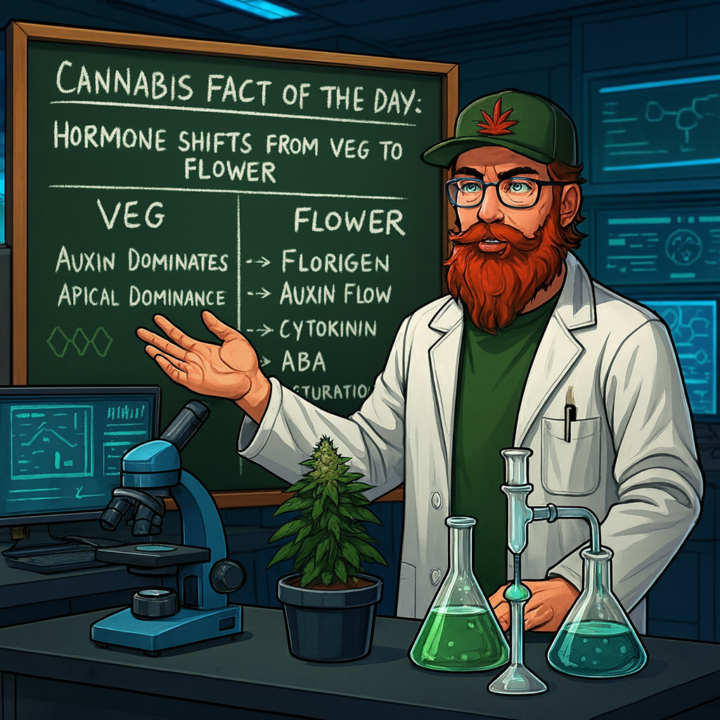
Cannabis Fact of the Day:Hormone Shifts From Veg to Flower Cannabis doesn’t “decide” to flower overnight.It undergoes a coordinated hormonal coup where growth priorities flip and the plant rewires itself from building structure to building reproduction.In veg the dominant voice is auxin.High auxin levels flow from the apical meristem downward enforcing apical dominance telling side branches to chill while the plant stretches upward toward light.This is why topping works—you interrupt auxin flow and cytokinin from the roots rushes in waking up lateral shoots.Cytokinins rule vegetative expansion.They drive cell division leaf production chloroplast development and root to shoot communication.A healthy veg plant is basically a cytokinin powered construction site. Gibberellins also play a role in veg especially during stretch phases.They elongate internodes and push rapid vertical growth which is useful early but becomes a liability if unmanaged.Once the photoperiod shortens the hormonal balance starts to tilt.The real switch isn’t a single hormone but a cascade.The leaf perceives night length and produces florigen a mobile flowering signal encoded by FT proteins.This signal travels to the shoot tips and flips genetic switches that reprogram meristems from leaf factories into flower factories. As flowering initiates auxin redistributes rather than disappears.Apical dominance weakens and energy gets redirected to inflorescence sites.Cytokinin levels drop in leaves but increase locally in floral tissues driving rapid bud cell division.Gibberellins spike briefly during stretch then taper off which is why internodal elongation slows mid flower.Abscisic acid rises steadily.ABA is the stress hormone but in flower it’s also a maturation manager.It regulates stomatal behavior resin gland development and late stage ripening.High ABA is associated with tighter buds and increased secondary metabolite production.
1
0
1-17 of 17
powered by

skool.com/grow-big-buds-101-2570
100% cannabis education A-Z through essays, lives , and how to videos galore. 40 plus years of grow experience between us. One breeder, One grower....
Suggested communities
Powered by