
Write something

Feb 15 •
When Do You Need to Renew Your FDD and What Is the Process to Update It Each Year?
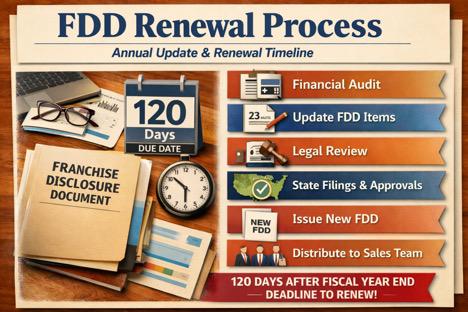
For any franchisor, the Franchise Disclosure Document (FDD) is not just a regulatory requirement—it is the legal foundation of your franchise offering. Keeping the FDD current, compliant, and accurate is one of the most important annual obligations in franchising. Failure to properly renew and update the FDD can result in rescission claims, regulatory penalties, delayed franchise sales, or even litigation. Understanding when you must renew your FDD and how to properly complete the annual update process is essential for both emerging and established franchise systems. Below is a comprehensive breakdown of FDD renewal requirements, timelines, and the step-by-step process franchisors follow each year. Part 1: When Do You Need to Renew Your FDD? A franchisor must update and renew its FDD within 120 days after the end of its fiscal year. This requirement comes from the Federal Trade Commission (FTC) Franchise Rule and applies to all franchisors operating in the United States. The 120-Day Rule Explained The FTC requires that a franchisor’s FDD include updated financial statements and current disclosures. Because audited financial statements reflect a specific fiscal year, the FDD must be updated within: 120 days after the close of the franchisor’s fiscal year. For example: - If your fiscal year ends December 31, - Your updated FDD must be completed and issued by April 30. After that date, you may not legally offer or sell franchises using the prior year’s FDD. What Happens During That 120-Day Window? During the 120-day period after your fiscal year ends: - You may continue selling franchises using the prior FDD. - You must be actively preparing your updated FDD. - You must obtain updated audited financial statements. If the 120-day deadline passes and the new FDD is not complete: - You must cease offering or selling franchises until the updated FDD is finalized. - In registration states, you must also wait for state approval before resuming sales.
Jan 12 •
When Are You Required to Register a Franchise With the State—and What Happens If You Don’t?
Selling a franchise is not just a business transaction—it is a regulated securities-style offering governed by federal law and, in many cases, state franchise registration laws. One of the most common and costly mistakes new and emerging franchisors make is misunderstanding when state franchise registration is required and what happens if they sell a franchise without complying. This article explains: - when a franchisor is legally required to register a franchise in a state - what counts as an “offer” versus a “sale” - which states require registration - what exemptions may apply - and the serious legal, financial, and operational consequences of failing to register properly Whether you are launching your first franchise or scaling an existing system, understanding this issue is essential. 1) The Legal Framework: Why Franchise Registration Exists Franchise registration exists to protect franchise buyers. At both the federal and state level, franchising is treated similarly to an investment offering, which means the law requires full disclosure before money changes hands. Federal law (baseline) At the federal level, the FTC Franchise Rule requires that a franchisor provide a Franchise Disclosure Document (FDD) to a prospective franchisee at least 14 calendar days before: - signing any franchise agreement, or - accepting any money However, the FTC Rule does not require registration of the FDD with the federal government. State law (additional layer) Certain states go further and require that the FDD be registered, approved, or filed with the state before the franchise is offered or sold in that state. This is where many franchisors get into trouble. 2) The Three Categories of Franchise States In the United States, states fall into three broad categories: A) Franchise Registration States These states require state approval or registration of the franchise offering before a franchise can be offered or sold in the state (unless an exemption applies).
3
0
Nov '25 •
How does the Franchise Registration Process Work?
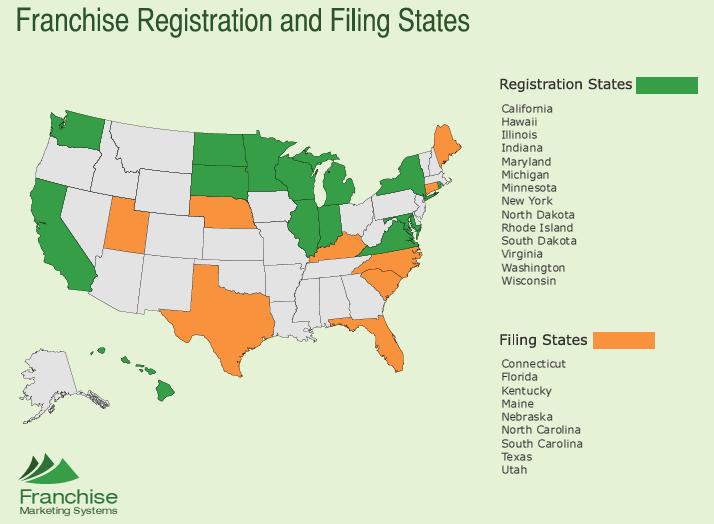
When a company (the franchisor) wants to offer and sell franchises, they must comply with both federal and state regulations. At the federal level, the Federal Trade Commission (FTC) Franchise Rule requires that a valid Franchise Disclosure Document (FDD) be given to prospective franchisees at least 14 days before any contract is signed or any payment made. On top of the federal requirement, many U.S. states have supplemental franchise laws requiring the franchisor to register, file, or otherwise submit the FDD and associated documents with a state regulator before selling a franchise within that state. In short: - A Registration State: A state where you must submit the FDD (and possibly other documents), pay a filing/registration fee, and obtain approval (or at least the right to offer/sell) before granting a franchise in that state. - A Filing State: A state where you only need to file a notice or submit the FDD plus a fee (but generally no substantive review or pre-approval). - A Non-Registration State: A state which does not require a specific franchise registration or filing (beyond the federal FDD disclosure) in order to sell franchises. Compliance across these categories is essential for a franchisor expanding nationwide. Failure to register or file where required can lead to penalties, inability to enforce franchise agreements in that state, or even injunctions against sale. The Registration Process: Step by Step Here’s a generalized description of the process a franchisor will follow when registering (or filing) in a state. Specifics will vary by state, so it is always advisable to engage experienced franchise counsel. 1. Prepare or update the FDD 2. Identify target states and classification 3. Submit application/filing to state regulator 4. State review (registration states) 5. Receive registration/approval or acknowledgment 6. Ongoing compliance, renewal and updates 7. Record in your FDD Overview of Franchise Registration / Filing States & Typical Fees
3
0
1-3 of 3
powered by

skool.com/franchise-marketing-systems-3411
Learn about franchising your Business and How to Franchise your Business Model into new markets through franchise growth.
Suggested communities
Powered by