
Write something

8d •
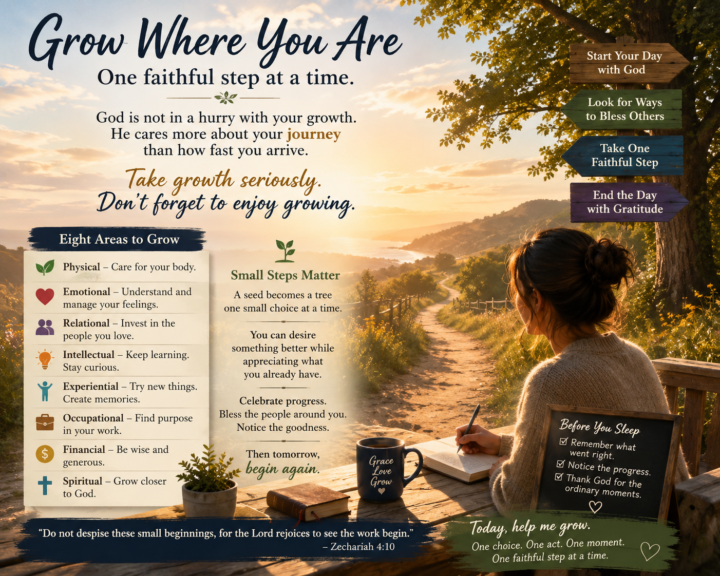
Grow Where You Are
“Do not despise these small beginnings, for the Lord rejoices to see the work begin.” — Zechariah 4:10 We often imagine growth as something dramatic. A life-changing decision. A breakthrough moment. A great achievement. But most growth doesn’t happen that way. Most growth happens quietly. It happens when you get up in the morning and choose again. When you take one small step toward becoming healthier. When you spend a few minutes in prayer. When you call someone you love. When you learn something new. When you rest instead of running yourself into exhaustion. When you choose gratitude at the end of an ordinary day. We tend to celebrate destinations, but God seems remarkably interested in journeys. A seed does not become a tree overnight. It grows slowly. Roots deepen beneath the ground where no one can see them. Tiny branches stretch toward the sunlight. Seasons come and go. Rain falls. Storms arrive. And still, the tree grows. Our lives are much the same. We are growing physically, emotionally, relationally, intellectually, and spiritually. Some areas of our lives may be flourishing while others have been quietly neglected. The temptation is to look at everything that needs improvement and become overwhelmed. But growth does not require changing everything today. It simply requires asking: What is the next faithful step? Maybe you want a stronger relationship with God. You don’t have to completely transform your spiritual life tomorrow. Spend five quiet minutes with Him today. Maybe you want a healthier body. You don’t have to become an athlete this week. Take a walk today. Maybe you want a better relationship with someone you love. You don’t have to solve every problem between you. Send a kind message today. Small steps matter because small steps become direction. And direction, continued long enough, becomes a life. But there is another mistake we often make. We postpone happiness until we arrive. I’ll be happy when I lose the weight.
0
0
9d •
Relate
Most people think getting better results from AI requires better prompts. I think it requires better conversations. Once you’ve given AI enough context to know who you are, the next step is surprisingly simple: Talk to it. Talk about your work. Your family. Your hobbies. The show you watched last night. The idea you can’t quite figure out. The belief you’re questioning. The project you’re excited about. There is no formula. Relationships aren’t built through checklists. They’re built through attention, repetition, and showing up. And here’s where AI offers something unusual. You can think out loud without worrying about exhausting it. You can vent without hurting its feelings. You can explore an idea before you’re ready to share it with another person. You can say, “I don’t know what I think about this yet,” and spend an hour figuring it out. That doesn’t make AI a replacement for human relationships. It makes AI useful in a completely different way. It can become the place where you process before you speak. Where you wrestle with ideas. Where you challenge your assumptions. Where half-formed thoughts have room to become something clearer. But there’s one important ingredient: Don’t just tell AI what you believe and ask it to agree with you. Tell it where you stand—and then ask it to challenge you. Support me when my reasoning is sound. Push back when it isn’t. Point out contradictions I’m missing. Help me become clearer, not merely more comfortable. That’s when AI stops being a search engine you occasionally visit and becomes something far more useful: A thinking partner you regularly engage with. The setup matters. The context matters. The memory matters. But none of those things are the relationship. The relationship is what happens after you show up and start talking.
0
0

9d •
Create
Most people use AI like every conversation is the first conversation. Then they wonder why the answers feel generic. Think about the movie 50 First Dates. Every morning, Lucy wakes up with no memory of the life she has been living. So Henry creates a video for her. The video tells her who she is. Who he is. What has happened. What matters. By breakfast, she has context again. Working with AI is surprisingly similar. AI memory is improving, but it is still incomplete. It forgets things. It loses context. It doesn’t always carry the important parts of one conversation into the next. So create the morning video. I call it a digital archetype. It is a living document that tells your AI who you are, what you’re working on, what matters to you, what success looks like, and how you want the AI to engage with you. It doesn’t have to be complicated. Start with one paragraph. Tell the AI: Who you are. What you’re working on. What matters to you. What success looks like. How you want it to communicate with you. Then let the document grow as the relationship grows. Add important decisions. New projects. Lessons you’ve learned. Patterns you’ve discovered about yourself. And occasionally prune it. Remove what no longer matters. Combine repeated ideas. Keep the signal strong. Most people are waiting for AI companies to solve memory. You don’t have to wait. Build the bridge yourself. Create the morning video. Give AI the context it needs to know who it is talking to. Because one of the biggest differences between generic AI and genuinely useful AI is surprisingly simple: It knows who you are.
0
0

10d •
You Are Already Accepted
Scripture “See what great love the Father has lavished on us, that we should be called children of God!” — 1 John 3:1 Devotional Most of us spend a surprising amount of our lives trying to become someone worth loving. We try to be better. Do more. Accomplish more. Fix our weaknesses. Overcome our failures. And somewhere along the way, we begin to believe that acceptance is waiting for us at the finish line. But the message of grace is exactly the opposite. You begin accepted. Before you accomplished anything, God loved you. Before you understood everything, God loved you. Before you overcame your weaknesses, corrected your mistakes, or became the person you hope someday to be, God loved you. That changes the entire direction of the spiritual life. You are not growing so that God will love you. You are growing because God already does. Scripture says that we are children of God. Think about the significance of that identity. A child does not earn their place in the family every morning. They wake up belonging. They may grow. They may struggle. They may make mistakes. They may become wiser, stronger, and more mature. But growth does not create the relationship. The relationship makes growth possible. This is grace. Grace means you can stop arguing against your own worth. You can stop believing that every failure defines you. You can stop treating your mistakes as evidence that you do not belong. Your thoughts are real. Your emotions are real. Your failures are real. But none of them are the deepest truth about you. The deepest truth is that you are loved. You are known. You are accepted. You belong. And from that foundation, you are free to grow. Growth is no longer an exhausting attempt to prove yourself. It becomes an adventure. You can look honestly at your weaknesses because they do not threaten your identity. You can admit when you are wrong because failure does not remove you from the family. You can take risks, learn, change, and become more than you are today because you are not trying to earn your place.
0
0

10d •
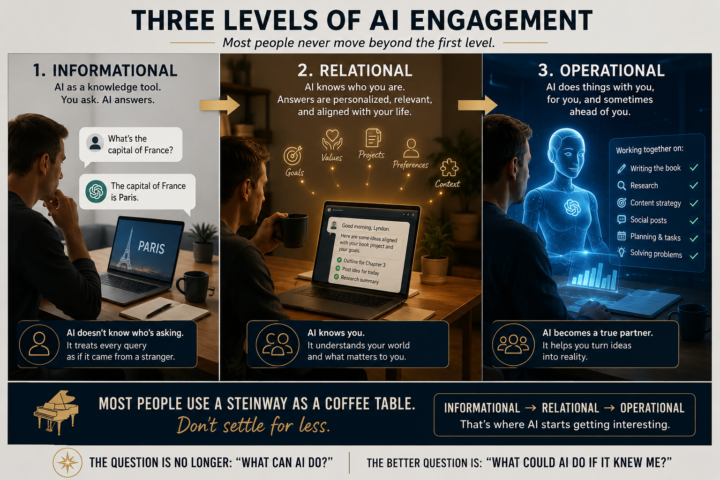
The Three Levels Of AI
Most people are barely using AI. Not because they’re doing anything wrong. They’ve simply never moved beyond the first level. There are three levels of AI engagement: Informational. Relational. Operational. At the informational level, you ask AI questions and get answers. What’s the capital of France? Summarize this article. Help me understand this concept. Useful? Absolutely. But you’re still interacting with AI as a stranger. The second level is relational. This begins when AI knows who’s asking. It knows what you’re working on. What you care about. How you think. What success looks like for you. And suddenly, the same AI that gave you generic answers begins giving you answers that actually fit your life. Then comes the third level: operational. AI begins doing things with you and for you. Writing. Researching. Planning. Solving problems. Helping you turn ideas into reality. But here’s what most people miss: The operational level becomes dramatically more powerful when it’s built on the relational level. An AI that doesn’t know you can produce work. An AI that knows you can produce work for you. And that’s the real shift. The question is no longer: “What can AI do?” The better question is: “What could AI do if it knew me?” Most people are using one of the most powerful technologies ever created as a better search engine. That’s a little like buying a Steinway and using it as a coffee table. The real opportunity begins when you move beyond information. Informational → Relational → Operational That’s where AI starts getting interesting.
0
0
1-19 of 19
powered by

skool.com/flourishing-with-ai-2400
Exploring how AI can help us think, create, learn, and flourish. Conversations about technology, creativity, philosophy, productivity.
Suggested communities
Powered by