
Write something
Pinned

7d •
Welcome to the Geek 2 Greek Starter Zone. Here's your orientation.
You found this community because something isn't adding up. You're sharp. You solve hard problems for a living. You can architect a distributed system at 2am with a cold brew and a deadline, but you can't seem to stick to a workout plan you've had open in another tab for three weeks. I get it. I was it. Twenty-five years as a software engineer, and I spent most of that time treating my body like a background process running at low priority. The result was exactly what you'd expect from any deprioritized system: degraded performance, memory leaks, and a UI that hadn't been updated since the early 2000s. This community exists because the standard fitness advice doesn't compile in your life. It was written for people who aren't managing stand-ups, sprints, on-call rotations, and the very specific mental tax of sitting in front of a screen for 10 hours a day. Here, we do things differently. #### # What this community is ############# A focused, low-noise space for desk-bound guys who want to build a body that matches the career they've already built. No bro culture. No supplement spam. No "just be more disciplined" advice from people who don't have your job. #### # What's available to you right now ############# The Classroom has three free courses that will give you more functional fitness knowledge in a few hours than most guys get in years of random gym visits: - Geek to Greek Starter Pack: The orientation. Why you're skinny-fat (and why that's a solvable problem), how the gym actually works, and what to eat without a PhD in nutrition. - The Training OS: The five movement patterns that everything else is built on. How to structure a training week. How to actually read your own progress data. - The Deployment Blueprint: The course most guys skip. Why you keep respawning at the same starting point. How to build a consistency system that doesn't run on willpower. #### # Where to go first ############# If you're brand new: Start in the Classroom with Lesson 1.1 of the Starter Pack. It takes 10 minutes and will reframe how you've been thinking about this problem.
1
0
Pinned
7d •
The rules. Read them. They're short.
Every good system has constraints. Here are ours. - Rule 1: No noise. This is a focused community. We're not here to debate whether creatine is "natural." We're not here for supplement referral links, random motivational quotes, or posts that could have been a Google search. If it doesn't move someone's training or nutrition forward, it probably doesn't belong here. - Rule 2: No bro culture. You know the type. The guy who responds to every question with "just lift heavy bro" or critiques form videos by listing their maxes. That energy doesn't live here. We're engineers. We explain the why. - Rule 3: Dumb questions don't exist here. Unasked questions do. The gym can feel like everyone else was born knowing how it works. They weren't. Ask the question you've been Googling for three weeks. Someone else has the same one and hasn't asked yet. - Rule 4: Be specific. "My back hurts" is not a post I can help with. "My lower back rounds on the bottom of my deadlift at 185lbs" is. The more specific the input, the better the output. This applies to form checks, nutrition questions, and everything else. - Rule 5: Self-promotion is off. Don't sell your stuff here. Don't drop affiliate links. Don't DM members about your coaching. This community exists to help you, not to be your funnel. - Rule 6: Progress counts, not numbers. Adding 5lbs to your squat after six weeks is a win worth posting. You don't need to be squatting 315 to use the 🏆 Level Ups category. Post the win. We'll acknowledge it. That's it. Short list. High standard. If you're unclear on whether something belongs here, ask yourself: Would Philip post this? If the answer is probably not, hold off and DM me instead.
1
0
5d •
Unpopular opinion: most of us don't have a time problem.
I'll say the quiet part out loud: most of us don't have a time problem; we have a prioritization problem that we've reframed as a time problem because it's easier to defend. I know this because I made this argument for years. I work a 9-5, and then a 6-9, leaving only Friday evenings and weekend free. My days are genuinely packed. The meetings are real. The deadlines are real. The clients are real. The exhaustion at 5pm, let alone 9pm(!), is real. What was not real was my belief that there was no available time. The 9-5 is remote, which means I have some flexibility mid-day. What actually happened to that flexibility: the couch. Reddit. Slack scrolling. YouTube rabbit holes. And then WoW in the evenings before I crashed into bed. Sometimes all of those at once. I'm not saying that to shame anyone. I'm saying it because I was doing the exact same thing and telling myself I didn't have time to work out. The actual reframe that worked for me: I stopped asking "when do I have time" and started asking "what am I currently doing with the time I have." The audit was uncomfortable. The result was useful. Three 30-minute sessions per week. That's 90 just minutes. In a 168-hour week. That's 0.54% of available time. If 0.54% of your week is genuinely not available, your problem is not fitness ... it's something else worth examining. What's the honest answer when you audit your own time? I'm curious where the hours actually go.
1
0
6d •
I optimized everything in my life except the most obvious thing.
For most of my career, I was the guy who automated the boring stuff, refactored the messy codebases, and built systems that scaled. I took pride in that. I still do. But for about fifteen years, I had a blind spot so obvious in hindsight that I'm mildly embarrassed to type it out: I never once applied any of that logic to my own body. I knew how to debug systems. I knew how to identify where inputs weren't producing expected outputs. I understood progressive overload in principle — the concept that you apply incremental stress, measure the response, and iterate. I taught this kind of thinking at work. And yet. My workout routine for the better part of a decade was whatever felt right that day, fueled by Google searches and whatever YouTube algorithm happened to surface at 11pm. I ran a 5-day bro split for two years — chest/tri, back/bi, the whole thing. I had almost nothing to show for it. Because my routine and my diet both sucked, and I didn't have a system to tell me that. The turning point wasn't dramatic. There was no inciting incident. It was more like a slow compile error that I finally stopped ignoring — a creeping awareness that I was spending serious energy optimizing my professional life and treating my physical health like a side project I'd get to eventually. I started treating fitness the way I treated engineering problems. Define the goal. Map the inputs. Find the feedback loop. Remove the variables I couldn't control. Measure what mattered. It worked. Not in a dramatic before-and-after-photo way — in the boring, sustainable way that good systems work. Slow, measurable, consistent progress. Strength went up. Body composition improved. Energy stabilized. The gym stopped feeling like a place where everyone else knew the rules except me. That's what I built this community to teach: the same analytical mindset you already have, applied to the one system you've been under-engineering. You already know how to think about this. You just need someone to show you how to apply it.
1
0

1-4 of 4
powered by
skool.com/cpz-fitness-4218
From desk-bound to damn-strong.
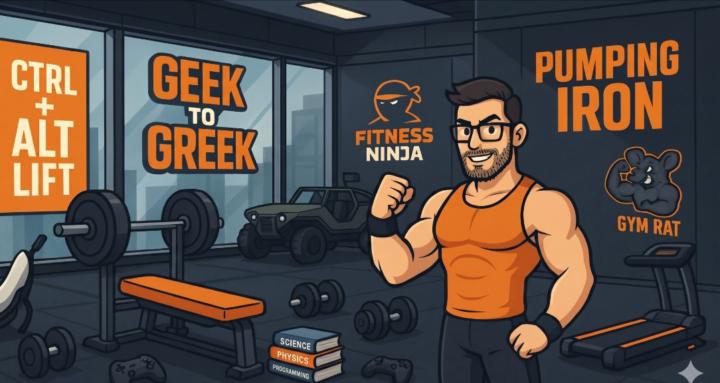
Geek 2 Greek is a community of nerds and geeks alike who want to level up their mind, body, and confidence.
Suggested communities
Powered by