

15d •
From Listing URL to Finished Property Video (With One Skill)
Most real estate photographers already have everything they need to sell AI video services: the listing photos. I built and tested a workflow where you simply paste a property listing URL, and the system automatically creates a complete property video with an AI virtual avatar. No manual editing. No scripting. Just the listing URL.


Jul 15 •
What 1.5 days and about 5 billion AI tokens produced
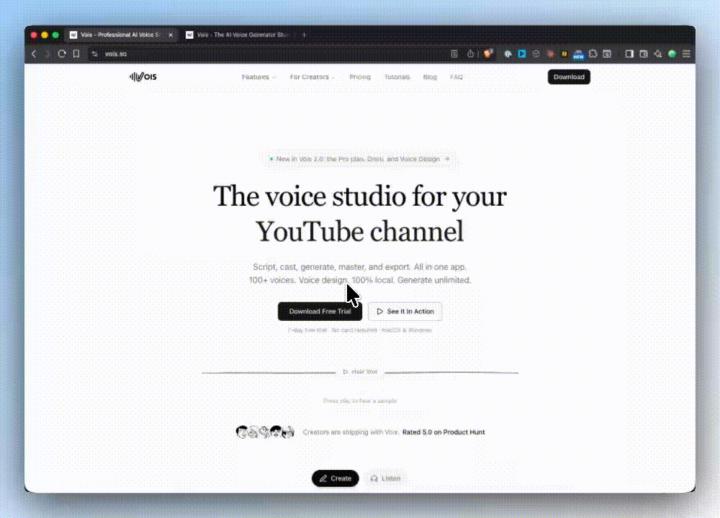
I just shared the full walkthrough of the Vois website refresh on LinkedIn. I have attached it here too because the process is more useful than the screenshots alone. The headline is big: less than 1.5 days from idea to deployment, with about 5 billion text-agent tokens used along the way. That total excludes image and video generation. Before I posted it, I asked a friend who is a veteran UI/UX designer to review the work. His response: "I hate you. this is good... I hate you for making it" For context, I am the founder of Vois, and this is my own product and codebase. I ran the refresh like a coordinated AI product team. I stayed responsible for the product direction, visual taste, quality bar, and every ship or reject decision. The setup: • GPT-5.6-sol handled the main orchestration. It broke the work into plans, assigned specialist agents, integrated their output, and kept the release moving. • More than 300 specialist sub-agents using GPT-5.6-terra and Grok-4.5 worked in parallel and in sequence across planning, UX, choreography, visual design, asset creation, copy, frontend development, mobile QA, accessibility, browser testing, performance optimisation, and deployment. • Fable-5 acted as an independent advisor. It reviewed alternatives, challenged decisions, and sent weak work back through another pass. • GPT-image-2 generated the images and characters. Grok Imagine generated the video assets. Their generation usage is not included in the roughly 5 billion text-token total. The text-agent token split: Main agent: 13% Sub-agents: 51.3% Advisor agent: 35.7% What shipped: • a complete visual refresh for Vois • a cinematic, scroll-driven homepage • a consistent design system across the site • dedicated desktop and mobile behavior • generated visual and motion assets • accessibility, performance, browser, and deployment fixes The 5 billion total makes the trade visible. I used far more compute and coordination to compress a large design and engineering cycle into less than 1.5 days.

Jan 15 •
🗺️ Voice AI Conversation w/ 3D Maps - Full FREE App
It's not just answering questions — it's showing you. "Hey, show me the best coffee shops near the Eiffel Tower" And it just... does it. Pans the map. Zooms in. Highlights spots. Talks back to you about what it found. This isn't search. This is conversation. --- What is this thing? Voice AI Conversation with Google Maps — a voice-powered AI agent that actually controls Google Maps while you talk to it. Ask it anything: - "What's the fastest route avoiding highways?" - "Find me beachfront hotels under $200 in Portugal" - "Show me where all the national parks are in Utah" - "Zoom out and show me the whole country" It doesn't just answer. It shows you. In real-time. While talking back. --- Why this hits different We've all typed into Google Maps. But talking to a map that responds, moves, and explores WITH you? That's a completely different experience. It's like having a knowledgeable local guide who also happens to control a giant interactive map on your wall. The Open Source Repo: https://github.com/moshehbenavraham/chat_with_google_maps --- The nerdy part (for my fellow builders) 🔧 Started with Google's AI Studio demo — cool proof of concept, but basically a toy. Nearly FULLY AUTOMATICALLY built: - Full authentication system - Secure backend (no exposed API keys 🔐) - Database for saving your stuff - AI monitoring dashboard and logging - Local/Dev/Production deployment on Vercel - 18,500+ lines of code Built the entire thing using the Apex Spec System — an open-source spec-driven Plugin/Skill for Claude Code. Every feature was spec'd out first, then built systematically. Complex project, zero chaos. 🔗 github.com/moshehbenavraham/apex-spec-system --- The future is conversational We're moving from: Click → Type → Talk This is just the beginning 🚀 Voice + AI + Maps is one combination. What about Voice + AI + your industry? The patterns we built here — security, monitoring, auth, database — they're reusable building blocks.

🔥
Feb 4 •
Using Claude to Make Money...
I've just finished my latest video: a three and a half hour zero-to-hero Claude Code explainer. I've included the most recent improvements on Claude to move as fast as possible and get a product which ACTUALLY makes money: https://youtu.be/roYQt9rL8Kc This is the actual method I'm using right now to generate solutions which people are genuinely excited to pay me! A real win-win... If you guys can drop some love on the video, I'd be SUPER grateful to try and help others with this... 🙏🏼

Nov '25 •
What’s a creator win you had this week? Big or small — let’s hear it. Post:
Let’s wrap up the week the right way. Maybe you filmed something, fixed your workflow, found a new tool, or even finally posted after procrastinating. What’s one creator win you had this week?
1-17 of 17

skool.com/content-academy
Build a profitable content strategy, efficient team & automated process
Leaderboard (30-day)
1
+47
2

🔥
+24
3
+14
4
+10
5

+7
Powered by