
Write something
Pinned

24d •
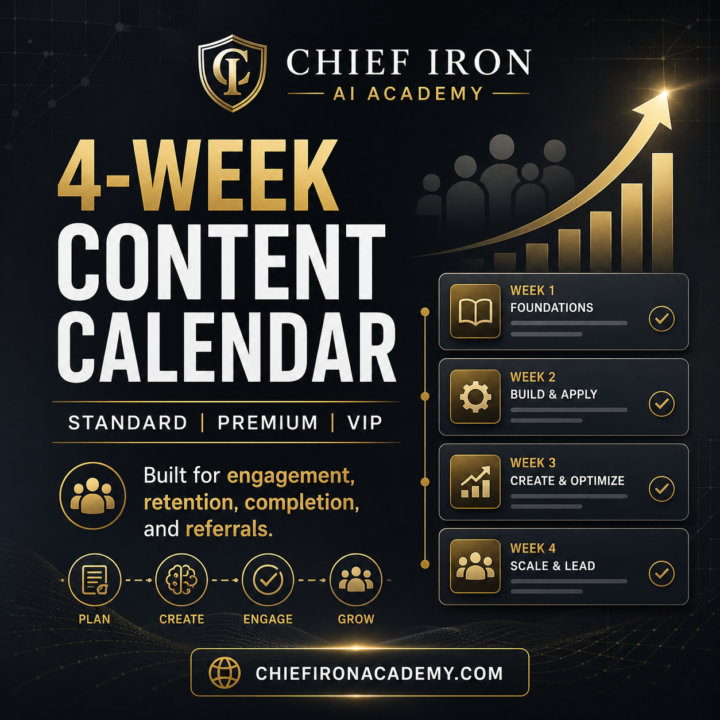
Your 4-Week AI Momentum Sprint Begins Tomorrow, May 11, 2026
May 11, we officially begin our 4-week Chief Iron AI Academy™ classroom sprint. This is not about watching random lessons and disappearing. This is about building real AI confidence, real workflows, real skill, and real momentum — one week at a time. Whether you are brand new to AI or already using it, the goal for this month is simple: Learn it. Use it. Build with it. Share your wins. Level up. Here’s how this month will work: Every week, you will receive a clear classroom lesson based on your tier: Standard Members Your focus is clarity, confidence, and beginner-friendly AI wins. You will learn how to: - understand AI without confusion - use ChatGPT for everyday tasks - write better prompts - build your first simple AI workflow Your goal this month:Get comfortable using AI and complete at least one real task with it each week. Premium Members Your focus is stronger prompts, better workflows, content creation, tool comparison, and monetization basics. You will learn how to: - get better answers from AI - turn one idea into multiple content pieces - compare ChatGPT, Claude, and Gemini - use AI to save time, create faster, and support income Your goal this month:Build repeatable AI workflows that produce real results. VIP Members Your focus is implementation, strategy, authority, offers, and higher-level execution. You will work on: - AI consultant thinking - diagnosing problems before choosing tools - shaping offers, workshops, or services - refining AI outputs until they are client-ready - building authority assets that can create opportunity Your goal this month: Turn AI knowledge into systems, offers, leadership, and implementation power. Your First Action Step Before tomorrow’s first lesson drops, comment below with: 1. Your current tier: Standard, Premium, or VIP 2. Your main AI goal for May 3. One thing you want AI to help you do better Use this format: Tier: My May AI Goal: I want AI to help me with: Example:
Pinned
Jan 14 •
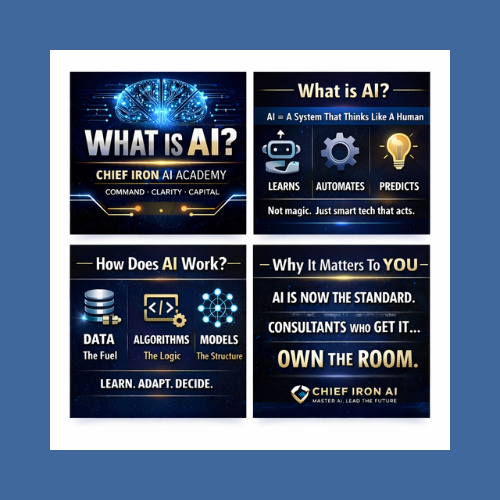
🧠 What Is AI? — Let’s Make It Clear, Now.
Chief Iron AI Academy — listen up. Before we talk tools, prompts, or profits… we build understanding. Because if you can’t define AI with clarity, you can’t consult on it with authority. So here it is — no fluff. 🔍 What Is AI? Artificial Intelligence (AI) is a system trained to think like a human — but faster, deeper, and always learning. It doesn’t mean robots with faces. It means software that learns patterns, makes decisions, and performs tasks without constant human input. This includes: - Chatbots that learn your customer’s tone. - Automation that handles repetitive tasks. - Prediction engines that forecast behavior, risk, or demand. AI is not magic. It’s just pattern recognition at speed and scale. ⚙️ How Does It Work? AI is powered by: - Data: The fuel (emails, images, numbers, voices, you name it) - Algorithms: The logic (rules, filters, decision trees) - Models: The structure (like GPT, trained on massive datasets) Put simply: “Feed it enough quality data, and AI starts making better decisions than most humans ever could.” 📌 Why It Matters To You You’re here to become an AI Consultant. That means you don’t just use tools — you explain them to business leaders with confidence. Your value is in translating AI into action: - Helping a law firm automate contracts. - Guiding a coach to scale content with generative AI. - Building systems that turn chaos into clarity. 🔑 Real-World Use Cases AI is already doing this: - Finance: Spotting fraud in real-time - Retail: Personalizing the customer journey - Health: Diagnosing patients faster than doctors - Education: Creating custom learning paths - Operations: Streamlining workflows with smart bots ✅ Your Move You are now responsible for this truth: “AI is not the future. AI is the standard. And consultants who understand it — own the room.” 📣 Drop a 💡 if this hit. Tell us below — which industry or client would you want to bring AI to first? You’re not learning AI. You’re mastering it.
Pinned
Dec '25 •
🔥 Welcome to Chief Iron AI Academy™
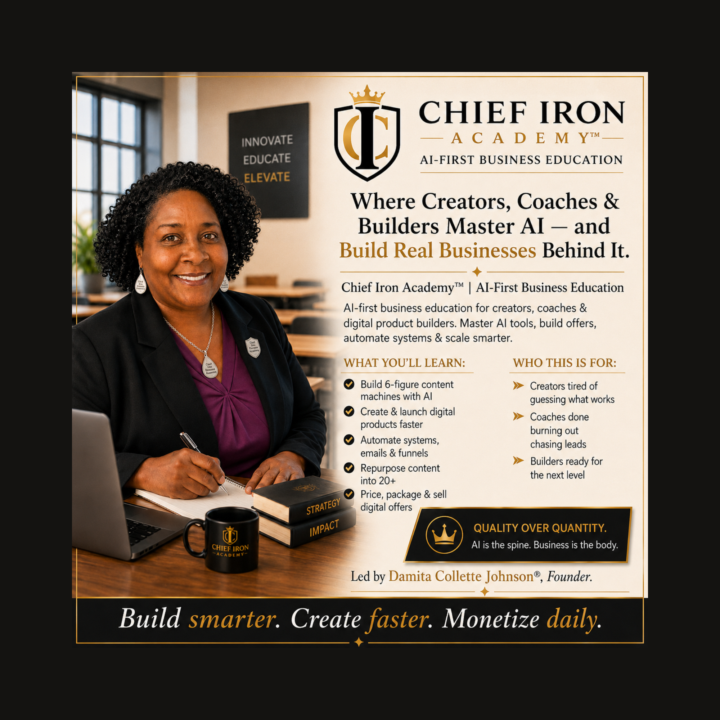
The #1 Skool for Creators, Coaches & Digital Product Builders who want to SCALE with AI. This isn’t just another AI group — it’s your launchpad for automated income, magnetic content, and AI-powered offers that convert. Whether you're just starting or scaling fast, here’s where elite solopreneurs and marketers come to learn: ✅ How to build 6‑figure content machines ✅ How to create & launch digital products with AI ✅ How to automate client systems, emails, & funnels ✅ How to repurpose one video into 20+ content pieces ✅ How to use ChatGPT, Canva, Notion, and more — tactically You’ll get plug-and-play prompts, live workflows, toolkits, and weekly community builds. We teach what works NOW. 🔗 If You’re Ready To: • Monetize your content without burnout • Launch digital offers faster than ever • Systemize your business with AI • Build a freedom-first business… Then you’re in the right place. 💬 New here? Introduce yourself and tell us: “What’s your #1 growth goal right now?” 🧠 Let’s build smarter. Create faster. Monetize daily. DOWNLOAD YOUR FREE EBOOK/JOURNAL TODAY! MOTTO: QUALITY over quantity!
4d •
I almost named this place wrong.
True story. Two days ago I sat down to refresh the brand and almost made a decision that would've cost me everything I've built here. I almost dropped "AI" from the name. The thinking was reasonable — broaden the appeal, attract general business buyers, not just AI people. Sounded smart on paper. Then I caught myself. Because here's what I know about the work being done inside this community: You're not here because you want "general business education." You're here because AI changed the rules — and you refuse to be the person who got left behind. You're here because you saw what AI does for creators who get it right, and you decided you'd rather be early than sorry. You're here because the difference between the coaches making $300/month and the ones making $30K/month is no longer "talent" or "hustle." It's AI fluency. Period. So I kept the name. I kept the spine. But I changed something else. Chief Iron Academy™ is no longer just about AI tools and prompts. It's about everything that AI makes possible: → The digital products you build in days, not months → The funnels that run while you sleep → The content engines that produce 30 pieces from 1 idea → The consulting offers that command premium prices → The systems that finally let you scale without burning out AI is the spine. Business is the body. We teach both. That's the promise. If you're new here — welcome. Read the rules. Introduce yourself in Wins, Questions & Support. Tell us what you're building. If you've been here — thank you. The work you do in this community is what made me protect the brand instead of dilute it. Now back to building. — Damita Founder | Chief Iron Academy™ P.S. The motto stays: QUALITY over quantity. Always. For educational and informational purposes only; not legal, tax, or financial advice.
1
0
11d •
AI Video Creation Toolkit: Tools to Script, Create, Voice, Score & Edit Your Videos
🎬 TEXT-TO-VIDEO GENERATION • Sora (OpenAI) → https://openai.com/sora • Runway Gen-3 → https://runwayml.com • Kling AI → https://klingai.com • Pika Labs → https://pika.art • Luma Dream Machine → https://lumalabs.ai ✍️ AI SCRIPTWRITING & STORY DEVELOPMENT • Claude (Anthropic) → https://claude.ai • ChatGPT (OpenAI) → https://chat.openai.com 🎨 STORYBOARDING & VISUAL DEVELOPMENT • Canva AI → https://canva.com • MidJourney → https://midjourney.com 🎙️ AI VOICE & NARRATION • ElevenLabs → https://elevenlabs.io • PlayHT → https://play.ht • Murf AI → https://murf.ai 🎵 AI MUSIC COMPOSITION • Suno → https://suno.ai • Udio → https://udio.com • Soundraw → https://soundraw.io 🎞️ VIDEO EDITING & ASSEMBLY • DaVinci Resolve → https://blackmagicdesign.com • CapCut → https://capcut.com • Adobe Premiere Pro → https://adobe.com/premiere
2
0
1-24 of 24
powered by

skool.com/chief-iron-ai-academy-6825
AI-First Business Education. Master AI. Build the business. Scale on your terms. For creators, coaches & digital product builders who lead with AI.
Suggested communities
Powered by