

3d •
Journal Club Number 6 is happening tonight!
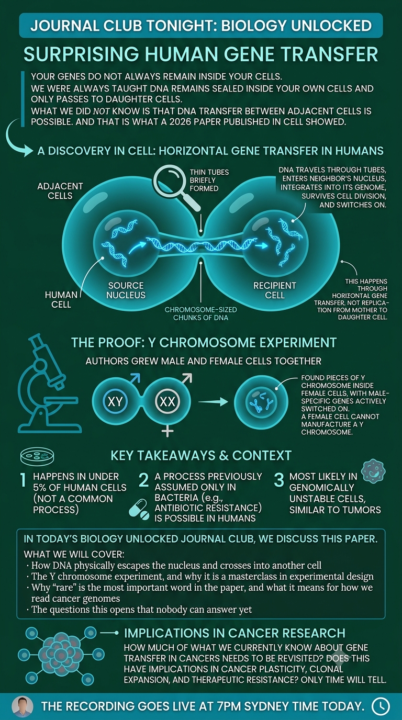
Your genes do not always remain inside your cells. Sounds weird right? We were always taught that DNA remains sealed inside your own cells and is only passed on to your own daughter cells. What we did not know is that DNA transfer between adjacent cells is possible. And that is what a 2026 paper published in Cell showed. It turns out, chromosome-sized chunks of DNA can be passed from one human cell to an adjacent one. The point to note here is that the DNA does not pass from mother cell to daughter cell through replication. This happens through a process called horizontal gene transfer. The DNA travels through these thin tubes that are briefly formed between two touching cells, enters the neighbour's nucleus, integrates into its genome, survives cell division, and switches on. What fascinates me is the proof. The authors grew male and female cells together, and found pieces of the Y chromosome inside the female cells, with the male-specific genes actively switched on. A female cell cannot manufacture a Y chromosome. This only happens under 5% of human cells, so it is not a common process of gene transfer. What is notable is that a process that we used to assume happens only in bacteria—i.e., horizontal gene transfer between bacteria is how they develop antibiotic resistance—is also possible in human cells. What is also important is that the cells most likely to do it are the genomically unstable ones. Similar to the ones in a tumor. In today's Biology Unlocked Journal Club, we discuss this paper. Here is what we will cover: · How DNA physically escapes the nucleus and crosses into another cell · The Y chromosome experiment, and why it is a masterclass in experimental design · Why "rare" is the most important word in the paper, and what it means for how we read cancer genomes · The questions this opens that nobody can answer yet The recording goes live at 7pm Sydney time today. This is also fascinating to me because of the implications of this paper in cancer research. If cells can transfer DNA to each other, how much of what we currently know about gene transfer is cancers needs to be revisited? Does this have implications in cancer plasticity, clonal expansion, and therapeutic resistance? Only time will tell.
5d •
Biology Unlocked Article #9
Anthropic just launched an AI workbench for scientists. It connects 60 scientific databases in one place. It still cannot tell you if your science is any good. Claude Science went live this week. Genomics, single-cell, proteomics, structural biology, all in one environment. Ask a question in plain language, get an answer synthesised across databases that used to take a full day to query separately. Every output carries a full audit trail. The exact code, the environment, the full history of how the result was made. That last part is important. We all know that reproducibility is a sore point for modern science, and most AI tools have made it worse, not better. This one is built to make it traceable. Here is what it does not do. It is not a new model. It is not smarter about biology than the model underneath it. It is a better interface for the tools you already use. Which means it will run whatever pipeline you give it, beautifully, whether or not that pipeline is asking a biologically sensible question. A well-organised analysis of the wrong question gives you a well-organised wrong answer. With a full audit trail attached. The tool removes the friction. It does not remove the need to know what you are doing. AI for science is not intelligence about science. It is infrastructure for science. The intelligence still has to come from you. If you connected every database you use into one interface tomorrow, what is the first question you would ask it? #bioinformatics #datascience #computationalbiology #AIinbiology
2
0
9d •
Journal Club No. 05 drops tonight at 7pm Sydney.
This one is different from the others. We are not reading a lab discovery. We are reading a tool: AlphaGenome, the model Google DeepMind released this year that takes raw DNA sequence and predicts thousands of things about what it does, at single-letter resolution. On paper it sounds like the genome is solved. It is not, and the reason why is the most useful part of the session. Here is the detail worth sitting with before you watch. The model hands you a score. This variant probably changes gene expression, by this much, with this confidence. That score is real, and it is often right. But a score is not the same thing as knowing what a change in the genome actually does. The model can tell you that something shifts. It cannot tell you why, or what the biological story behind it is. That gap between prediction and understanding is not a footnote. It is the whole reason biological fluency still matters even when the AI is very good. We cover what AlphaGenome gets right, where it quietly breaks, and what you can and cannot trust it for if you work with genomic data yourself. No background needed. Recording goes up here at 7pm Sydney, free to watch. Just head over the to Classroom and click on “Journal Club” or click on this link (https://www.skool.com/biology-unlocked-7569/classroom/becc80e4?md=13cb2db885b94e94b7360e549df8f738) to watch! Paper: Avsec et al. (2026). Advancing regulatory variant effect prediction with AlphaGenome. Nature 649, 1206–1218. DOI: 10.1038/s41586-025-10014-0
2
0
10d •
Journal Club #5 is happening tomorrow!
AlphaFold read proteins. AlphaGenome is trying to read the genome. Google DeepMind just published a model that takes one million base pairs of DNA as input and predicts thousands of functional outputs at single base-pair resolution. Gene expression. Splicing. Chromatin accessibility. Transcription factor binding. All from sequence alone. It matched or outperformed every existing model on 25 out of 26 benchmark tasks. It can simulate known mutations responsible for leukaemia and predict what goes wrong at the regulatory level. 98% of genetic variants that affect disease risk sit in non-coding DNA, the parts of the genome that don't make proteins but control how genes are switched on and off. AlphaGenome was built specifically to read that part. This is what we are breaking down tomorrow in Journal Club. Not just what AlphaGenome can do, but what it still cannot do, and what that tells us about how much of the regulatory genome we actually understand. Tomorrow. Saturday. 7pm Sydney, 2:30pm IST. Biology Unlocked Journal Club. Free to join. Link in the first comment. #molecularbiology #genomics #bioinformatics #AlphaGenome
2
0
12d •
Biology Unlocked Article #8
A drug showing 15-fold downregulation of an oncogene sounds like a breakthrough. It wasn't. And only a biologist caught it. Jan was testing whether her drug could reduce expression of two oncogenes in a cancer cell line. Her positive controls were showing roughly two-fold downregulation. Her drug was showing fifteen-fold. She sent the data to Jon, the bioinformatician in the collaborating lab. The numbers held up. They agreed: this drug had potential. Except something was bothering Jan. She wasn't seeing the protein-level changes you would expect from a 15-fold shift. And the cells weren't dying the way they should be. So she went back to the raw Ct values. She found it. One of her three reference genes had inconsistent expression across samples. Reference genes are used in qPCR to normalise data across samples. The assumption is that they are stably expressed regardless of condition. But reference gene expression varies across tissues and cell types. A gene that works in one tissue may be completely unreliable in another. When one reference gene is unstable, your normalisation is wrong. When your normalisation is wrong, every fold-change built on it is wrong. The 15-fold downregulation was not a drug effect. It was a maths problem built on a biological assumption nobody had checked. Jon never saw it. The analysis was clean because the input looked clean. An AI would have called this a finding. Jan caught it because she knew what raw Ct values meant. Because she knew that reference genes are not always reference genes. If she hadn't, this would have been submitted. Possibly published. Resources spent chasing a result that was never real. The difference between a finding and an artefact is not always in the statistics. Sometimes it is in knowing which biological assumptions your numbers are resting on. Would your pipeline have caught this? #bioinformatics #datascience #molecularbiology #qPCR
2
0
1-27 of 27
powered by
skool.com/biology-unlocked-7569
Molecular biology for data scientists, AI engineers, editors and research-adjacent professionals. No biology degree needed. Start from anywhere.
Suggested communities
Powered by