
Write something
Pinned

Aug '25 •
You are working harder than you need to on that lawn...
Switching from a quick‐fix, synthetic fertilizer mindset to a true biological lawn care system can feel like an uphill battle. You’ll face skeptics, weather setbacks, and the occasional patch of stubborn thatch—but remember: every challenge is a stepping stone toward a healthier, more resilient lawn. Take a deep breath, lean into the process, and don’t forget to roll around on that lush green carpet once in a while—it’s good for your body, mind, and soul. Read more on our blog: https://www.springslawns.com/the-fight-is-worth-it-embrace-the-biological-lawn-care-journey/
1
0
13d •
The Two Water Magic Tricks: Getting It Into the Soil and Keeping It There
The Two Water Magic Tricks: Getting It Into the Soil and Keeping It There For much of my career, I’ve thought about two water problems as magic tricks: getting water into the soil and keeping it there. They sound simple. Turn on the sprinklers, water the lawn, and let the soil do its job. But a surprising amount of irrigation never reaches the roots in a useful way. Some water is lost to evaporation and wind. Some runs across the surface, pools in low spots, or moves below the root zone. And sometimes the soil is so compacted that water struggles to get in at all. A water bill tells you how much water passed through the meter. It doesn’t tell you how much reached the roots. You can spend hundreds of dollars watering a lawn and still lose much of that water to poor timing, poor coverage, runoff, or soil that cannot hold the moisture your grass needs. Magic trick number one: Get water into the soil Many lawns are watered by habit: the timer runs for the same number of minutes on the same days, whether the weather, soil, or grass needs it or not. Sprinkler heads may be misaligned, blocked, or unevenly spaced. A long cycle can put water down faster than the soil can absorb it, sending it onto a sidewalk or driveway. The soil itself can make the problem worse. Compaction reduces the larger pore spaces that allow air and water to move through the ground. Roots need those spaces, too. Along the Front Range, compacted and clayey soils can make it harder for water to infiltrate and for roots to grow deeply. CSU Extension Healthy soil structure develops as roots and soil organisms interact with organic matter. Microorganisms help bind small soil particles into aggregates. Those aggregates create a network of spaces where water can enter and move, and where roots can grow. It takes ongoing care; one quick treatment cannot build lasting soil structure overnight. CSU Extension
0
0

15d •
It's been a while...
It's been a while since I have been in here but it was with good reason. The biology program that I hav ebeen working on for th epast 9 years hit warp drive. WE made some rather important discoveries since last year and it is so much more effective. We can now provide someone the keys to th eprocess on how to have a lawn that works when you are gone, and does it far more better. Be sure to read our blog @ www.springslawns.com/blog Here is a primer to get you up to speed... https://www.springslawns.com/bob-and-bill-two-neighbors-two-very-different-lawns/
0
0
Feb 9 •
Time to get thinking about 2026. Automation and a Biological system will be KING this year.
Alright crew — welcome to 2026. This is the year we stop “trying harder” and start getting leverage. Here’s the big idea I’m building everything around: Automation + Biology will be KING. Why Automation wins If you’re still relying on human effort to create consistency, you’re fighting a losing battle. Automation gives you: - Consistency (the #1 ingredient for results) - Time back (less chaos, fewer bottlenecks) - Better outcomes (because the system never “forgets”) Robotic mowing isn’t a gimmick — it’s a platform. It changes everything: weed pressure, density, recovery, appearance, and your ability to actually run a modern program without burning out. Why Biology wins Synthetic lawn care is the illusion of health. Biology is the real thing.When the soil is alive and balanced, the lawn stops acting fragile. It becomes resilient. That means: - Better water handling - Stronger roots - Fewer weeds over time - Less dependence on “inputs” that keep you trapped Getting started (do this now) This week, I want you to take 3 simple steps: 1. Pick your lane: Service customer or DIY warrior — either way, commit to consistency. 2. Get a baseline: pics + what you’re currently doing (watering, mowing, products). 3. Start thinking like a builder: we’re not “treating grass,” we’re building a system. Your first post Drop a comment with: - Your goal for 2026 (simple + specific) - Your biggest lawn frustration - Whether you’re going Automation, Biology, or both Let’s make this the year you look back on and say: “That’s when everything changed.”— Brian
Jan 2 •
Happy New Year!
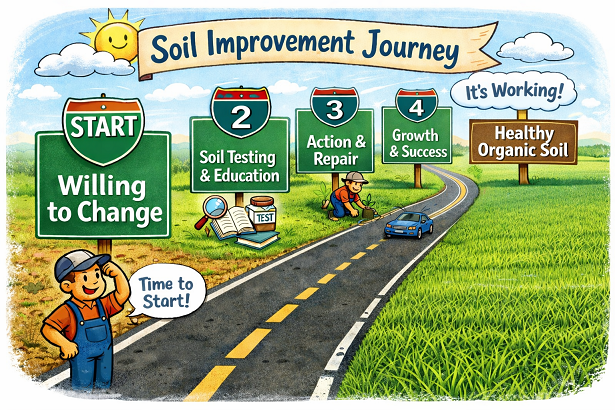
We have some exciting things in store for 2026. We have polished our Biological program and made some massive breakthroughs that will make people want to pay attention but the biggest problem in that step is understanding the process and realizing how bad things really are and how awesome things can be. I have prepared a simple roadmap of what the journey looks like. If you ever want to know what I am thinking you can always check out the MASSIVE resource center (our blog) on our website: www.springslawns.com. WE are just about to unveil what everyone has been waiting for, our Biology course, coming real soon! Have a great New Year. I hope that you reach all of your goals this year. Let the betterment of your lawn be one of them! https://www.springslawns.com/blog/ Thank you, Brian
1-30 of 59
powered by

skool.com/biological-turf-5671
We are learning the world of regenerative soil repair using microbial life to replace the use of synthetics. We are solving problems...
Suggested communities
Powered by