
Write something
14d •
Enoki vs. Carpet vs. PISLAB
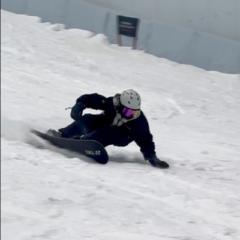
In this post let's discuss the pros and cons of each snow-simulating material. 1. Enoki mushroom: This material can be seen on both simulators and dry slopes for airbag/park. Pros - Can feel the snowboard's edge bite into the material. When practicing tricks on airbags, has a sturdy platform to jump off the ramp. Cons - Does not allow early edge change. Does not support high edge-angle. Best used for - Practicing basic turns at low speed/ Static Ground tricks/ Airbag jumps. 2. Carpet: Mostly seen to be used on simulators. Probably the least liked material out of all 3. Pros - Consistent feel, least vibrations felt. Cons - Extremely grippy and catchy at low speed, edge does not bite into the carpet at all, also does not allow early edge change. Best used for - People just starting out to learn side-slipping on heel and toe (provides a consistent feel to build good balanced posture). Perhaps learning a little bit of traversing. Side Note: The feeling of trying to do S-turns on this material differs from the snow to a great extent, feels least like the snow out of all 3 types of material. 3. PISLAB outdoor dry slope This is a less popular material mainly seen in Japan's summer slopes like Nozawa. Pros - Least catchy, allows for early edge change and high speed high edge-angle carving. Feels the most similar to actual snow out of all 3 types of material. Cons - Requires precise control, not beginner-friendly. Which types of dry slopes have you tried riding on and what are your thoughts? Let me know in the comments!
2
0
21d •
3 types of dry slopes for summer training
When we look at options for summer training, there are different types of material used which give us vastly different feels for riding. So far I have tried on 3 different types of dry slope materials: 1. Enoki Mushroom 2. PISLAB 3. Carpet There are pros and cons of each material and I will be making a detailed comparison about the benefits of training on each of the materials in the following posts. Stay tuned!
1
0

Jun 19 •
How to turn elegantly on red slopes?
I have created a new set of content explaining about the "flexing edge change" technique used to ride steeper slopes with ease. Go check them out! 👇 https://www.skool.com/andys-snowboard-skool-7773/classroom/f6628f1b
1
0

Jun 6 •
Off-Season training tool: SURFSKATE
Recently I have picked up a new off-season training activity - surfskating. I found many similarities between surfskating and snowboarding and I'd like to share my findings with you guys here. Potentially this could be something that you guys can pick up to work on snowboarding skills during summer 😏 𝗤: 𝗪𝗵𝗼 𝗶𝘀 𝘀𝘂𝗿𝗳𝘀𝗸𝗮𝘁𝗶𝗻𝗴 𝗳𝗼𝗿? 𝗔: 𝗜𝗻𝘁𝗲𝗿𝗺𝗲𝗱𝗶𝗮𝘁𝗲 𝘀𝗻𝗼𝘄𝗯𝗼𝗮𝗿𝗱𝗲𝗿𝘀. Riders who can already do S-Turns on snow, surfskate will help to train your overall balance to sharpen your turns and clean up bad habits. If you are just starting out and new to snowboarding, meaning still learning how to control your edges to sideslip, going for the simulator would probably be more effective. However, intermediate riders may find the carpet material on the simulator not quite similar to snow and struggle to do turns going back to the simulator. Hence, surfskate will be a good alternative. 𝗤: 𝗪𝗵𝗮𝘁 𝘀𝗶𝗺𝗶𝗹𝗮𝗿𝗶𝘁𝗶𝗲𝘀 𝗱𝗼 𝘀𝘂𝗿𝗳𝘀𝗸𝗮𝘁𝗲 𝘀𝗵𝗮𝗿𝗲 𝘄𝗶𝘁𝗵 𝘀𝗻𝗼𝘄𝗯𝗼𝗮𝗿𝗱𝗶𝗻𝗴? 𝗔: 𝗧𝗵𝗲 𝗳𝗼𝘂𝗿 𝗱𝗶𝗿𝗲𝗰𝘁𝗶𝗼𝗻𝘀 𝗼𝗳 𝗯𝗼𝗱𝘆 𝗺𝗼𝘃𝗲𝗺𝗲𝗻𝘁𝘀. Surfskate and snowboarding share the same 4 direction of body movements: Vertical, Lateral, Longitudinal and Rotational. Surfskate uses a lot of upper body rotational movements as well as vertical movements (compressing & extending). Practicing surfskate help riders to explore their range of movements on snow. Surfskate also uses ankle movements to press on the heel and toe rail which is also what we need do on heel edge and toe edge. When pumping the surfskate to generate speed, there is the presence of shifting the weight from front foot to back foot, which corresponds to the fore-aft movement in snowboarding. 𝗖̲𝗼̲𝗻̲𝗰̲𝗹̲𝘂̲𝘀̲𝗶̲𝗼̲𝗻̲:̲ I find practicing surfskating useful for training our body to stay balanced dynamically on a moving board, requiring us to use ankles, knees, hips, shoulders and arms to control the direction and size of turns. Practicing surfskate -> better body balance and wider range of body movements -> better balance and more dynamic movements on snowboard.
4
0
May 19 •
Fore-Aft movement: Task for intermediate riders
Without fore-aft movement: Board swings back and forth pivoted under the front foot, behaves like a 'wiper'. Less grip towards the end of a turn and often accommodated with upper-body counter-rotation. With fore-aft movement: Pressure on the nose of the board at the turn entry, pressure on the tail of the board at turn exit. Board behaves in S shape, spreads out the pressure evenly throughout the duration of each turn. Maintains grip on edge especially when exiting the turn.

1-30 of 43
powered by
skool.com/andys-snowboard-skool-7773
Snowboard Virtual Coaching. ✅Instructional Videos. ✅Video Analysis ✅Basics through Advanced.
Theory-based, Customized step-by-step approach
Suggested communities
Powered by