
Write something
Pinned

Oct '25 •
Welcome and Introduce yourself here 🔥
👋 Hi! Welcome to the Community Step 1: Introduce yourself in this thread below! (✄ Copy/paste template 👇) Where are you from? Tell us something about you? What do you hope to achieve here? Which platform brought you here? IMPORTANT Step 2: Engage with others. Like at least 5 introductions to unlock most of the content and start building connections. Step 3: Read the pinned posts as they include important guidelines and resources to help you get the most out of this community. 🚨 Please do not promote paid services (mentorship, courses, other communities, etc). Doing so will result in a ban. We’re glad to have you here and looking forward to your introduction! Don't forget to completed this poll
Poll
379 members have voted

Pinned
Oct '25 •
AI Foundations Recording
If you missed todays live event watch here TLDW Nelson welcomed the group and asked participants to turn on their cameras. He noted that the session was being recorded and would be shared afterwards. There was some initial technical setup as participants joined and got their cameras working. Nelson provided an overview of AI foundations, explaining the key concepts of data, training, models, and outputs. He emphasized that AI models learn from data, not explicit rules, and that the quality and diversity of the training data is crucial. He also discussed the differences between open-source and closed-source AI models. Nelson explained the importance of prompting and context when interacting with AI models. He discussed the different types of prompts (instructional, question, few-shot, and system) and how they guide the model's responses. He also covered the concept of context, noting that models have a limited "memory" and providing too much context at once can overwhelm them. Nelson introduced the concept of AI agents - systems that can autonomously perform tasks on behalf of the user. He explained how agents have access to tools and APIs that allow them to take actions in the real world, beyond just generating text. He demonstrated how an AI agent can be configured with a chat model, memory, and various tools to execute commands. Nelson discussed how AI agents can be used for automation, with the ability to trigger actions on schedules or events. He explained the Model Context Protocol (MCP) which allows AI models to integrate with external tools and APIs. He provided examples of how an agent could be used to perform tasks like sending emails or checking internet traffic. Nelson summarized the key topics covered and noted that he would be publishing the recording for the community. He also mentioned plans to invite guest speakers, like Java expert Josh Long, for future sessions in the Amigos Code community.
Pinned
Sep '25 •
Important Resources and Links
→ Platform - Amigoscode 2.0 - Amigoscode 1.0 → Merch - Amigoscode Merch → Socials - Amigoscode Youtube Channel - Lets connect on LinkedIn → Join the team - Coming Soon → Amigoscode Academy - Join waiting list → Current Giveaways - Macbook pro (1) - Mac Mini M4 (1) - MX Mouse and Keyboard (3) - 32 Inch Monitor with Arm (1) The the above items apply here. T&Cs apply. → Freebies - 3 months FREE Jetbrains Licence

8d •
Knowing how to code is NOT enough: The root problem in our learning process
Hi @Nelson Djalo 👋, first of all, thank you for the immense value you bring to the community. Your courses have taught thousands of us how to master code. But today I want to put a challenge on the table for a future course. I've realized the root problem we have in current tech education: We consume hundreds of hours of tutorials learning languages and frameworks, but we DO NOT know how to design software. We know how to write a class in Java, but when a client asks for a project from scratch, we hit a brick wall. We are missing the lost link: Object-Oriented Analysis and Design (OOA/D). Anyone who wants to build real software (whether at home or at a company) needs to master skills that go way beyond the programming language itself: ✅ Gathering real requirements (without getting overwhelmed). ✅ Differentiating and documenting functional vs. non-functional requirements. ✅ Writing Use Cases that actually add business value. ✅ Translating those Use Cases into Sequence Diagrams and Domain Models. ✅ Knowing how to elegantly assign responsibilities to objects (GRASP/GoF Patterns). The request: Could you guys consider making a full course on OOA/D? But with the Amigoscode magic: 100% PRACTICAL. We don't want more boring, 200-page university theory that no one reads. We want to see Nelson sit down with a "client", extract the messy requirements, draw the diagrams on a whiteboard, and then translate it into real code step-by-step using Agile iterations. I believe this is the ultimate leap to go from being just a "coder" to a true Software Engineer/Architect.
21h •
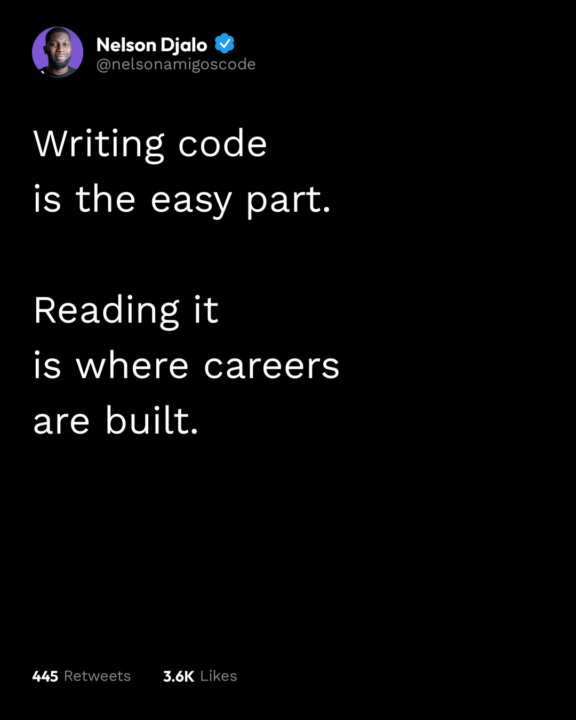
Writing code is the easiest part
Most developers think their job is to write code That mindset works fine in the first year or two But it stops working the moment you start joining real teams and inheriting real systems Because in production engineering you spend far more time reading code than writing it You read pull requests You read legacy code You read code AI just generated You read code that broke at 3am The engineers who get stuck at junior level treat reading as a chore The engineers who level up treat it as the actual skill Here is the mental model you should have → Reading code is how you understand systems you did not build → It is how you spot mistakes before they reach production → It is how you learn patterns that took other engineers years to figure out → It is how you debug AI generated code instead of trusting it blindly → It is how you make better decisions about what to write in the first place → It is how you build the judgement that makes a senior engineer valuable The biggest mistake juniors make is rushing to type They want to ship something They want to look productive They want their commit to land first But shipping fast without reading first is how bugs enter the codebase Strong engineers slow down before they speed up They read the existing code They read the related tests They read the commit history They read the surrounding context Then they write something that fits the system instead of fighting it Reading is not the boring part of engineering It is the part where careers are actually built If you opened your team codebase right now would you understand what is happening end to end Share your thoughts below Follow Amigoscode for practical lessons that help developers move from coding to real software engineering
1-30 of 162
skool.com/amigoscode
A free learning community led by Nelson Djalo. Master Programming & AI, get updates, and grow in a fast-moving industry.
Leaderboard (30-day)
1
+16
2

+8
3

+5
4

+4
5

+4
Powered by