Activity
Mon
Wed
Fri
Sun
Sep
Oct
Nov
Dec
Jan
Feb
Mar
Apr
May
Jun
Jul
Aug
What is this?
Less
More
Memberships
Amigoscode
1.9k members • Free
5 contributions to Amigoscode

Apr 23 •
Knowing how to code is NOT enough: The root problem in our learning process
Hi @Nelson Djalo 👋, first of all, thank you for the immense value you bring to the community. Your courses have taught thousands of us how to master code. But today I want to put a challenge on the table for a future course. I've realized the root problem we have in current tech education: We consume hundreds of hours of tutorials learning languages and frameworks, but we DO NOT know how to design software. We know how to write a class in Java, but when a client asks for a project from scratch, we hit a brick wall. We are missing the lost link: Object-Oriented Analysis and Design (OOA/D). Anyone who wants to build real software (whether at home or at a company) needs to master skills that go way beyond the programming language itself: ✅ Gathering real requirements (without getting overwhelmed). ✅ Differentiating and documenting functional vs. non-functional requirements. ✅ Writing Use Cases that actually add business value. ✅ Translating those Use Cases into Sequence Diagrams and Domain Models. ✅ Knowing how to elegantly assign responsibilities to objects (GRASP/GoF Patterns). The request: Could you guys consider making a full course on OOA/D? But with the Amigoscode magic: 100% PRACTICAL. We don't want more boring, 200-page university theory that no one reads. We want to see Nelson sit down with a "client", extract the messy requirements, draw the diagrams on a whiteboard, and then translate it into real code step-by-step using Agile iterations. I believe this is the ultimate leap to go from being just a "coder" to a true Software Engineer/Architect.
Apr 21 •
Pass By Value With Reference Types
💡 Java Memory Tip: "Objects are passed by reference"... RIGHT? Wrong! A huge misconception in Java is how objects are passed to methods. Let's clear it up: Everything in Java is Pass-by-Value. Everything. When you pass an Object to a method, you are NOT passing the object itself. You are passing a copy of the reference (the memory address). 📺 Think of it like a TV and a remote control: The Object (the TV) lives in the Heap memory. Your variable in the Stack is just a remote control. When you pass it to a method, Java makes a photocopy of your remote. Now you have two remotes pointing to the SAME TV. If the method uses its remote to change the channel, your original remote will see the new channel too! Don't believe me? I've set up an interactive execution. Click the link, step through the code, and watch how the Stack and Heap interact in real-time 👇 🔗 Step through the memory visualizer here: > https://tinyurl.com/57wb886x
2 likes • Apr 23
@Fernando Piedade Here you can see that the variable object just contain the memory address. You are passing that memory address (the value). I hope you understand what I tried to explain.
Apr 21 •
Pass-by-Value with Primitives
💡 Demystifying Java Memory: Pass-by-Value with Primitives One of the most common confusions when learning Java is understanding how variables are passed into methods. Here is the golden rule: In Java, EVERYTHING is passed by value. When dealing with primitive data types (like int, double, boolean), Java doesn't give the method the original variable. Instead, it creates a brand new box in the memory Stack and passes a photocopy of the value. 🤔 What does this mean? If you modify the variable inside the method, your original variable remains completely untouched. They live in different blocks of memory! I've set up a quick interactive example. Click the link below and use the "Forward" button to step through the execution. Watch closely how the Stack behaves when modifyCopy() is called! 🔗 Try the execution step-by-step here: > https://tinyurl.com/3zz7xfan
Apr 20 •
Small correction on "Reference Types and Objects Differences"
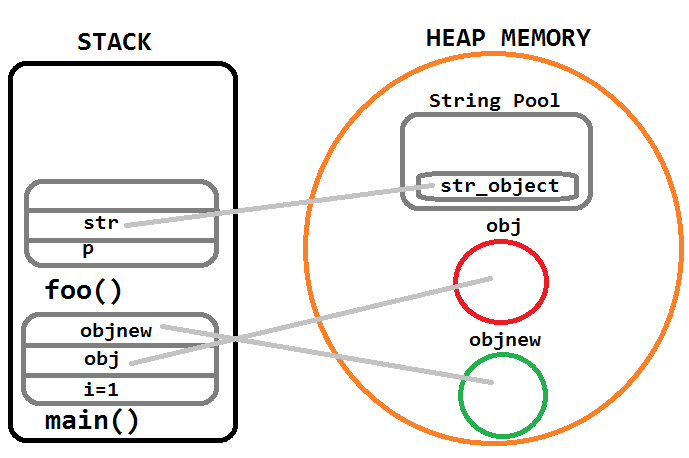
Great video. Really helpful explanation overall. Just a small technical correction: in the diagram it looks like object fields (like x and y) are stored in the stack inside a “frame for the object”, but in Java those fields actually live in the heap as part of the object itself. The stack only stores method frames and references to objects. Also, stack frames are created per method call (such as main) and are removed when the method finishes, they are not created per object. Might be worth clarifying this to avoid confusion, but the rest of the explanation is very good 👍 I'll add an image to show the correct visualization of the stack, heap, and string pool.

🍀
Oct '25 •
Welcome and Introduce yourself here 🔥
👋 Hi! Welcome to the Community Step 1: Introduce yourself in this thread below! (✄ Copy/paste template 👇) Where are you from? Tell us something about you? What do you hope to achieve here? Which platform brought you here? IMPORTANT Step 2: Engage with others. Like at least 5 introductions to unlock most of the content and start building connections. Step 3: Read the pinned posts as they include important guidelines and resources to help you get the most out of this community. 🚨 Please do not promote paid services (mentorship, courses, other communities, etc). Doing so will result in a ban. We’re glad to have you here and looking forward to your introduction! Don't forget to completed this poll
Poll
482 members have voted

4 likes • Apr 13
Where are you from? I’m from Spain 🇪🇸 Tell us something about you? I’m interested in video games and technology. I’ve studied programming and development in high school and higher education courses. I enjoy learning how software is built, even if I’m still at a beginner stage in Java. What do you hope to achieve here? I want to restart my path in software development, improve my Java skills, and become more confident writing real-world code. I sometimes struggle with math, but I’m working through it step by step. Which platform brought you here? Amigoscode
1 like • Apr 20
@Ömer Fadıl Usta Thanks!
1-5 of 5

Active 99d ago
Joined Apr 13, 2026
Powered by