
Write something
Pinned

May 21 •
Welcome to AI Income Court
Court is now in session. My name is Michael Essany and I have spent years in the trenches of ecommerce and digital products building six-figure businesses, watching trends explode and collapse, and working alongside thousands of AI innovators and entrepreneurs across the digital products and physical commerce worlds. I have seen what works. I have also seen... what doesn't. And I have watched too many smart, motivated people waste their time and money chasing AI income ideas that were never going to deliver what they promised. That stops here. This is where I will drag AI money-making ideas into our courtroom. The evidence gets examined. The hype gets cross-examined. And this court delivers a verdict your wallet can actually use. Innocent means the idea holds up. It's real, valid, and realistically buildable. I'll also tell you exactly how to execute it. Guilty means it falls apart under scrutiny. I'll tell you why, and what to do instead. No gurus allowed in this courtroom. No agendas. No courses to sell you. Just honest verdicts from someone who has been in this space long enough to spot a bad idea in the first sentence. But ultimately, you are the jury. Show up, weigh the evidence, and drop your verdict in the comments. I'm looking forward to your appearance in court! Your AI Judge, Michael Essany


7h •
YouTube Automation is changing the game.
These results show what's possible when the right strategy, consistency, and scalable content work together. Millions of views, thousands of subscribers, and impressive earnings aren't luck they're built through proven systems. Ready to learn how to grow a profitable YouTube automation business? ✅ Check the comments and join our Telegram community to get started today! Ready to Build a Successful YouTube Automation Business? Discover the proven strategies behind high-performing faceless YouTube channels. Learn how to create content that attracts millions of views, grow your audience consistently, maximize your earnings, and scale your channel into a long-term online business without ever showing your face. 💬 Need one-on-one guidance? Message me directly on Telegram: https://tinyurl.com/Hkimh Start building a YouTube channel that generates consistent income and lasting growth.

7d •
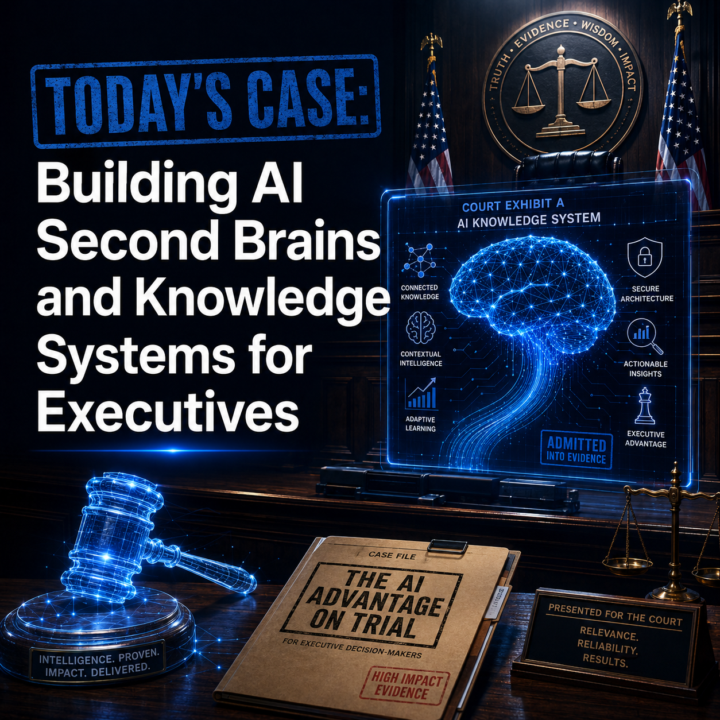
⚖️ Today's Case: Building AI Second Brains and Knowledge Systems for Executives
THE IDEA: Create personalized AI knowledge systems for executives and high-performers — organizing their documents, notes, meeting transcripts, research, and institutional knowledge into a queryable AI-powered system that surfaces the right information at the right moment. The prosecution came prepared. It left confused about why it came at all. 🛡️ The defense presents the client profile: The executive managing a $10 million business operates across dozens of simultaneous contexts — client relationships, team dynamics, strategic initiatives, market intelligence, financial performance, regulatory requirements. Their institutional knowledge lives in their head, scattered across email threads, saved PDFs, handwritten notes, and half-remembered conversations from six months ago. The AI second brain consolidates all of it into a system that can be queried in plain language. "What did we decide about the Chicago expansion?" "What are the key concerns our largest client raised in Q3?" "What did I read last month about that competitor's pricing change?" The answer surfaces in seconds from a system trained on everything the executive has ever documented. That is not a productivity tool. That is a competitive advantage. 🧾 Exhibit A: The willingness to pay is exceptional at this market segment. Executives who understand what they are buying pay $2,000 to $5,000 for the initial system build and $500 to $1,500 per month for ongoing curation, maintenance, and expansion. The ROI conversation is short. A senior executive whose time is worth $500 per hour recovers the monthly cost in the first two hours of reclaimed search time. The system pays for itself before the first invoice is due. 🧾 Exhibit B: The service is deeply personal and therefore highly sticky. An AI knowledge system trained on one executive's specific documents, communication style, and institutional context is not transferable to another provider without significant rebuilding. The switching cost is high. The relationship that develops between practitioner and executive — built on intimate familiarity with the client's business and thinking — is the most defensible client relationship in professional services.
6d •
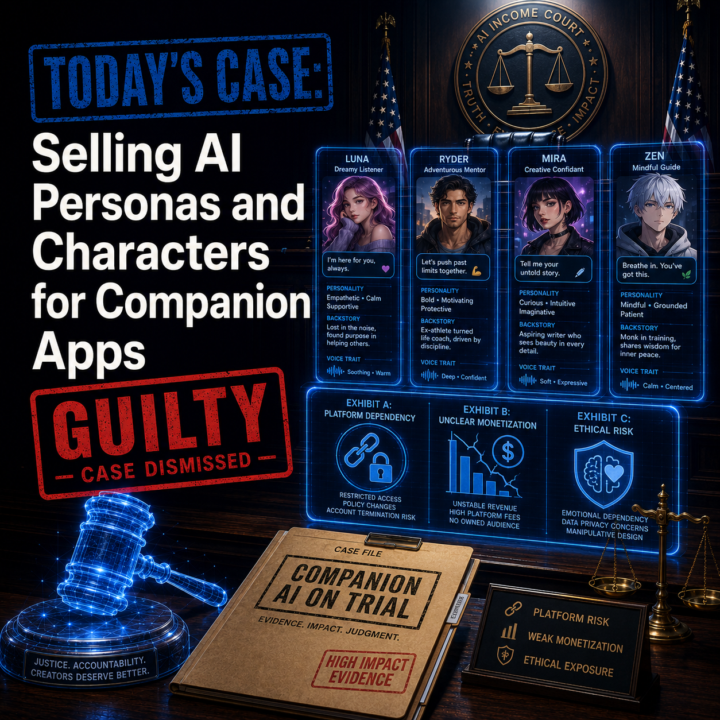
⚖️ Today's Case: Selling AI Personas and Characters for Companion Apps
THE IDEA: Create original AI character personas — with backstories, personality profiles, conversation guidelines, and voice characteristics — and license or sell them to companion app platforms like Character.ai, Replika, or emerging AI social platforms. The prosecution entered carefully. This case involves both a business model and a set of ethical questions the court cannot ignore. ⚖️ The court establishes the scope: This case is about the commercial opportunity of building and monetizing AI personas for companion app platforms. The court will evaluate the business model. It will also address the ethical dimensions because they are inseparable from the commercial reality. 🧾 Exhibit A: The platform dependency problem is severe. Character.ai, Replika, and similar platforms have changed their terms, their content policies, and their monetization structures multiple times with minimal notice to creators. Replika removed romantic relationship features from its product overnight in 2023 — a decision that devastated the user base and eliminated revenue streams for anyone who had built around that functionality. A creator who has invested significant time building characters on a platform they do not control is building on rented land with an unpredictable landlord. The platform owns the distribution. The platform owns the user relationship. The platform owns the ability to remove your character at will. 🧾 Exhibit B: The monetization path is unclear and inconsistent. Unlike content platforms with established creator monetization programs, companion app platforms do not have mature, reliable revenue sharing arrangements with character creators. The financial upside for persona creators is speculative and platform-dependent. The court finds the income claims circulating in this category to be largely unverified and unverifiable. 🧾 Exhibit C: The ethical dimension cannot be separated from the commercial one. Companion AI applications serve users who are, in many documented cases, experiencing loneliness, social anxiety, or difficulty forming human connections. Characters designed to maximize engagement and emotional dependency in these users — without transparent disclosure of their artificial nature — raise ethical questions that the court considers material to the business model evaluation.
15d •
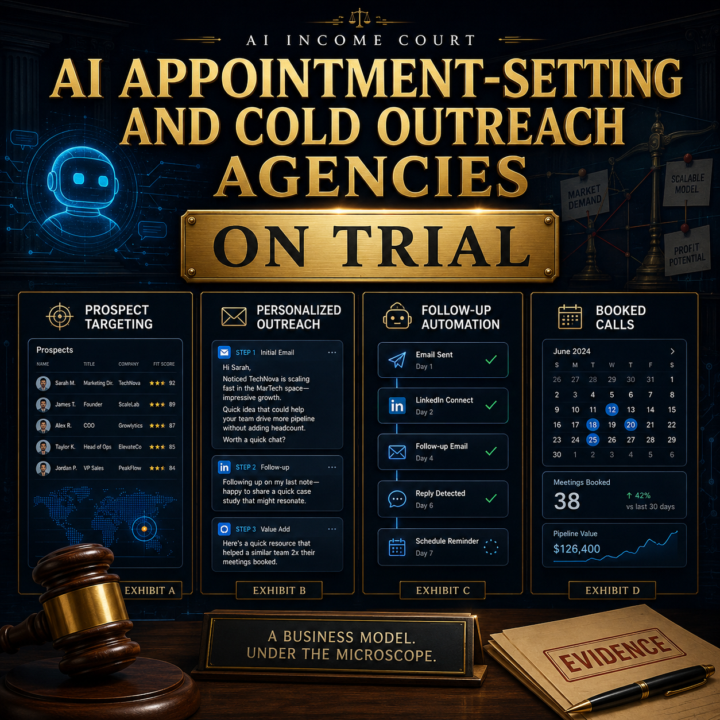
⚖️ Today's Case: AI Appointment-Setting and Cold Outreach Agencies
THE IDEA: Deploy AI agents to identify prospects, personalize outreach, follow up automatically, and book sales calls for businesses on a monthly retainer. The defendant entered the courtroom carrying a laptop, a calendar filled with booked calls, and a dashboard showing thousands of personalized messages sent without a single human touching the keyboard. The prosecution entered carrying a spam folder. This case will turn on one distinction: Is AI-powered appointment setting a legitimate business service that helps companies reach qualified prospects more efficiently? Or is it automated cold-email pollution wearing a monthly retainer? The court will examine the evidence. 🛡️ The defense opens with the business problem. Every business needs customers. Most business owners know they should be prospecting consistently, following up with leads, and reaching out to potential buyers. Very few have the time, systems, or discipline to do it every day. Traditional appointment-setting agencies solve this problem by hiring teams of researchers, copywriters, and sales development representatives to build lists, write messages, send follow-ups, and qualify responses. AI can now assist with nearly every step of that process. It can analyze prospect data, identify likely buyers, research companies, personalize opening lines, organize follow-up sequences, categorize responses, and route qualified prospects into a calendar. That does not eliminate the need for strategy. It dramatically reduces the labor required to execute it. The gap between businesses that need a reliable flow of conversations and businesses that know how to build that system is enormous. That gap is the opportunity. 🧾 Exhibit A: The value proposition is easy for clients to understand. Businesses do not need another vague AI consultant promising “digital transformation.” They understand booked sales calls. An appointment-setting agency can connect its work directly to a visible business outcome:
1-29 of 29
powered by

skool.com/ai-income-court-3070
This is where AI money-making ideas go on trial. Innocent means real opportunity. Guilty means empty hype.
Suggested communities
Powered by