User
Write something
🚀 The Era of Agentic Workflows Is Here (And Why It Changes Everything)
For years, automation meant dragging nodes in tools like n8n, Make, and Zapier. Connect this → map that → handle errors → pray nothing breaks. It worked.But it was fragile. One API change. One unexpected response. And your entire workflow collapses. That’s traditional automation. Now we’re entering something different: 𝐀𝐠𝐞𝐧𝐭𝐢𝐜 𝐖𝐨𝐫𝐤𝐟𝐥𝐨𝐰𝐬 Instead of wiring every step manually, you define the goal and the agent figures out the steps. Recently, I built an autonomous AI News Agent using Antigravity, leveraging Claude Opus 4.6 for natural language agent control and Gemini 2.0 Flash for automated news summarization within structured pipelines.The difference was obvious. I didn’t: • Manually define every integration • Hard-code every edge case • Write defensive logic for every possible failure Instead, I defined the outcome: “Every morning at 9AM, fetch important AI news and send me a clean briefing to my Gmail inbox” The agent handled: Research Filtering Formatting Error handling 𝐖𝐡𝐲 𝐀𝐠𝐞𝐧𝐭𝐢𝐜 𝐖𝐨𝐫𝐤𝐟𝐥𝐨𝐰𝐬 𝐖𝐢𝐧 Here’s what makes them fundamentally different: • Outcome-driven, not step-driven: You define what needs to happen. The system decides how. • Self-adaptive: If something changes (API, format, response), the agent can adjust instead of crashing. • Less manual debugging: The agent can interpret errors and fix issues without you rewriting the entire flow. • Faster to build: No more wiring 20 nodes. One directive can replace an entire visual workflow. • Scales better: As complexity grows, you don’t get a spaghetti mess of connections. • You focus on thinking, not plumbing: Your value shifts from wiring tools to designing intelligent systems. Traditional tools (n8n, Make, Zapier):You design the steps. Agentic workflows:You design the outcome. That shift changes everything. Instead of being a builder wiring nodes,you become an architect defining intent. Automation was about workflows. Agentic systems are about intelligence. And this shift is just getting started.
🚀 The Era of Agentic Workflows Is Here (And Why It Changes Everything)
GDPR Scanner Found 3 Compliance Gaps in Vendor Policy Before Contract Signed (7 Nodes) 🔥
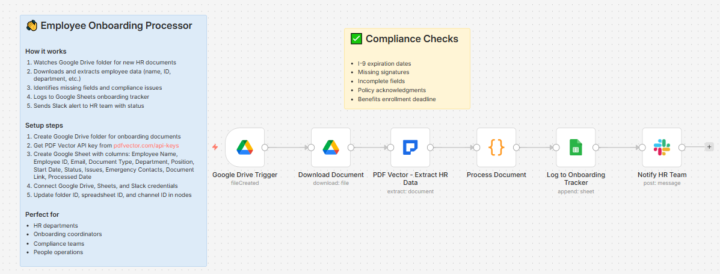
New vendor. 15-page privacy policy. Legal review takes 2 weeks. We need to sign this week. Built GDPR scanner. Policy scored 42%. Three gaps flagged. Remediation requested before signing. THE COMPLIANCE REVIEW BOTTLENECK: Every vendor needs privacy review. Legal team backlogged. Policies written in legalese. Required elements buried in paragraphs. Signed contract. Discovered GDPR gap. Six months of remediation. THE DISCOVERY: Document extraction checks all GDPR requirements. Code calculates compliance score. Gaps identified automatically. Systematic verification. Same checklist every time. Nothing missed. THE WORKFLOW: Google Drive trigger watches policies folder → Download document → Document extraction checks data controller, DPO contact, user rights, legal bases, international transfers → Code calculates compliance score and identifies gaps → Sheets logs scan results → IF checks if not compliant → Alert Slack with specific gaps. 7 nodes. Vendor compliance automated. THE COMPLIANCE SCORING: Code checks 6 required user rights: Access, Rectification, Erasure, Portability, Objection, Withdraw Consent. Score starts at 100%. Deducts 10% per gap: - Missing DPO contact - No legal basis - No breach notification - International transfers without safeguards - Missing user rights THE STATUS THRESHOLDS: - 80% and above: Compliant - 50-79%: Needs Attention - Under 50%: Non-Compliant Conditional alert only for non-compliant policies. Specific gaps listed. THE TRANSFORMATION: Before: 2-4 hours per policy for manual review. Gaps discovered after contract signed. Inconsistent checking. After: 45 seconds with compliance score. Issues flagged before relationship begins. THE NUMBERS: 23 policies scanned last month 8 non-compliant policies caught 14 missing user rights identified 2 hours → 45 seconds per review Template in n8n and All workflows in Github
0
0
GDPR Scanner Found 3 Compliance Gaps in Vendor Policy Before Contract Signed (7 Nodes) 🔥
🔴 Free n8n Automation Mastery — 14 Week Roadmap
Most people try to learn n8n randomly… watch tutorials, copy workflows, and still feel confused. So I created a 14-Week AI Automation Roadmap to help you go from Beginner → Advanced Automation Builder. What’s inside: → 14-Week structured AI automation learning plan → AI fundamentals (LLMs, APIs, JSON, Webhooks, RAG) → Complete n8n foundations (nodes, workflows, setup) → AI integrations (ChatGPT, Claude) → Intermediate automation logic (IF, Switch, loops, error handling) → Advanced AI systems (RAG workflows, AI chains, function calling) → Workflow best practices & scaling methods → Essential tools list (n8n, APIs, Sheets, vector DBs) → 30-Day sprint plan with daily tasks This roadmap shows exactly what to learn and in what order so you don’t waste months jumping between random tutorials. It’s 100% free. Comment ''ROADMAP'' and I’ll send it.
🔴 Free n8n Automation Mastery — 14 Week Roadmap
Bank Had 35 Million Unorganized Documents - AI Classified Them All in 2 Weeks 🔥
American Bank. 35 million documents. No organization. 275 different document types mixed together. Manual classification would take years. AI did it in 2 weeks. THE DOCUMENT NIGHTMARE: Decades of files: - Loan applications - Bank statements - Tax returns - Asset verification - Compliance filings - Historical records All in shared drives. No naming convention. No searchable index. Compliance audits = nightmare. "Find all 2018 commercial loan docs" = weeks of manual searching. THE 4-NODE WORKFLOW: 1. Scan document folders 2. Convert PDFs and images to text 3. Classify by document type (loan app, tax return, etc.) 4. Extract key metadata (date, account number, dollar amount) 5. Build searchable database THE CHALLENGE: 35 million documents = expensive if you process everything. Solution: Process in batches, prioritize by business need: - Regulatory compliance docs first (immediate audit risk) - Active account documents second - Historical archives last Total processing: 2 weeks for critical docs, 3 months for full archive. THE IMPACT: Before: - Audit request: "All 2020 mortgage applications" - Time to comply: 2-3 weeks manual search - Cost: $18,000 in staff time After: - Same request: 15 minutes database query - Cost: $0 incremental - Audit compliance time: 94% reduction THE MORTGAGE PROCESSING USE CASE: Once classified, built automated loan processing: - Applicant uploads docs - System pulls income, employment, assets - Pre-fills underwriting system - Flags missing documents Loan processing: 30 days → 3 days. THE SALES ANGLE: Don't sell "document classification." Sell "you have 35 million documents you can't find when auditors ask. I make them searchable in 2 weeks." Compliance fear > efficiency desire. 📚 All templates library in Github What business has years of documents they can't search when they need them?
Healthcare Clinic Wasted 66 Minutes Daily on Patient Paperwork - Automated It to 2 Minutes 🔥
Family practice. 4 physicians. 2,400 active patients. Every new patient = 20 minutes of manual data entry. 8-12 new patients daily. Built intake automation. Reduced to 2 minutes verification only. 66 minutes saved per provider per day. THE PATIENT INTAKE BURDEN: Every new patient submits: - Insurance card (front and back photos) - Medical history questionnaire - Current medications list - Consent forms - Emergency contact info Admin staff manually types everything into EHR. 20 minutes per patient. THE 6-NODE WORKFLOW: 1. Patient uploads forms via portal (phone photos accepted) 2. Convert images and PDFs to text 3. Pull patient demographics, insurance details, medical history 4. Verify insurance eligibility via API 5. Pre-populate EHR system 6. Flag missing info for followup Staff verifies accuracy (2 minutes) instead of manual entry (20 minutes). WHAT CLINICS ACTUALLY CARE ABOUT: Not "AI is cool." They care about: Provider time. That's their most expensive resource. 20 minutes of admin work per patient = less patient time. Automation gives providers back 66 minutes daily for actual patient care. THE RESULTS: Before: - Manual intake: 20 minutes per patient - Daily new patients: 8-12 - Admin time wasted: 2.5-4 hours daily - Annual cost: $32,000 After: - Automated intake: 2 minutes verification - Charts ready before appointment - Admin redeployed to patient coordination - Annual savings: $27,000 - ROI: 1.5 months THE HIPAA CONVERSATION: "Isn't this a HIPAA nightmare?" No. Processing via API = no data storage. Encrypted transmission. Sign BAA. Done. HIPAA compliance scared away most competitors. That's the opportunity. THE PRICING: Small practices (1-3 providers): $400/month Medium practices (4-10 providers): $1,200/month Large practices (10+ providers): $3,000/month Setup: $4,000 Payback is immediate when you show them the provider time savings. 📥 Workflow n8n here and 📚 More templates in Github
1
0
1-30 of 148
N8nLab
skool.com/ai-automation-7100
A hub for marketers and creators building AI automations with n8n. Get free templates, learn to automate ads, copy, and video creation.
Leaderboard (30-day)
Powered by