Activity
Mon
Wed
Fri
Sun
Nov
Dec
Jan
Feb
Mar
Apr
May
Jun
Jul
Aug
Sep
Oct
What is this?
Less
More
AI Automation Mastery
818
Free
n8n ⭐
1.3k
Free
AI Income Maxxing
2.6k
Free
AI Automation Base
1.3k
Free
AI Automation Society
466.9k
Free
AI Automation Agency Hub
335.4k
Free
6 contributions to AI Income Maxxing

Apr 10 •
Update: My AI Content Master got a major upgrade!
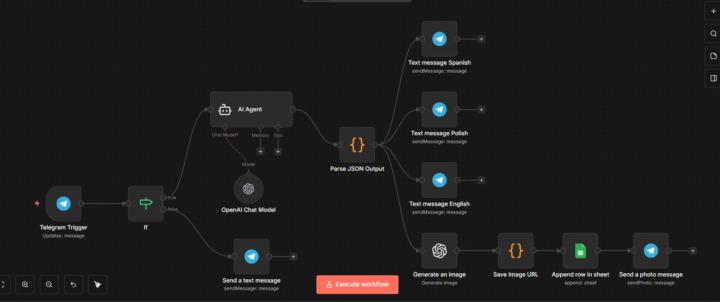
18 days ago I shared my first automation project here. Since then, I've significantly improved its architecture — and I'm excited to share what's new! What changed: 🗄️ Cross-Workflow Data Bridge: Added Google Sheets as a reliable data layer between Generator and Moderator workflows — seamlessly passing image URLs and multilingual texts between two separate n8n workflows. 🔗 Real LinkedIn Publishing: Connected LinkedIn OAuth2 API — approved posts now go live automatically in the selected language (EN, PL, or ES) with just one tap in Telegram. 📘 Facebook Publishing Ready: Facebook Graph API node is already implemented in the workflow and ready to activate for clients who need it. 📝 Universal Prompt: Removed the archaeology-specific focus — the agent now creates expert content on ANY topic the user sends via Telegram bot. The system now consists of two interconnected n8n workflows — a true agentic architecture! About the Development: This upgrade was co-developed with Claude (Anthropic) as a technical mentor and debug partner. If you're learning AI automation — don't be afraid to iterate and improve. Every upgrade teaches you something new! 🚀 PhD in Archaeology → AI Automation at 55. It's never too late! 👉 See where it all started: https://www.skool.com/data-and-ai/my-first-experience-in-automation?p=76cc6cfe 📂 Full project on GitHub: https://github.com/Evgeniy1970-ai/ai-content-scout
0 likes • Jul 18
@Chiranjeevi K Thank you! 🙏 That's exactly the right approach — start small, ship something that works, then iterate. My first version was a single workflow with a hardcoded topic; now it's two interconnected workflows handling multiple languages and platforms. Honestly, half the learning happened after the first version was live — debugging real issues taught me more than any tutorial. Keep building those small workflows, they add up fast! Good luck with your n8n journey!
1 like • Jul 21
@Chiranjeevi K That's the spirit! Building and iterating is the only real curriculum in automation. Looking forward to seeing what you ship next — feel free to tag me when you do! 💪
May 3 •
How I automated 5 core restaurant operations with AI agents — modular architecture breakdown
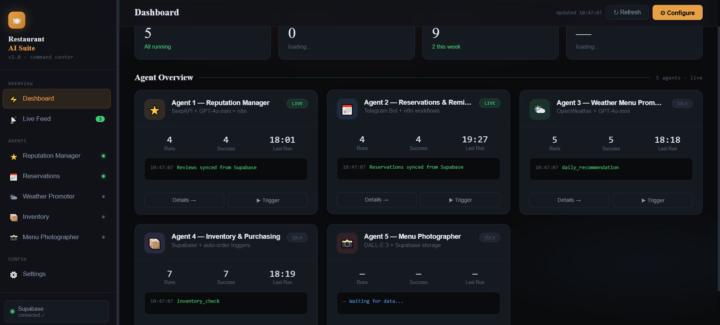
Hey everyone 👋 Finished a portfolio project I'm excited to share — a Restaurant AI Suite that automates 5 core areas of restaurant operations. The problem it solves: Restaurant owners spend hours every week on tasks that can be fully automated — checking reviews, handling bookings, monitoring stock, promoting the menu. This system handles all of it. 🍽️ What it does: → Monitors reputation on Google Maps, TripAdvisor & Yelp — AI sentiment analysis every 6 hours → Handles reservations via Telegram bot — auto-confirms by email, sends reminder 24h before → Recommends menu items daily based on live weather conditions → Checks inventory and sends low-stock alerts before items run out → Analyzes dish photos with AI vision and generates professional menu photos with DALL-E 3 All results go into a live dashboard the owner can check from their phone. 💡 The key design decision: modular architecture. Each agent is an independent n8n workflow. The client can start with 1 agent and add more over time — without touching existing workflows. Need a guest return engine? Delivery bot? Social media poster? Each one slots in as a new agent. This is the approach I use for all client projects now — start small, expand modularly. Full project on GitHub: github.com/Evgeniy1970-ai/restaurant-ai-suite Portfolio: neolithai.netlify.app Has anyone here built automation for HoReCa clients? Would love to hear what challenges you ran into.
0 likes • Jul 18
@Chiranjeevi K Thanks! 🙌 To answer your question — it's all n8n, no LangGraph or other orchestration layer involved. Each agent is a fully independent n8n workflow with its own webhook trigger. There's no central "orchestrator" agent — they're loosely coupled by design, which is exactly what makes it modular: I can add, remove, or update one agent without touching the others. Cross-workflow data (like image URLs or shared state) passes through Google Sheets or Supabase when needed. It's a simpler approach than code-first frameworks, but for client-facing SMB projects it's been the right tradeoff — easier to maintain, debug, and hand off.
1 like • Jul 19
@Chiranjeevi K Glad it was helpful!
Mar 28 •
Building a Linear AI Prospecting Engine with n8n
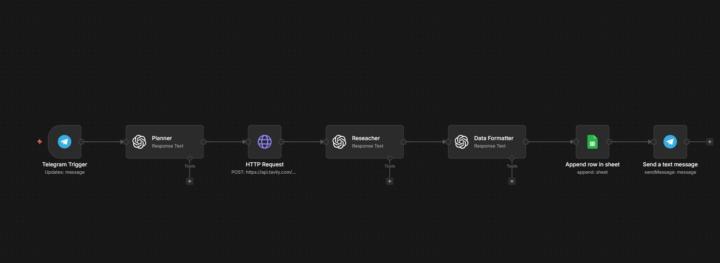
My second agent is officially live! After the Content Scout, I’ve moved into B2B sales automation. Instead of complex "black-box" agents, I’ve built a high-reliability Linear Engine that performs deep web research and structures data for CRM. Key Tech Stack: 🔹 n8n (Linear Workflow) 🔹 Tavily API (Live Web Search & Scraping) 🔹 OpenAI GPT-4o (Analysis & Data Formatting) 🔹 Google Sheets (CRM Integration) What it does: It doesn't just find names. It identifies specific automation gaps for the client and writes a personalized ice-breaker based on live news. Just open-sourced the JSON on my GitHub for the community! Check it out here: https://github.com/Evgeniy1970-ai/AI-Lead-Gen-Prospecting-Engine Feedback from fellow builders is highly appreciated! #n8n #AIAutomation #BuildInPublic
1 like • Mar 30
@Ryan Nolan Spot on! You caught a bit of 'Legacy Architecture' in this specific flow. Currently, that 2nd OpenAI node acts as a 'Parser' because the first one produces a very dense, unstructured report. But you're right — it's not the most cost-effective way. My next step is to merge these: either by forcing the Researcher to output a strict JSON schema directly, or replacing the 2nd node with a zero-cost JS script to handle the regex extraction. I'm currently prioritizing 'Reliability' over 'Cost' during the beta, but shifting to a Single-Agent + JS Formatter is definitely the play for production.
0 likes • Jul 19
@Chiranjeevi K The most challenging part was definitely the data formatting between nodes. Each tool speaks its own "language" — Tavily returns raw JSON, GPT-4o needs clean structured prompts, and Google Sheets expects specific column mapping. Getting them all to "talk" to each other reliably took the most debugging time. The breakthrough came when I stopped trying to pass everything in one big object and started breaking the data into clean, focused variables at each step. The lesson: in linear workflows, clarity of data flow beats cleverness every time. Happy to share more details if you're building something similar!
Jun 12 •
🚀 Just shipped: BFS Suite (Big For Small) — a multi-agent AI support system built entirely with n8n + RAG
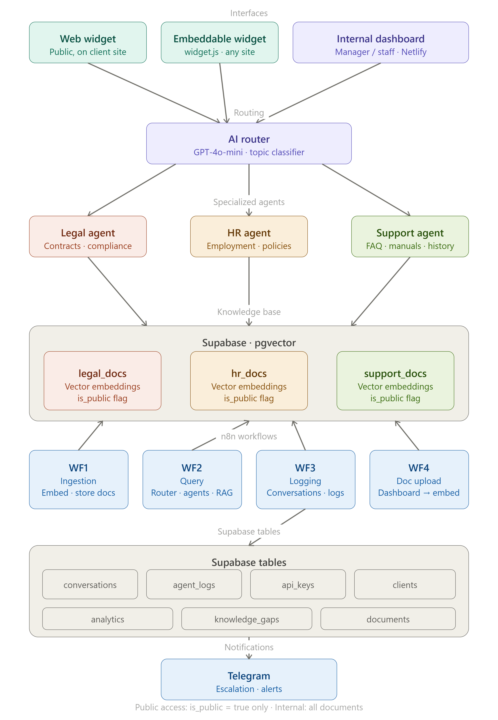
🚀 Just shipped: BFS Suite (Big For Small) — a multi-agent AI support system built entirely with n8n + RAG Here's what I built: 3 specialized AI agents under one roof: → Legal agent — contracts & compliance → HR agent — policies & onboarding → Support agent — FAQs & troubleshooting Every query goes through an AI Router (GPT-4o-mini) that classifies the topic and routes to the right agent in real time. ⚙️ Under the hood: • RAG with pgvector similarity search (Supabase) • Dual access: public web widget vs internal dashboard • Knowledge gap detection — unanswered questions logged automatically • Escalation via Telegram — 3 triggers: low similarity score, explicit user request, or ambiguous routing (Legal/HR overlap) • Human-in-the-loop — when the router's confidence drops below 0.7, the query goes to a human instead of guessing • Full analytics dashboard with live charts • Document upload straight from the dashboard 🛠 Stack: n8n · GPT-4o-mini · Supabase (pgvector) · Netlify · Telegram Bot API 📊 5 workflows: Ingestion → Query → Logging → Upload → Escalation Everything is production-ready — real RAG, real logging, real escalation. Not a toy project. 🔗 GitHub: github.com/Evgeniy1970-ai/bfs-suite 🌐 Live dashboard: charming-sable-0dd4f8.netlify.app Happy to answer any questions about the build — drop them below 👇
1 like • Jun 21
@Justin Connell Great questions, thanks for digging in! 1. Configuration every time? No. Settings are persisted via localStorage (webhook URL, API key, Supabase credentials). One-time setup, everything survives page reloads and browser restarts. 2. Single index.html — backend plans? n8n actually serves as the backend here. It handles all request processing, AI routing, RAG search, logging, and escalation logic. Supabase handles data persistence. So the architecture is: - Frontend: index.html on Netlify (static) - Backend: n8n workflows (5 in total) - Database: Supabase (PostgreSQL + pgvector) - Auth: dual API key model (public for widget, private for dashboard) The real limitation right now is that n8n runs locally with ngrok. Moving n8n to a cloud deployment (n8n Cloud, Railway, or VPS) is the actual next step before going to production — that gives a permanent webhook URL and removes the dependency on a local machine. The localStorage point is fair though — for a multi-tenant SaaS with multiple users per client, server-side session management would be the right move. That's a natural evolution once the product is deployed on cloud infrastructure. 3. Authentication and role-based access? There's already a two-tier access model via API keys: a public key for the embeddable widget (restricted to public documents only) and a private key for the internal dashboard (full document access). It's lightweight but functional for the target market — small businesses. Full login/register with role-based access is the next layer, and it fits naturally into the backend milestone. Demo — absolutely yes. The dashboard is live right now at charming-sable-0dd4f8.netlify.app and the widget is embeddable on any site. Happy to walk through it on the next call. Would love to hear your thoughts on the architecture and where you see it going.
1 like • Jun 21
@Justin Connell thank you for the invitation! I will endeavour to participate in the call either next week or the week thereafter.
Apr 11 •
I built a full B2B lead gen pipeline in n8n — one Telegram message triggers everything. Here's the full breakdown
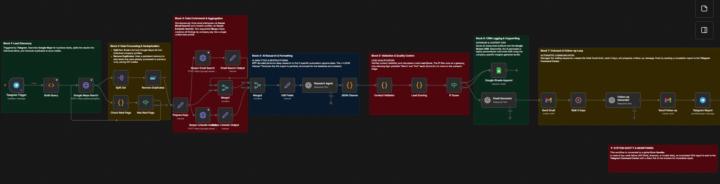
Hey everyone, I just finished a production-ready AI lead generation workflow in n8n and wanted to share the full architecture with the community. Happy to answer questions and hear how you'd improve it. 🔧 What it does (end-to-end): 1. You send a search query to a Telegram bot (e.g. "IT consulting firms Amsterdam") 2. Google Maps Places API returns up to 10 businesses 3. Leads are split, deduplicated across runs (persistent memory), and paginated 4. Prepare Keys node enriches each item with company_name, website, phone, address and generates a company_key for merging 5. Two parallel Serper searches run simultaneously: 6. Two sequential Merge nodes combine everything by company_key 7. Edit Fields normalizes all data into a clean unified object 8. Research Agent (GPT-4o-mini) generates 3 automation opportunities + personalized icebreaker per company 9. JSON Cleaner (Code node) parses the AI response and merges it with contact data 10. Contact Validator scores email/LinkedIn quality (0–100) 11. Lead Scoring calculates total score: corporate email (+40), LinkedIn (+25), website (+15), phone (+10), icebreaker quality (+10) 12. IF Score gates the outreach — only leads ≥ 55 proceed 13. Google Sheets Append logs everything to CRM 14. Email Generator (GPT-4o-mini) writes a personalized cold email 15. Gmail creates a draft → waits 3 days → follow-up draft created → Telegram report sent 🐛 Interesting bugs I hit and fixed: - $json context loss after Serper nodes — fixed by using $('Prepare Keys').item.json.company_key explicitly - websiteUri returning undefined for businesses without a website — fixed with || $json.nationalPhoneNumber || 'unknown' fallback in the key - JSON Cleaner failing with raw.slice is not a function — GPT-4o-mini returns a parsed object, not a string, when json_object mode is enabled - Merge nodes not joining — caused by null company_key on one input branch - Remove Duplicates discarding all items — cleared deduplication history after test runs - - 💡 Key design decisions:
1-6 of 6

@yevhenii-nohin-9140
Hi! The modern world is changing so rapidly that I am excited to see what the future holds! I'm really excited to learn how to create AI agents.
Active 29d ago
Joined Jan 30, 2026
Powered by