Activity
Mon
Wed
Fri
Sun
Sep
Oct
Nov
Dec
Jan
Feb
Mar
Apr
May
Jun
Jul
Aug
What is this?
Less
More
Clief Notes
45.1k members • Free
Early AI-dopters
1.3k members • $77/month
8 contributions to Clief Notes

3h •
I’ve been sleeping under a rock
most of my work is done in Claude Cowork sessions. I almost never use Claude code (CLI) and the challenge I have is that regardless of what I’d like to do unrelated to my work, Claude always defaults to my work profile. So if I use a Claude code, create a folder just for the specific unrelated search or idea, my .md file should be delivering all that knowledge about me separately with a proper context! Am I thinking correctly?!
1 like • 2h
@Joel G correct… always pulls from the memory, So every time I have to tell it to forget it

👑
Jul 8 •
Connection Hub: 🧱 Data & Infrastructure Tech
Intros for The Connection Hub - The Vault 👤 Who I am: (name + where you're based) 🛠️ What I actually do: (the specific work — not "I'm in real estate" but "I run a 3-agent team doing residential resale in Austin") 🤖 What I'm building with AI right now: (your current project, workflow, or the thing you're stuck on) 🎯 What I'm looking for connection-wise: (pick one or two) 💡 Someone who's solved [X] 🤝 A collaborator / accountability partner 👀 Just here to learn from people in my field 🧰 Trading workflows & systems 📬 Best way to reach me: (DM here / comment / link)
2 likes • Jul 13
Who I am: Hi I am Vlad, based in St Louis Missouri 🛠️ What I actually do: I am managing partner at IGC, focused on wide set of IT services, MSP provider but mostly focusing on enterprise data and AI security 🤖 What I'm building with AI right now: Built a local AI stack (privacy and independence matter) 🎯 What I'm looking for connection-wise: I am looking to connect with folks that I can learn from and get to the next level of orchestration layer 💡 Someone who's solved these types of tasks before and that have a workflow process 👀 I am here to learn from anyone 🧰 Trading workflows & systems 📬 Best way to reach me: Connect with me here directly
0 likes • 2d
@Jonathan Rodriguez Good question. I think that would be dependent on your ask or outcome you want to reach. It is obvious that frontier models are better than local ones but In my opinion besides the model you use, harness is probably one of the most important things you need to invest in. again that all depends on what you are solving for. I am still in my own testing phase but what I Iike about ICM concept is that (my assumption) ICM structure can stay intact while models change... I still need to verify that but maybe somebody from community can comment who is more experience with ICM than me...

13d •
🏆 WEEKLY COMP #10: THE DIAGNOSTICIAN 🏆
🎟️ PRIZE: FREE SEAT IN THE LYCEUM 🎟️ Pick your cohort. Technical, Business, or Creator. Your call. 📋 THE CHALLENGE Build a folder-based AI diagnostician that reads something broken and tells you WHY it's broken. Not how to fix it. Why it failed. This week's deliverable is one diagnostician folder that someone could drop into a Claude project and use to figure out why something in their world isn't working. 🎯PICK YOUR DOMAIN The domain is yours. Pick something specific. Pick a failure you've actually seen happen. A few sparks to get you thinking: - 📉 Why a landing page isn't converting - 📧 Why cold emails to a specific buyer aren't getting replies - 📋 Why a product spec keeps getting pushed back by engineering - 📄 Why a resume isn't getting callbacks in a specific industry - 🚪 Why users drop off at one step of an onboarding flow - 💸 Why a pricing page isn't converting trials - 🎥 Why a YouTube video underperformed the channel average - 🤝 Why a sales deal stalled after the demo - 📱 Why an app's retention craters in week two The more specific, the better. "Diagnoses marketing problems" is too broad. "Diagnoses why cold emails to enterprise IT buyers get opened but never answered" is right. 🗂️THE METHODOLOGY If this is your first comp, welcome. Here's what you need to know: This week (and every week) you're learning interpretable context methodology. Folders as architecture. Each file does one job well. Your diagnostician is a folder with five things: - 📄 identity.md (who the diagnostician is, what they diagnose) - 📐 rules.md (how they diagnose: what they look at, how they separate cause from symptom) - 💬 examples.md (2-3 example diagnoses showing the reasoning) - 📚 reference/ (common failure modes, diagnostic frameworks, benchmarks) - 📖 README.md (how to use it, what to feed it) Drop the folder into a Claude project. Claude becomes the diagnostician. Reusable. Shareable. Portable. 🔥 THE ANGLE THIS WEEK A diagnostician is NOT an editor. Last comp was The Editor. That one critiques craft. It looks at a draft and says "this part is weak, go fix it."
4 likes • 13d
https://github.com/vladai-git/dspm-deal-stall-diagnostician DSPM Deal-Stall Diagnostician Diagnoses why enterprise data-security (DSPM) deals stall between a "successful" POC and signature, for sellers, SEs, and competitive-intelligence analysts tired of "lost to no decision" as a cause of death. Feed it a stalled deal's evidence — timeline, attendees, readout, pricing, email threads — and it returns one primary cause from a 12-mode failure taxonomy, a confidence-tagged reasoning chain anchored to that evidence, and the evidence that would change its mind. Live-fire tested on a real (sanitized) stalled deal twice; it corrected the intake premise ("your POC didn't actually win"), held its diagnosis across an evidence revision, and that run is now Case 4 in the repo.
1 like • 13d
@Ry Mac You are amazing my friend...
👑
27d •
🛠️ New tool: ICM Architect
I explain the details about it on today's high tea . I built a Claude skill that turns a process, an idea, or a messy folder into an ICM workspace. The folder structure does the orchestration. Numbered folders carry the order, the hierarchy scopes context, and plain markdown files hold state. One agent walks the right files at the right time and does the work a multi-agent setup would. Repo: github.com/RinDig/icm-architect 📦 What it does Two modes. 🔨 Build. You describe your work and it pulls out the structure already sitting in how you talk about it. The stages, the points where you stop and check, what stays the same every run versus what is new. Then it picks one of five proven forms and scaffolds the smallest workspace that carries the job. ♻️ Restructure. Point it at a folder, repo, or vault you already have. It reads every file, sorts each one by role, shows you a migration map, waits for your yes, then moves and checks the result. 🧩 The five forms Pipeline, umbrella, record library, knowledge bundle, context map. They mix and nest, so most real workspaces use more than one. ✅ The walk test Every result gets checked cold. An agent with no memory has to open the root, find its way, act, and report status from the files alone. If it can't, the structure gets fixed until it can. ⚙️ How to use it You can honestly just tell claude to download it from the link, but if you're using codex or something else it will just have to restructure the claude.md to agents.md Or if you want to do more Hands-On install Claude Code: drop the folder in ~/.claude/skills/icm-architect/, then say "ICM this" or "build me a workspace for X." Claude apps: zip the folder and upload it under Settings, then Capabilities. Fork it, break it, tell me what you built. 👇
4 likes • 27d
Fantastic
Jul 7 •
Feedback is Welcome
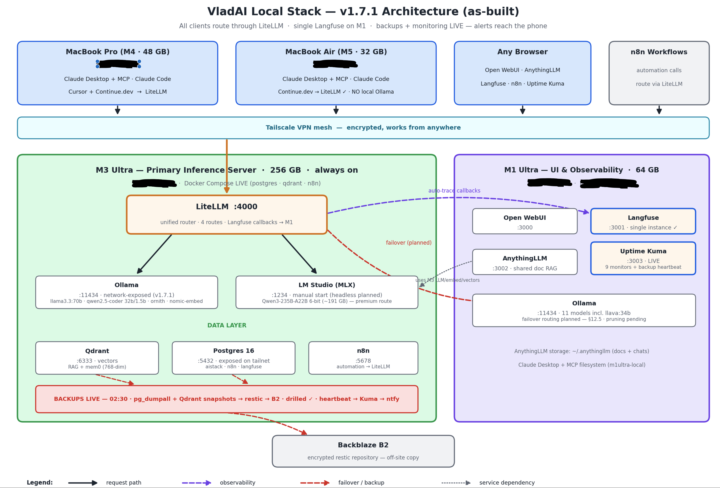
Hey guys, I wanted to reach out and see if anyone has any feedback for me on my Local AI infrastructure project build. Good or bad ... I am learning a lot and playing a lot so this is just one way of my progression... :)
0 likes • Jul 7
@Alex Brown So I thought, what would stack look like if I can build something independent of cloud models and to what level? Second thing is privacy. What is your version and how did you build it and what are you using it for?
1-8 of 8
Active 1m ago
Joined May 7, 2026
Powered by