Activity
Mon
Wed
Fri
Sun
Dec
Jan
Feb
Mar
Apr
May
Jun
Jul
Aug
Sep
Oct
Nov
What is this?
Less
More
The Inner Sovereign Society
17
5.0
$44/m
Ayurveda Ambassador Network
224
Free
10 contributions to Ayurveda Ambassador Network
2d •
In the Age of AI, Your Greatest Advantage Is a Strong, Centered Mind.
What's One Luxury You Simply Can't Live Without? My answer: MEDITATION . We are living through one of the most transformative periods in human history. Artificial Intelligence is changing the way we think, learn, work, communicate, and make decisions. Tasks that once took hours or even days can now be completed in seconds. Information is everywhere, productivity is accelerating, and technology is opening doors we never imagined possible. But amid all this progress, there's a bigger question we need to ask: As our technology gets smarter, are we becoming wiser? Are we developing the mental clarity, emotional resilience, and inner strength to keep up with the world we're creating? Because the future isn't just about how advanced our technology becomes. It's also about how grounded we remain as human beings . That's where the Human Stability Framework comes in. WHY HUMAN STABILITY MATTERS IN THE AGE OF AI According to the World Economic Forum's Future of Jobs Report 2025, approximately 39% of the skills workers rely on today are expected to change by 2030. Technical expertise will continue to matter, but it won't be enough on its own. Adaptability, critical thinking, resilience, emotional intelligence, and the ability to keep learning will become just as important. As AI continues to reshape our world, we're likely to face five major challenges: - Mental Overload: Staying focused and clear-headed in a world filled with constant information and digital distractions. - Emotional Pressure: Managing stress, fear, uncertainty, and the pressure to keep up with change. - Loss of Identity: Understanding what makes us uniquely human as machines become capable of performing more tasks traditionally done by people. - Disconnection: Maintaining meaningful relationships and genuine human connection in an increasingly digital world. - Loss of Purpose: Finding meaning beyond productivity, financial success, and material achievements. - The real opportunity is to advance technologically without losing touch with ourselves.
Poll
Cast your vote

0 likes • 2d
@Eva W Madhavan
1 like • 2d
@Eva W Madhavan Absolutely! In the age of AI, simply having information is not enough. What truly matters is the ability to distinguish between what is true and what is false. In my view, along with Critical Thinking, Meditation is equally important for young people because only a calm and stable mind can think clearly, understand situations, and make the right decisions. We must develop not just smart young people, but aware, wise, and mentally stable individuals. That is the true future of humanity.
Apr 20 •
The Great Convergence: Bridging Vedic Systems Biology and Modern Bio-Optimization.
I am pleased to share my latest academic perspective paper: The Great Convergence: Bridging Vedic Systems Biology and Modern Bio-Optimization. This work explores an emerging healthcare paradigm where ancient Ayurvedic systems biology meets modern scientific advances in epigenetics, gut-brain axis research, precision medicine, and bio-optimization. The paper examines how prevention-centered health models, personalized biology, and integrative medical thinking may shape the future of global healthcare. It also introduces the concept of the "200% Life" and the Prevention Economy, proposing a unified framework integrating physical vitality with cognitive clarity. This publication represents an effort to translate traditional wisdom into contemporary scientific language and stimulate interdisciplinary dialogue among researchers, clinicians, and health innovators. Read the full paper here: https://doi.org/10.5281/zenodo.19625716 I welcome thoughtful discussions and collaborations from researchers and integrative health leaders worldwide. #Integrative Medicine #Ayurveda #DakshinamurthyAyurveda #SystemsBiology #Prevention Healthcare #BioOptimization #HealthInnovation #LepamSudarshan
0
0
Apr 8 •
Nigeria’s Crisis and Humanity’s Responsibility
When fear becomes a daily reality for a nation, the crisis is no longer only external. It becomes a crisis of human consciousness. What is happening in Nigeria reminds us of a deeper truth: violence does not only wound bodies. It reshapes minds, relationships, and the collective spirit of society. Ayurveda teaches that true health is not merely the absence of disease, but the balance of body, mind, and community. When people live continuously under fear, grief, and insecurity, the collective psyche moves into imbalance. From this imbalance emerge generational trauma, mistrust, social fragmentation, and loss of shared humanity. Today, humanity faces an important question: Do we only aim to stop conflicts? Or do we also seek to heal human consciousness? This moment calls for global dialogue and collective healing. We need a new humanitarian vision where: • Modern psychology and ancient wisdom traditions work together • Ayurveda, yoga, meditation, and emotional healing become part of community recovery • Global cooperation supports mental balance in conflict-affected societies • World leadership recognizes peace as not only political stability, but psychological and spiritual restoration Peace is not created merely when violence stops. Peace begins when fear is replaced by trust. Nigeria’s situation is a call for awareness to the entire world. If we truly want a different future, we must make the healing of the human mind a global priority. Let this be the beginning of dialogue. Let this be the beginning of collective healing. Let this be the beginning of restoring human balance. #GlobalHealing #Ayurveda #SpiritualHumanity #Nigeria #CollectiveConsciousness

0 likes • Apr 8
Every conflict leaves visible damage and invisible wounds. Addressing psychological trauma is not secondary to peacebuilding; it is central to rebuilding trust, identity, and humanity itself. @Eva W Madhavan
Mar 31 •
When Technology Accelerates Faster Than Human Biology
Over the past decades, technology has followed an exponential growth curve often described through Moore’s Law. Computational systems evolve every few years. Human biology, however, adapts through far slower evolutionary mechanisms. This growing gap raises an important question: Can human physiology sustainably support the cognitive load, digital exposure, and leadership demands of the 21st century? As a researcher working at the intersection of Ayurveda, systems biology, and neuroscience, my recent work explores this divergence through a translational scientific framework. My published research, Bio-Field Architecture, examines how classical Ayurvedic principles can be interpreted through modern biological language, including: • Neuro-endocrine regulation and circadian synchronization • Bio-electromagnetic signaling and cognitive resilience • Integrative models of human performance and preventive health The central proposition is simple: Health should not be treated only as disease management. It must be understood as foundational human infrastructure for future innovation, leadership, and societal progress. This work represents an attempt to translate traditional knowledge systems into a contemporary research dialogue accessible to global scientific communities. 🔬 The research is now publicly available on Zenodo: https://doi.org/10.5281/zenodo.19333050 I welcome dialogue with researchers, clinicians, and interdisciplinary laboratories interested in integrative health science and human performance research. Vivek Santosh Galkhe Founder, Dakshinamurthy Ayurveda Pvt. Ltd. Independent Researcher | Integrative Health Systems #AyurvedaResearch #SystemsBiology #IntegrativeMedicine #HumanPerformance #PreventiveHealthcare #OpenScience #Zenodo #TranslationalResearch https://doi.org/10.5281/zenodo.19333050
0 likes • Mar 31
This research attempts to translate Ayurvedic physiological intelligence into a contemporary systems biology framework. I welcome constructive feedback, interdisciplinary collaboration, and perspectives from neuroscience, integrative medicine, and human performance research communities. Research grows through conversation. @Eva W Madhavan
Mar 22 •
The Great Convergence: Havan as a Modern Solution for Global Warming & Nano-Aerosol Medicine
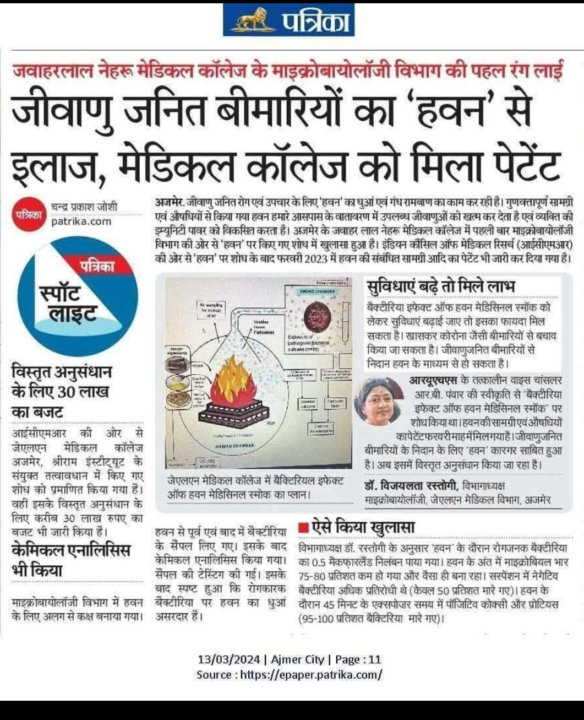
The Great Convergence: Havan as a Modern Solution for Global Warming & Nano-Aerosol Medicine As a Founder and Author, my mission has always been to decode the 'missing link' between Vedic Systems Biology and modern functional science. The recent patent granted to the Microbiology Department of JLN Medical College for the antibacterial effects of 'Havan' smoke is not just a scientific milestone it is the beginning of a Healthcare & Environmental Revolution that defines the roadmap for the next 100 years. Global Warming & The "Atmospheric Microbiome" When we discuss Global Warming, we aren't just talking about rising temperatures; we are addressing a 'Biological Shift' where heat-driven pathogenic evolution and 'Antibiotic Resistance' are becoming existential threats. Eco-friendly Biosecurity: While synthetic sanitizers and chemical purifiers often leave a toxic footprint, 'Havan' acts as a Zero-Carbon Footprint Green Technology. It reduces the microbial load in the air by up to 80%, resetting the environment without ecological conflict. The Nano-Aerosol Edge: When specific medicinal herbs interact with high-temperature fire, they undergo a transformation into Nano-particles. This is 'Information Medicine' a delivery system that re-syncs our Circadian Biology with nature, countering the disruptions caused by climate change. From Ritual to Radical Tech: This research proves that what we once called 'ancient ritual' is actually Climate-Tech and Future-Medicine disguised in tradition. Scaling the "200% Life" Vision: At Dakshinamurthy Ayurveda, we believe the greatest crisis of the next century is the intersection of human health and planetary health. Our vision isn't just to heal the individual; it’s to empower the entire ecosystem. The future of healthcare is Hybrid, where the legacy of the 'Vaidya' meets the data of the 'Scientist' to unlock the Apex Human potential. New Milestone: Launching the Latest Course Module To take this vision from theory to practice, I am releasing a specialized module from our upcoming curriculum at Dakshinamurthy Ayurveda:
0 likes • Mar 25
@Vipul Sharma I’m truly excited to learn about this initiativ it feels like the beginning of something meaningful. Have you started shaping a strategic roadmap around it? Looking ahead, healthcare and medicines are set to become significantly more expensive. This isn’t just a projection—it’s a signal of where the world is heading. In that reality, humanity will be compelled to explore fundamentally different, sustainable pathways. I strongly believe this is where ancient practices like Agnihotra can evolve into structured, scalable life-care solutions. What key steps do you see as essential to move in this direction? Especially in terms of developing Agnihotra-based life-care products and therapeutics that can meet future global needs. I would love to understand your vision on how we can translate this into a tangible, impactful model for the future.
1 like • Mar 26
@Vipul Sharma Thank you for sharing this vision. The initiative is truly aligned with the future of integrative preventive healthcare. Happy to explore meaningful collaboration ahead.
1-10 of 10

@vivek-galkhe-3815
Founder of Dakshinamurthy Ayurveda Pvt. Ltd., a wellness organization bridging the gap between traditional Ayurvedic wisdom and modern medical science
Active 1d ago
Joined Jan 24, 2026
Maharashtra India