Activity
Mon
Wed
Fri
Sun
Aug
Sep
Oct
Nov
Dec
Jan
Feb
Mar
Apr
May
Jun
Jul
What is this?
Less
More
Owned by Dairo
Memberships
Specialty Coffee Community
2.9k members • Free
Hard Knocks Army
365 members • Free
School of Mentors
6.2k members • $49/month
"Mini Celebrity Status" Ads
3.3k members • Free
AI Automation Society
422.9k members • Free
Imperium Academy™
68.4k members • Free
Elites Coaching
3.1k members • $39/month
The Ayubi Collective
1.1k members • Free
High Ticket Ecom Academy™
16.7k members • Free
12 contributions to AI Automation Society

7d •
Developers listen up.
I created a webapp (liftjournal.vercel.app). I will like you feedback 🙂. In the future i will like to monetize this if possible. Im looking for a partner that have ideas or want to make some money online. What the app do: Lift Journal is a mobile-first gym tracking app that helps users plan workouts, log sets, and track progress over time. It includes core tabs for routines, workout logging, calendar/history, and progress check-ins so users can stay consistent and see results clearly. The app is designed to feel premium and simple to use while making it easy to record completed, partial, skipped, or rest-day workouts.

1 like • 7d
@Jorge Rubio I like how clean and straightforward it feels. Making rest days part of the experience instead of treating them as missed workouts is a nice touch, and the overall flow seems easy to follow. I think the biggest opportunity now is adding something unique that gives people a reason to choose Lift Journal over other fitness trackers. Have you thought about what your standout feature will be?
0 likes • 7d
@Jorge Rubio I think you're approaching it the right way by studying the market first. One thing I'd suggest is looking beyond features and mapping the entire user journey from onboarding to daily use to identify where competitors create friction. Sometimes the biggest competitive advantage isn't adding more features, it's making the experience noticeably simpler. If you solve that well, your pricing becomes an added benefit rather than the main selling point.

7d •
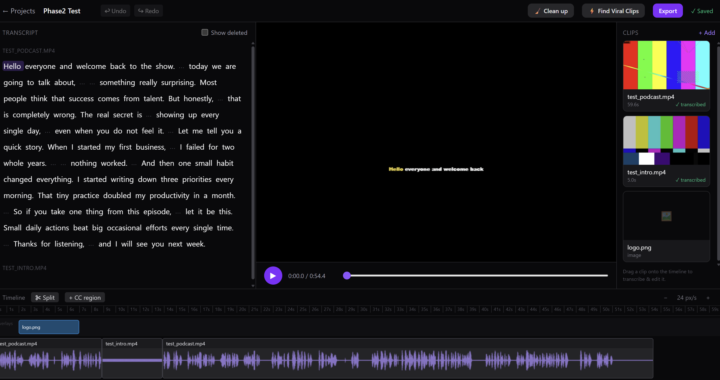
5 Days of Fable: Simple Audio Editing Tool
Fable 5 is only here for a couple of days so I've challenged myself to make something new with Fable 5 until that window is gone. Today's challenge was inspired by Descript. There are a lot of tools in Descript that I just don't need. Why would I pay for a subscription of tools that I don't need when I can just use Fable 5 to build it custom to my needs? I took the basic audio editing and document-editing style of descript and shrunk it down into just the basic tools I needed. I have been using Fable 5 to get the bulk outline of the project working with whatever credits I have in my 5 hour credit limit. I hope to go back and tweak this project and polish it later.
1 like • 7d
@Cj Marshall That’s a solid mindset because you’re essentially turning a learning exercise into a potential product pipeline. A lot of good SaaS tools start exactly like this built to solve a personal problem first, then refined once you see others wanting it too. If you keep focusing on simplifying the core experience and removing anything unnecessary, you’ll naturally get closer to something people would actually pay for. What do you think would be the first feature that would make it market ready instead of just a personal tool?
1 like • 7d
@Cj Marshall I like where you're taking this because you're solving a very specific pain point instead of trying to compete feature-for-feature. One thing I'd recommend is validating the quality of the AI clipping early by letting a small group of creators compare your results with tools like Vizard. If your clips consistently require less manual editing, that becomes a much stronger selling point than simply having the same features. The easier you can prove the time savings, the easier it'll be to position the product.

7d •
Friends please your help. 🙏
Right now I'm using Codex, but I feel like I'm hitting the limits very quickly. Which one do you think offers better value for money: Claude or Codex?
1 like • 7d
@Erick Robayo That actually makes a lot of sense for your use case. Since you're already working with funnels, CRM, and ads, the real leverage now is probably in connecting everything so data flows automatically instead of being manually tracked. Claude tends to handle longer context and strategy work better, so it might help more on the planning and automation side, especially if you're building systems around your brand. Are you currently trying to fully automate the lead to sale process or just parts of it for now?
1 like • 7d
@Erick Robayo That makes a lot of sense, especially at your stage getting clarity on what should stay manual vs automated first will save you a lot of cleanup later. A gradual approach usually works better than trying to automate everything at once, particularly when CRM, funnels, and ad data are all involved. By the way, what niche is your personal brand focused on, and what kind of audience are you primarily serving right now?

7d •
My AI‑Powered Second‑Brain System, I want y'all opinion
I built my own knowledge system that is a second brain for my work and life. Three separate knowledge bases. One for strategy, planning and personal usage, one for emails and work, one for all kinds of building. All connected through a graph index with Graphify. How it basically works Each knowledge base has its own folder structure (raw data, references, live state, logs). Every file gets indexed into a graph that maps connections between them. A graph query surfaces related files instantly, so my agent doesn't have to guess where something lives. Important decisions get their own file with context and reasoning so I can retrace them later. The whole thing auto-commits to a private GitHub repo every 6 hours. This made my agent stop digging through files or losing context. With this system, I can ask it "what did I decide about X" or "show me everything related to Y" and get accurate answers. What do you think? Tips or things you would do differently?
0 likes • 7d
@Yahya Shehabi That’s a good approach these systems usually need real usage before you can define reliable rules, so testing and refining over time will give you better results than planning everything upfront.
0 likes • 7d
@Rafael Falcon It’s more of a graph-based setup rather than strictly Obsidian or a wiki style system, designed around linking structured notes and decisions. For outdated or conflicting information, the key is not relying on full automation older nodes get reviewed or superseded manually, and the system prioritises active or recently validated context over static history. The optimisation mainly comes from keeping clear separation between raw data and validated knowledge so the graph doesn’t treat everything equally.

7d •
[Day 1] Newsletter Completed + Reflections #AISChallenge
Hey everyone! I actually finished this AI newsletter 2 weeks ago, but forgot to share and want to keep going with the challenge so i can use Fable more effectively this week. 😄 I was very happy to learn how to use Claude Code in VS Studio as i had only tried it in terminal. I also learned how to get APIs and copy over securely and it was pretty easy to set up the newsletter after going through all the steps. Thank you Nate for creating this and make the steps easy to follow. Excited to continue learning over the next few days. 😊
![[Day 1] Newsletter Completed + Reflections #AISChallenge](https://assets.skool.com/f/b51c57150c70495899bf4bc8aaee8166/bd60a1e55afc44a1aa879b3b7dad7727e556608891354d6884010e78f798e290-md.png)
1 like • 7d
@Nancy Wong That makes sense, using it for work presentations is actually a solid use case because it saves time and improves output quality at the same time. I haven’t gone deep into personal use yet either, but I can see how it could be useful for quickly turning ideas into structured slides or content. Have you thought about what personal project you might try it on first?
1 like • 7d
@Nancy Wong That’s a smart direction to explore, especially if you start with a simple dashboard rather than trying to build a full OS from day one. Most of these systems become useful when they’re grounded in real daily workflows, so I’d recommend focusing first on tracking one core area like tasks, notes, or content then gradually layering AI features once you see clear value. This helps avoid overengineering and ensures the system stays practical rather than just impressive. Are you planning to build this around Obsidian specifically or as a standalone tool?
1-10 of 12

@victor-dairo-max-6770
I'm Dairo Victor | CEO of Meta Digital Solutions Helping Ai model scales & authors build visibility through strategic promotion & smart automation
Active 39m ago
Joined Jun 25, 2026
Powered by