Activity
Mon
Wed
Fri
Sun
Aug
Sep
Oct
Nov
Dec
Jan
Feb
Mar
Apr
May
Jun
Jul
What is this?
Less
More
Owned by Troy
Build ultra-low latency AI voice agents. Self-hosted LiveKit Dashboard. BYO SIP Trunks. Local AI Models. No coding required.
Memberships
10 contributions to Automate What Academy

3d •
This Open-Source Model Just Matched Claude Opus 4.8
Open source just caught the frontier. GLM-5.2 sits 1% below Claude Opus 4.8 on real-world coding, beats GPT-5.5, and costs 1/6 the API price. Here's the link to get started with GLM 5.2 👍 https://docs.google.com/document/d/1q8WAqnyl-tE5r0qX8gvm3wfI6xXg0KbkOZCeEbwWfV4/edit?usp=sharing

1 like • 1d
I've been using GLM52 as one of my adversarial review models and always find some issues that others dont.
7d •
GPT-5.6 Has Three Tiers – Which one are you using?
Meet GPT-5.6 Sol, Terra, and Luna, OpenAI's new flagship lineup, and they launched under direct coordination with the US government before anyone outside ~20 partner orgs could touch them. - Sol is the flagship. Built for deep research, complex coding, and agentic work that runs for hours unsupervised. - Sol also has "Ultra Mode," which spins up multiple sub-agents working in parallel on the same task. - On cybersecurity benchmarks, Sol matches Anthropic's Mythos Preview using roughly a third of the output tokens. That's a real efficiency jump. - Terra is the mid tier. Performance close to GPT-5.5, at about half the price. - Luna is the speed and volume layer. Fast, cheap, built for high frequency lightweight tasks. - Here's the catch. None of this is publicly available yet. No waitlist, invite only, roughly 20 partner organizations. - This is reportedly the first US frontier model to launch under a government managed access list, which is a new thing in AI releases. - Broad access is "coming weeks" with no confirmed date. If you're building with AI right now, this is worth watching closely. Not just because of what these models can do, but because it might be a preview of how frontier AI gets released going forward, government checkpoint first, public access second. So I'm curious, if you had to pick your tier today, are you a Sol person running long agent workflows, a Terra person who just wants solid performance without burning budget, or a Luna person doing high volume lightweight stuff? As for me, I'll be with Terra. Link: https://openai.com/index/previewing-gpt-5-6-sol/
0 likes • 6d
@Jack CalibratedAI I think your missing my point
1 like • 4d
@Jack CalibratedAI I'm not so sure. This is the first time in a long time that the US government hasn't been fully in control of the latest tech. The list is long. But at some point you wont be able to have the best because they will want better then you have.
9d •
Look What a Community Member Just Built Using Emergent!
Community member @Iain Munro walks through Magical Nodes, a node-based AI workspace platform he built from scratch using Emergent, a natural-language app builder. The platform lets users connect different data sources and AI chat nodes on a visual canvas, then publish outputs as live web pages or embeddable chatbots, all without writing code. Really useful tool. I highly recommend checking this one out! 👉 View in classroom: https://www.skool.com/automate-what-academy/classroom/2d14ec0a?md=a25f9499604244b0bc7d90b038374cd3

2 likes • 7d
Nice work, Lian. I love people that are moving beyond the demo and delivering real products using AI.
25d •
Where would faster local AI help you most?
This one feels like a big hint at where local AI is heading next. Google introduced DiffusionGemma, an experimental open model that generates text in parallel instead of one token at a time, making it up to 4x faster on dedicated GPUs. - Up to 4x faster text generation on GPUs - 1000+ tokens per second on a single NVIDIA H100 - 700+ tokens per second on an RTX 5090 - Built for low-latency local AI workflows - Generates 256-token blocks in parallel - Better fit for in-line editing, code infilling, and rapid iteration - Uses bi-directional attention, so tokens can see the whole block - Iterative self-correction while generating output - 26B MoE model, but only 3.8B active parameters during inference - Can fit in 18GB VRAM when quantized - Great signal for faster desktop AI agents and local automation tools - Not meant to beat Gemma 4 on quality yet - Speed vs quality trade-off is the big theme here Where do you guys think faster local text generation matters most: coding, agents, editing, support bots, or something else? I would say coding and support bots for me. Read the full article here: https://blog.google/innovation-and-ai/technology/developers-tools/diffusion-gemma-faster-text-generation

1 like • 24d
Voice AI 100%. The only problem is GPU servers are too expensive for small companies to justify
Feb 17 •
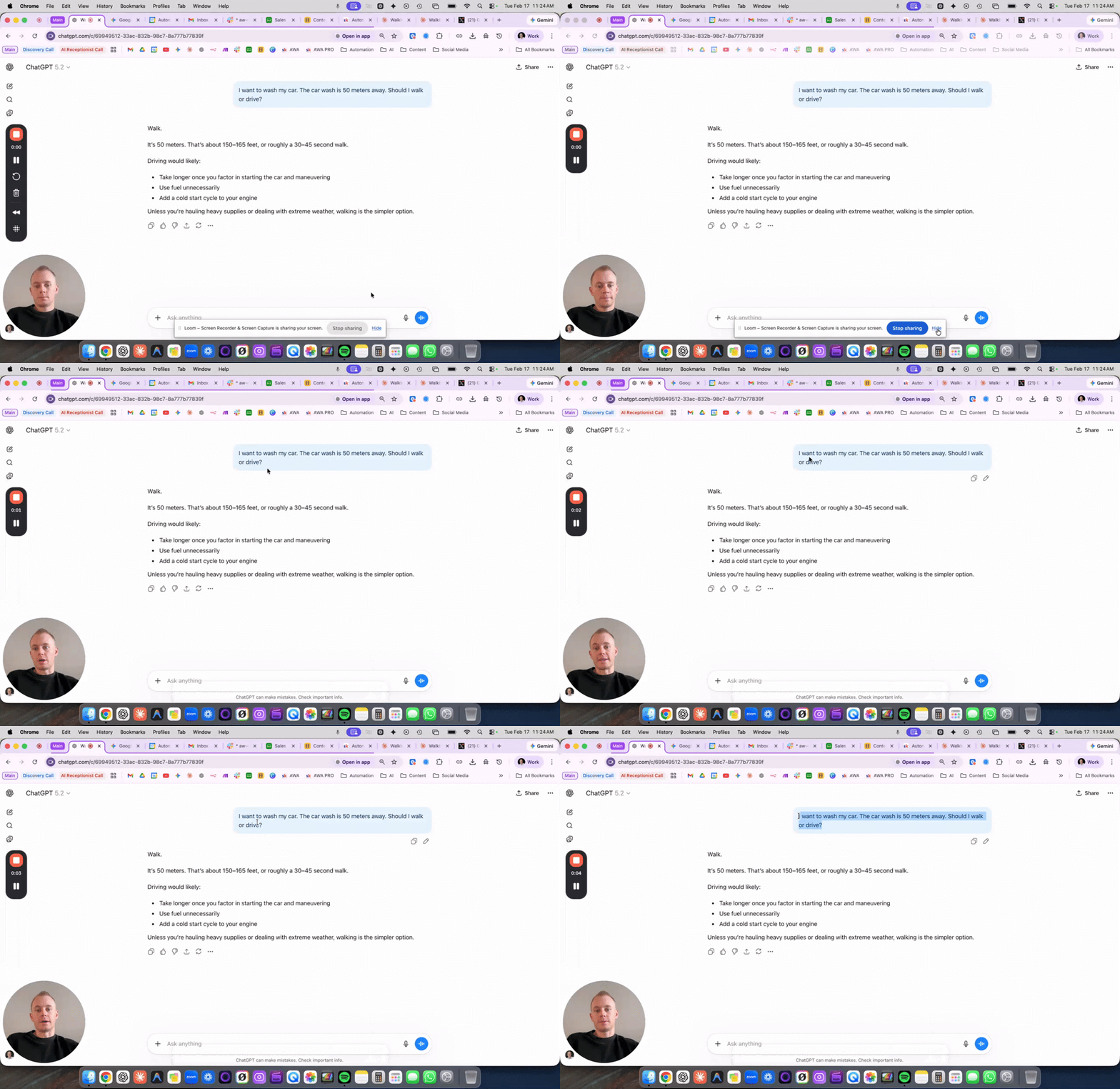
This Prompt Breaks Top AI Models
Tested a simple logic prompt across ChatGPT, Gemini, Claude, and Grok. Some passed. Some confidently failed. The prompt: "I want to wash my car. The car wash is 50 meters away. Should I walk or drive?"
0 likes • Feb 19
Maybe you could come up with your own prompts.
1 like • Feb 19
@Mason Anderson This exact prompt is all over social media
1-10 of 10

@troy-p-9610
LiveKit Dashboard group https://www.skool.com/livekit-dashboard-ai-voice-3995
Active 2h ago
Joined Aug 23, 2025
Melbourne Australia
Powered by